Skip to content
← All teaching packs

Equal Groups and Multiplication - Grade 3 Teaching Pack

Connect equal groups, repeated addition, and multiplication, naming what each factor means.

5 student sheets · 3 guide & answer pages · Letter / A4

Download ready-to-print PDFs

No account needed. Give students the student edition; the complete file includes answers after the practice pages. English reading texts stay in English in the Chinese support edition.

Actual student PDF first page: Equal Groups and Multiplication - Grade 3 Teaching Pack
Preview rendered from the actual first PDF page. Download includes the later stages.

Choose your starting point

Count small sets and add equal small quantities.

  1. Begin with the start check. Model or read aloud when support is needed, then retry.
  2. Use the supported page to connect a model and method, then try independent practice.
  3. Use application for explanation and checking. Discuss the exit page to choose a next step; one score does not establish mastery.

Try three short sessions of 15-20 minutes. Allow drawing, oral response or adult scribing when appropriate; listen to English sounds for phonics tasks.

Watch for: The number of groups and the number in each group play different roles, even when products match.

Explore the related learning unit →

Original editorial content and automated checks; independent specialist review is not recorded. Editorial policy

P95D3031 · 2026-10-24
Full activities and answer criteria

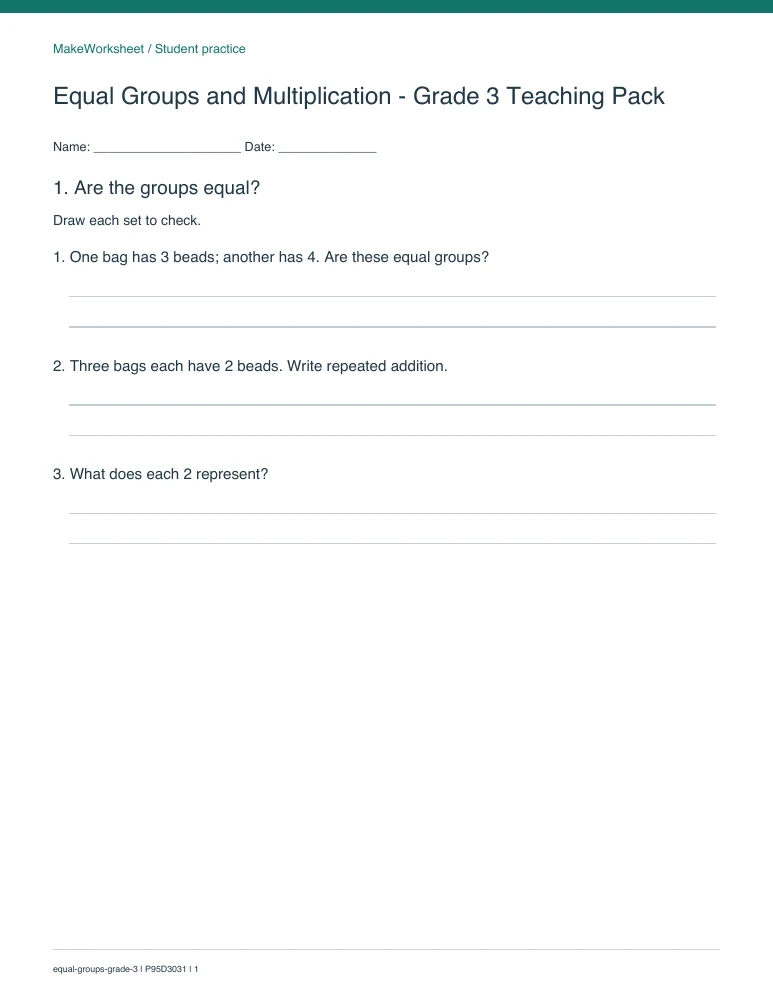
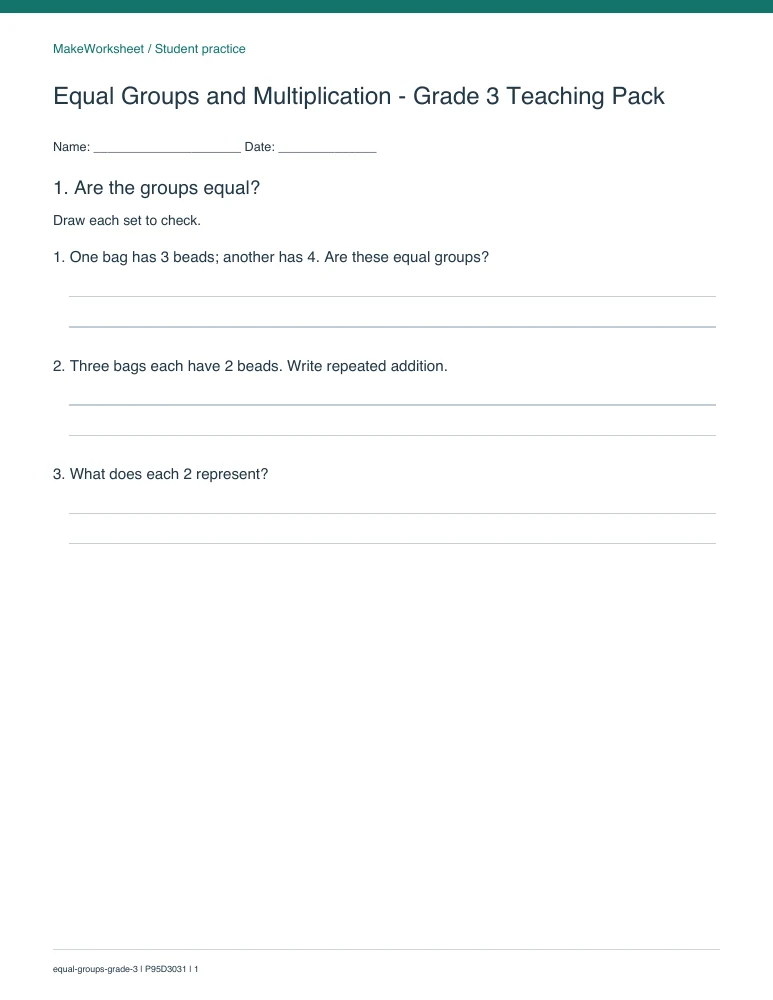
1. Are the groups equal?

Draw each set to check.

View this actual PDF page and diagramsAre the groups equal? - actual student PDF page
  1. One bag has 3 beads; another has 4. Are these equal groups?
  2. Three bags each have 2 beads. Write repeated addition.
  3. What does each 2 represent?
Show answers and response criteria
  1. No.
  2. 2 + 2 + 2 = 6
  3. The beads in one bag.

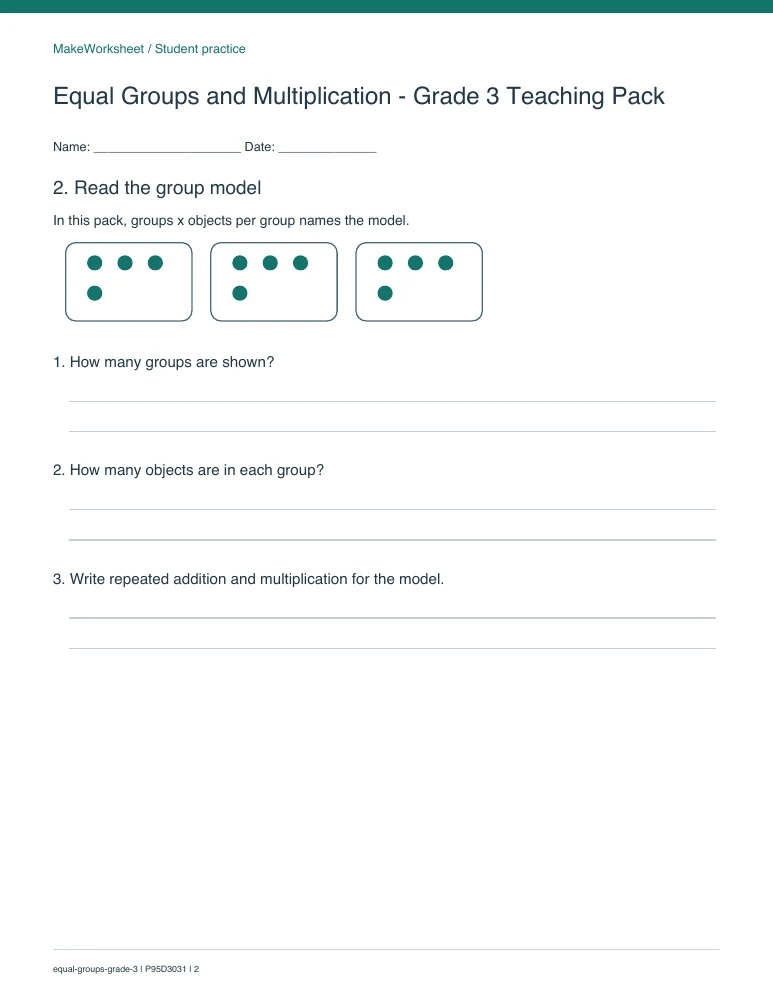
2. Read the group model

In this pack, groups x objects per group names the model.

View this actual PDF page and diagramsRead the group model - actual student PDF page
  1. How many groups are shown?
  2. How many objects are in each group?
  3. Write repeated addition and multiplication for the model.
Show answers and response criteria
  1. 3
  2. 4
  3. 4 + 4 + 4 = 12; 3 x 4 = 12.

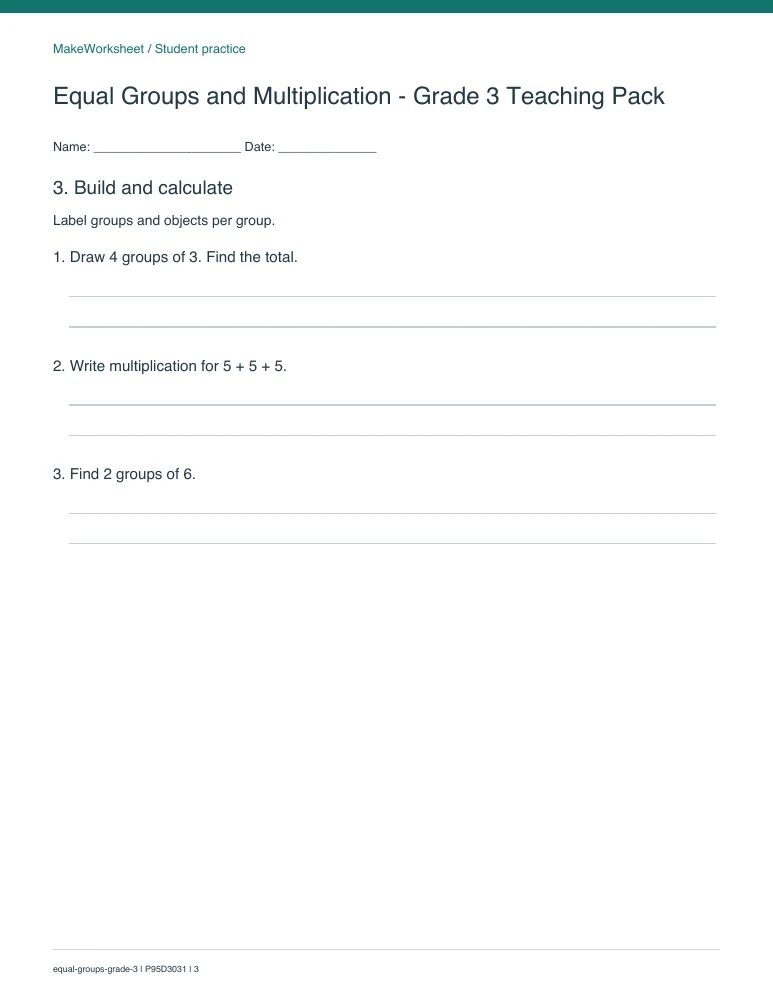
3. Build and calculate

Label groups and objects per group.

View this actual PDF page and diagramsBuild and calculate - actual student PDF page
  1. Draw 4 groups of 3. Find the total.
  2. Write multiplication for 5 + 5 + 5.
  3. Find 2 groups of 6.
Show answers and response criteria
  1. 12; four groups with three in each.
  2. 3 x 5 = 15.
  3. 12

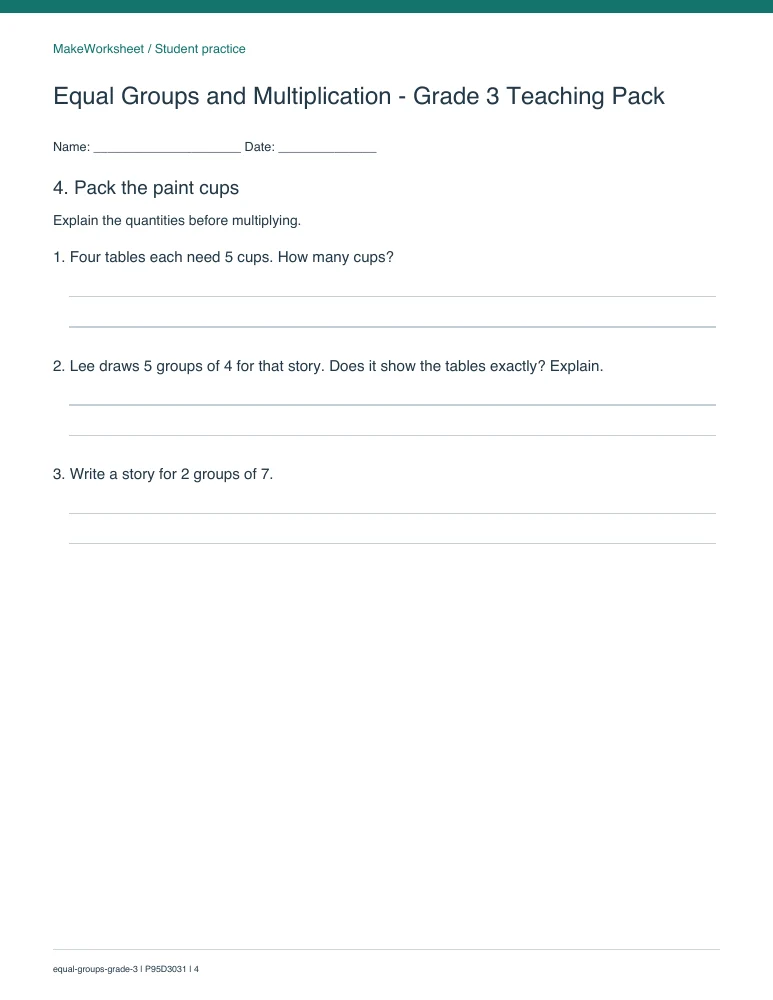
4. Pack the paint cups

Explain the quantities before multiplying.

View this actual PDF page and diagramsPack the paint cups - actual student PDF page
  1. Four tables each need 5 cups. How many cups?
  2. Lee draws 5 groups of 4 for that story. Does it show the tables exactly? Explain.
  3. Write a story for 2 groups of 7.
Show answers and response criteria
  1. 20
  2. The total is 20, but the model shows 5 tables with 4 cups each.
  3. A valid story with two equal groups of seven, total 14.

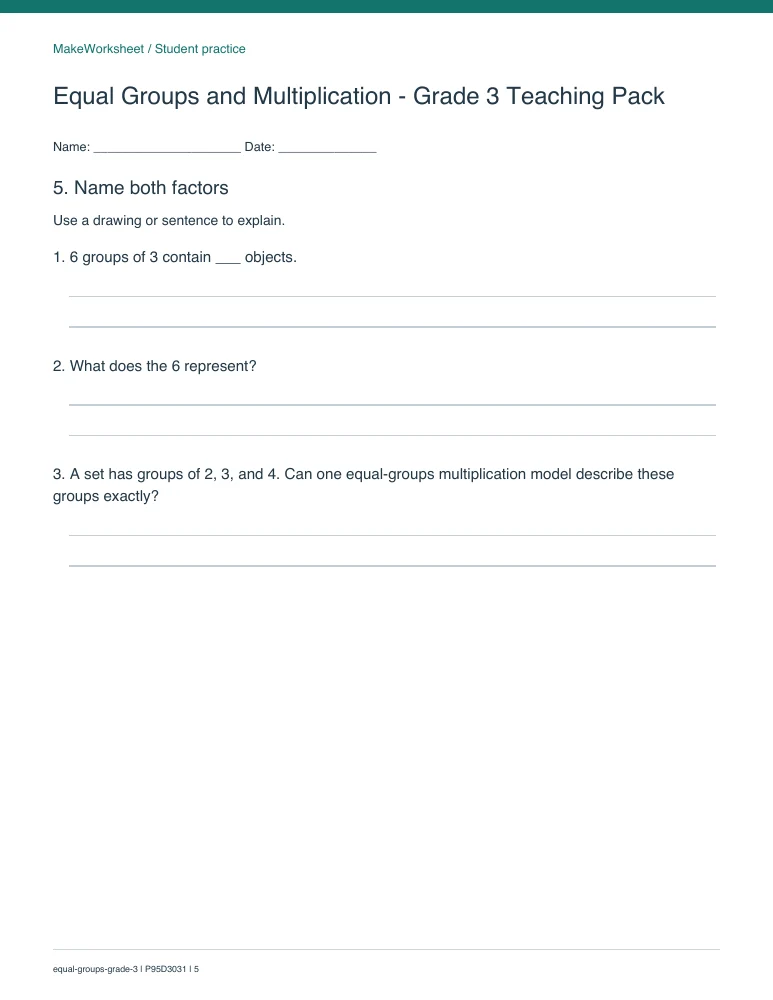
5. Name both factors

Use a drawing or sentence to explain.

View this actual PDF page and diagramsName both factors - actual student PDF page
  1. 6 groups of 3 contain ___ objects.
  2. What does the 6 represent?
  3. A set has groups of 2, 3, and 4. Can one equal-groups multiplication model describe these groups exactly?
Show answers and response criteria
  1. 18
  2. Number of groups.
  3. No; the groups are unequal. The total is 9 by addition.