Geometry and Measurement Worksheets
Distinguish reading a geometric representation from calculating with measurements. Choose angle and coordinate reading for interpretation, and area, perimeter or volume for calculation.
Where to start
Check the quantity first: boundary length, surface area and volume answer different questions. Use the units on the diagram to select an appropriate calculation.
A common mistake
Perimeter uses linear units, area uses square units and volume uses cubic units. A protractor reading starts from the ray’s zero-degree baseline.
What to try next
Ask learners to label the unit and justify the formula for one example, then try a different diagram.
Practice in learning order
Select the resource that matches the learner’s current skill. Grade labels are guides; the activity and prerequisite skills matter more than completing every sheet.
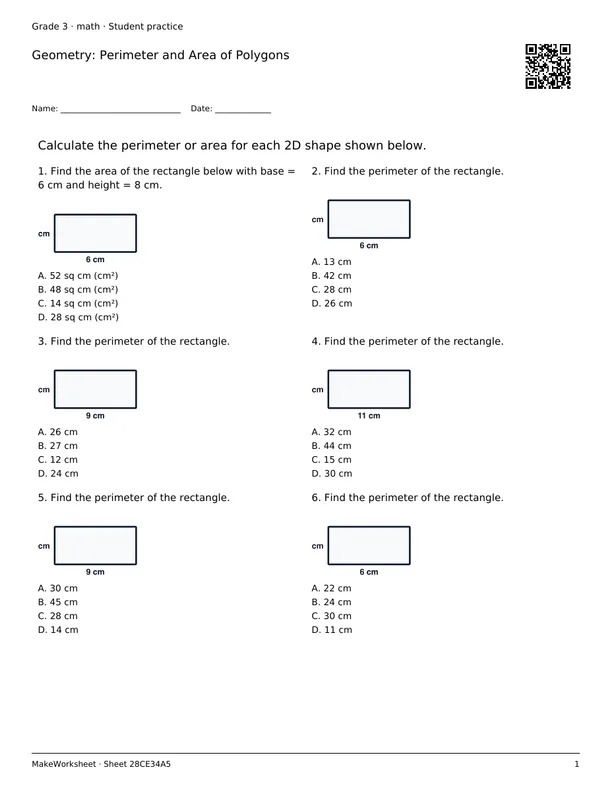 Practice preview
Geometry: Perimeter and Area of Polygons
Calculate perimeter by adding outer boundaries and area using base × height from labeled geometric polygon diagrams.
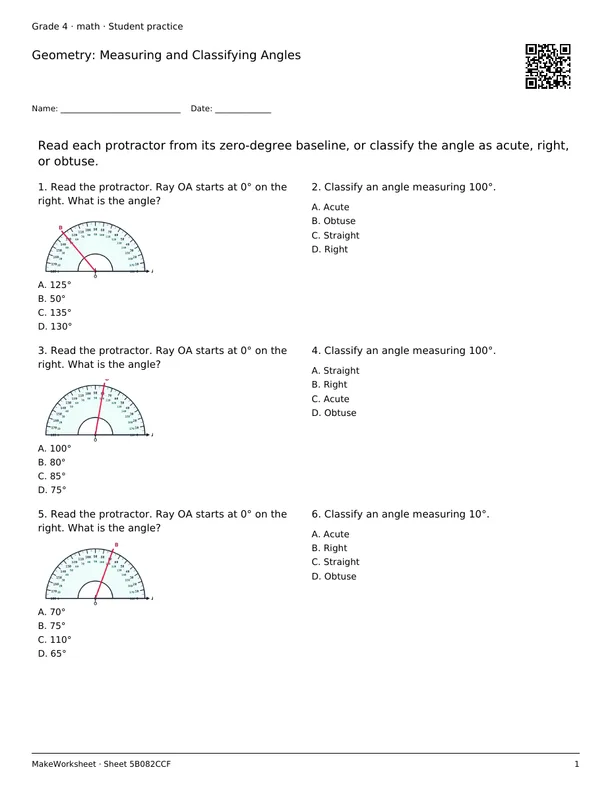 Practice preview
Geometry: Measuring and Classifying Angles
Read protractors and classify acute, right, and obtuse angles with structured practice.
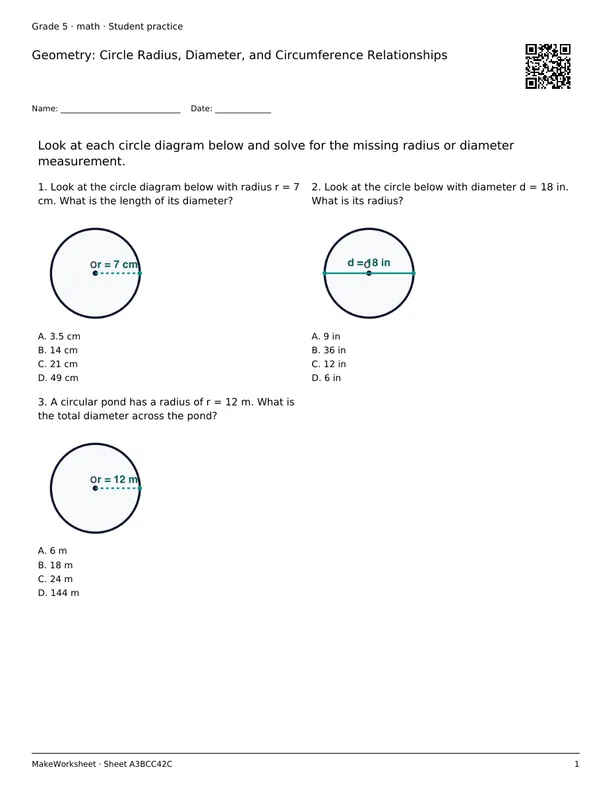 Practice preview
Geometry: Circle Radius, Diameter, and Circumference Relationships
Calculate radius from diameter and diameter from radius using d = 2r. Authentic geometric circle diagrams with complete answer key.
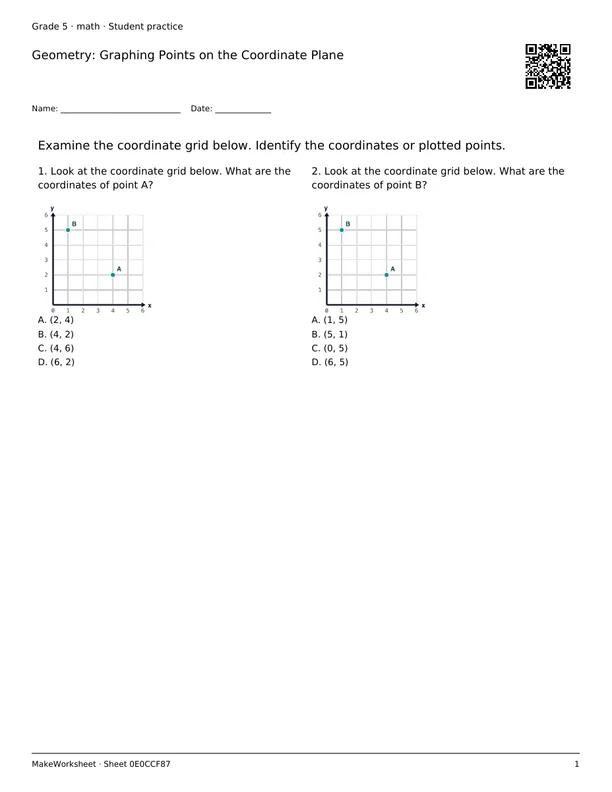 Practice preview
Geometry: Graphing Points on the Coordinate Plane
Plot and identify ordered pairs (x, y) on a Cartesian coordinate grid in Quadrant 1. Essential 5th grade geometry with step-by-step answer key.
 Practice preview
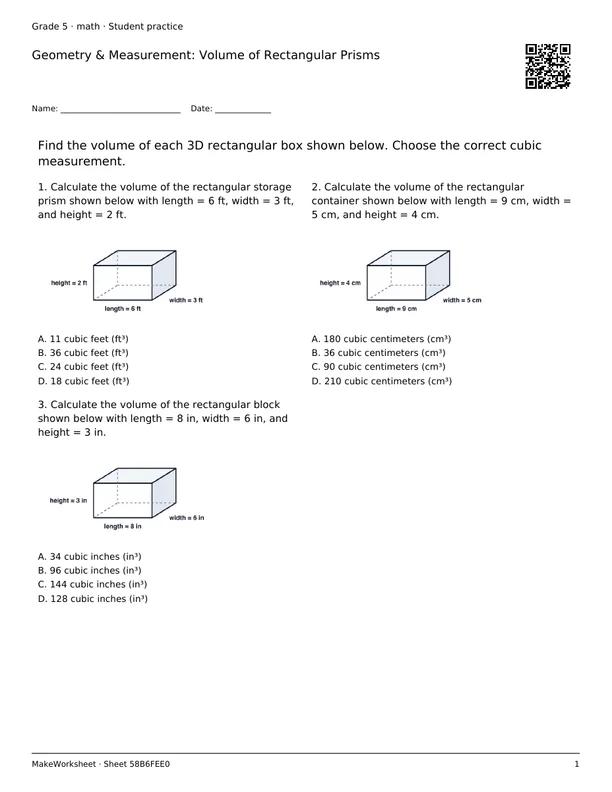
Geometry & Measurement: Volume of Rectangular Prisms
Calculate cubic volume using V = length × width × height with authentic 3D diagrams and step-by-step answer key.