Visual Fractions and Equivalent Fractions Worksheets
Use equally divided models to connect a shaded region with its numerator and denominator, then compare equivalent representations.
Where to start
Start by checking that the parts are equal. Ask learners to name all parts and shaded parts separately before matching a fraction to a picture.
A common mistake
The denominator counts all equal parts, not just unshaded parts. A different number of pieces can still represent the same amount.
What to try next
Draw a second model of the same fraction. Move to unlike-denominator arithmetic when equivalence is understood.
Practice in learning order
Select the resource that matches the learner’s current skill. Grade labels are guides; the activity and prerequisite skills matter more than completing every sheet.
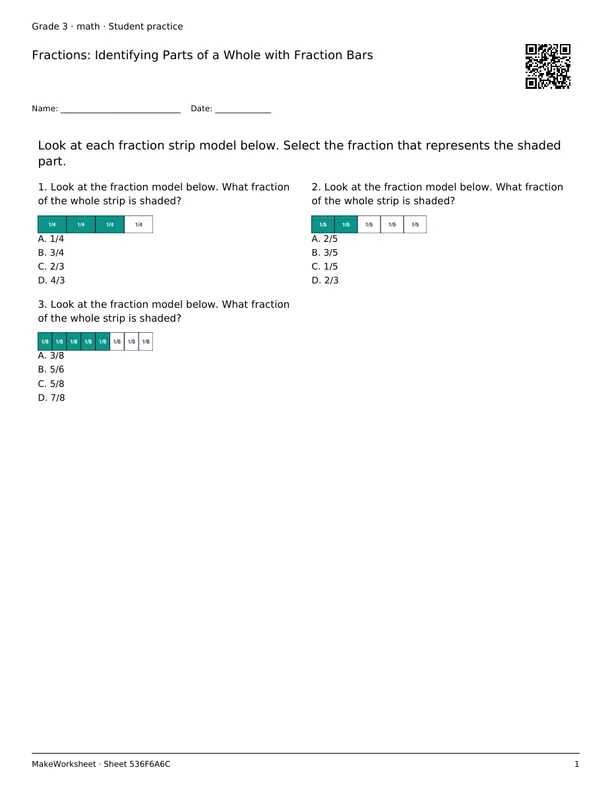 Practice preview
Fractions: Identifying Parts of a Whole with Fraction Bars
Learn to read and write fractions using visual shaded strip models. Count the shaded parts as the numerator and total equal parts as denominator.
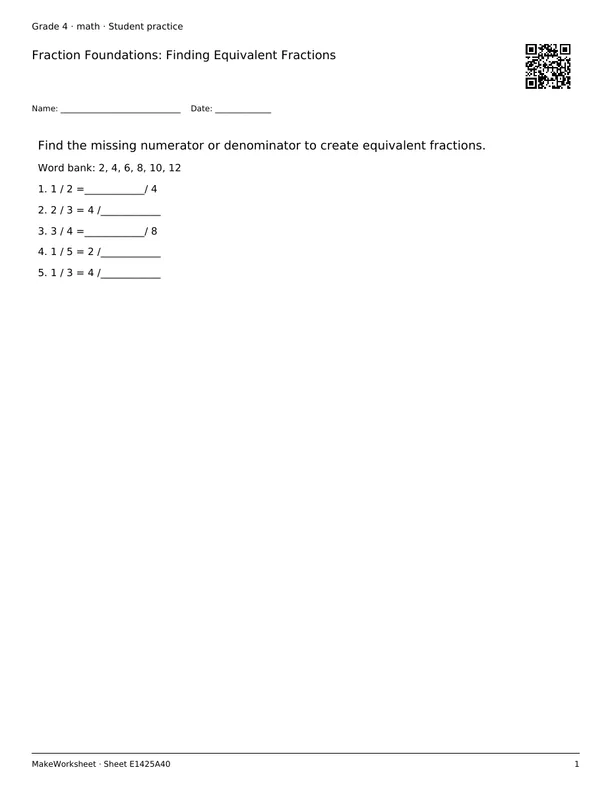 Practice preview
Fraction Foundations: Finding Equivalent Fractions
Practice equivalent fractions by finding missing numerators and denominators. Multiply numerator and denominator by the same non-zero number.
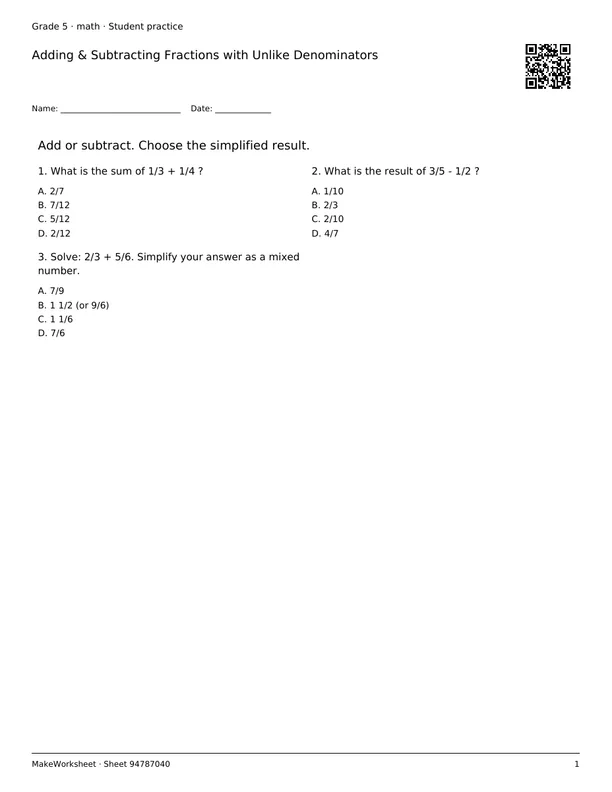 Practice preview
Adding & Subtracting Fractions with Unlike Denominators
5th grade fraction arithmetic practice. Find common denominators, convert equivalent fractions, and simplify sums to simplest form.