Skip to content
← All teaching packs

Story Sequence and Retelling - Grade 1 Teaching Pack

Retell a short English story in order and use a text detail to explain an action.

5 student sheets · 3 guide & answer pages · Letter / A4

Download ready-to-print PDFs

No account needed. Give students the student edition; the complete file includes answers after the practice pages. English reading texts stay in English in the Chinese support edition.

Actual student PDF first page: Story Sequence and Retelling - Grade 1 Teaching Pack
Preview rendered from the actual first PDF page. Download includes the later stages.

Choose your starting point

Listen to or read short sentences; an adult may read while the child follows.

  1. Begin with the start check. Model or read aloud when support is needed, then retry.
  2. Use the supported page to connect a model and method, then try independent practice.
  3. Use application for explanation and checking. Discuss the exit page to choose a next step; one score does not establish mastery.

Try three short sessions of 15-20 minutes. Allow drawing, oral response or adult scribing when appropriate; listen to English sounds for phonics tasks.

Watch for: Retell what happened in the text rather than adding a plausible event that was never stated.

Explore the related learning unit →

Original editorial content and automated checks; independent specialist review is not recorded. Editorial policy

P6B59F24 · 2026-10-24
Full activities and answer criteria

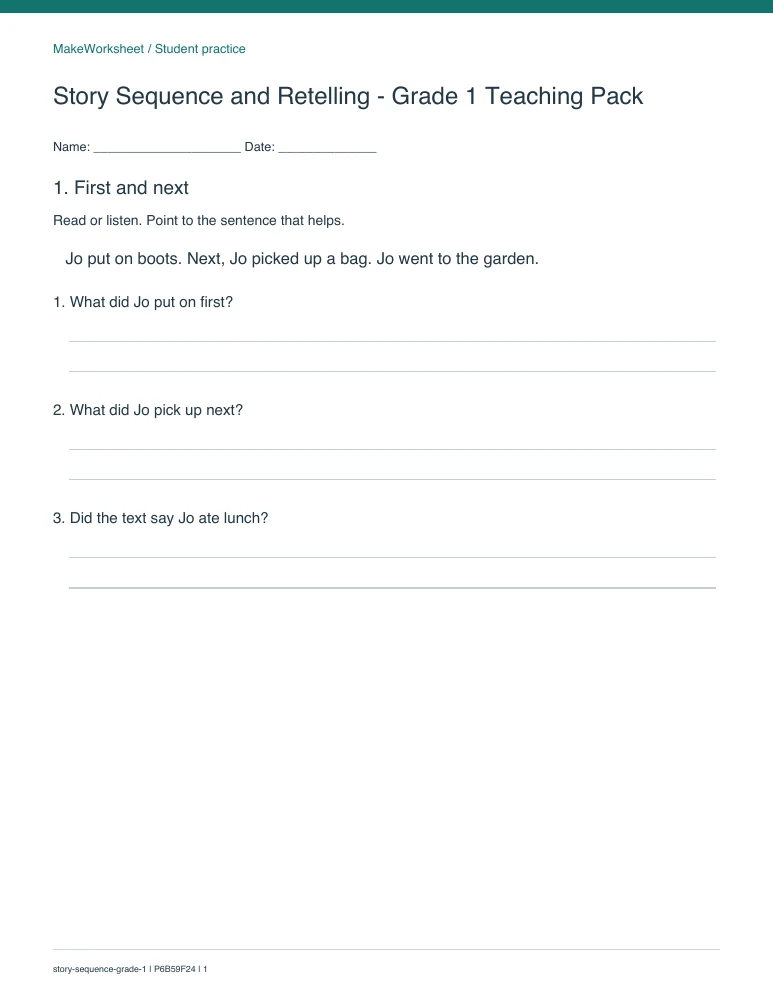
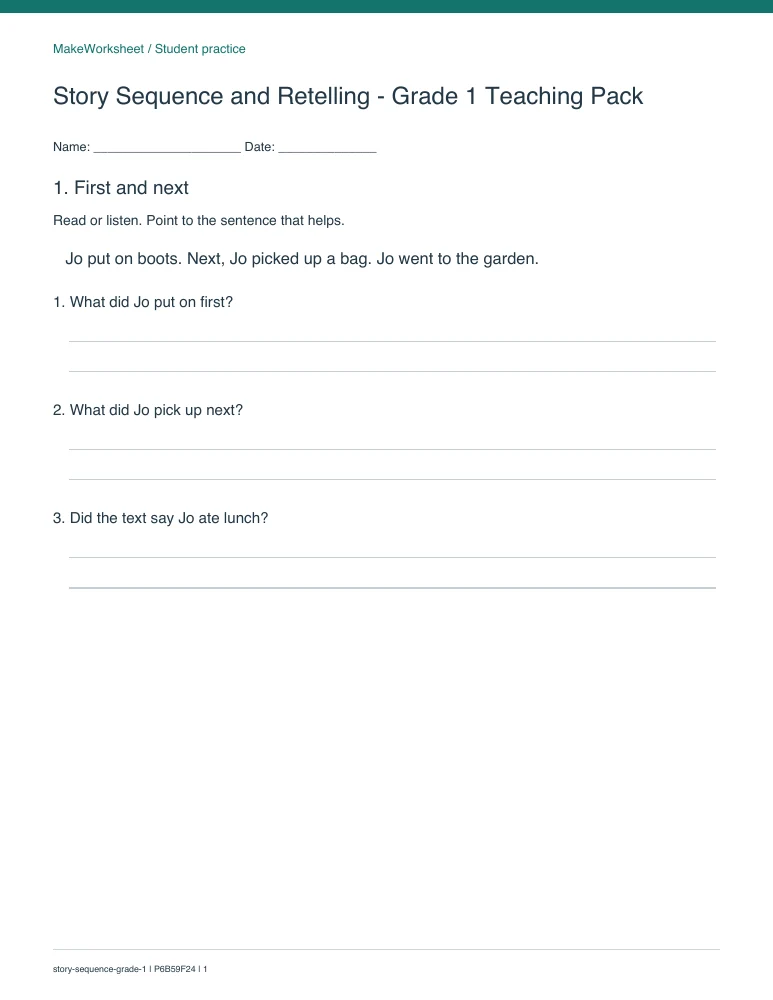
1. First and next

Read or listen. Point to the sentence that helps.

Jo put on boots. Next, Jo picked up a bag. Jo went to the garden.
View this actual PDF page and diagramsFirst and next - actual student PDF page
  1. What did Jo put on first?
  2. What did Jo pick up next?
  3. Did the text say Jo ate lunch?
Show answers and response criteria
  1. Boots.
  2. A bag.
  3. No.

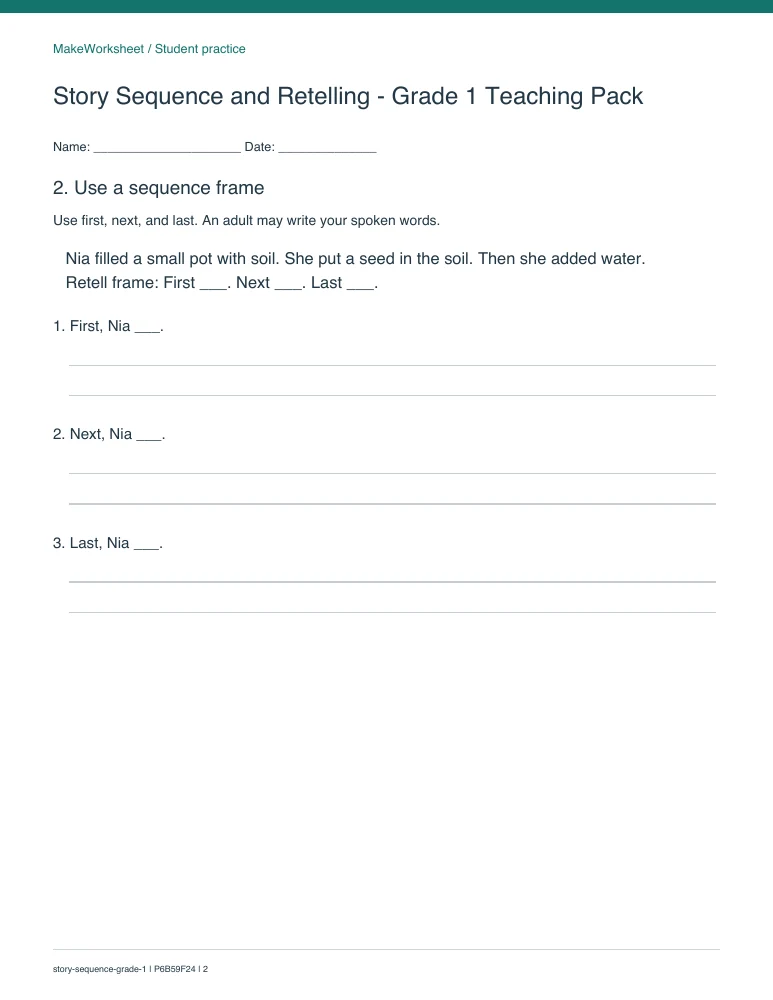
2. Use a sequence frame

Use first, next, and last. An adult may write your spoken words.

Nia filled a small pot with soil. She put a seed in the soil. Then she added water. Retell frame: First ___. Next ___. Last ___.
View this actual PDF page and diagramsUse a sequence frame - actual student PDF page
  1. First, Nia ___.
  2. Next, Nia ___.
  3. Last, Nia ___.
Show answers and response criteria
  1. Filled a small pot with soil.
  2. Put a seed in the soil.
  3. Added water.

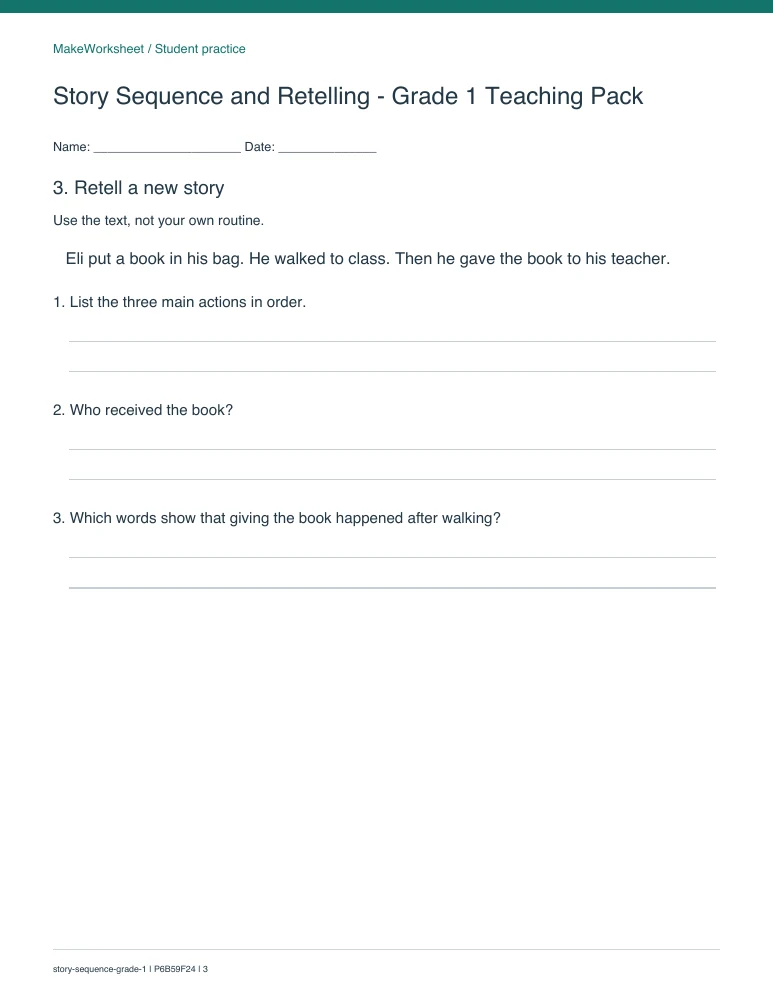
3. Retell a new story

Use the text, not your own routine.

Eli put a book in his bag. He walked to class. Then he gave the book to his teacher.
View this actual PDF page and diagramsRetell a new story - actual student PDF page
  1. List the three main actions in order.
  2. Who received the book?
  3. Which words show that giving the book happened after walking?
Show answers and response criteria
  1. Puts a book in the bag; walks to class; gives the book to the teacher.
  2. The teacher.
  3. Then; the sentence order also supports the sequence.

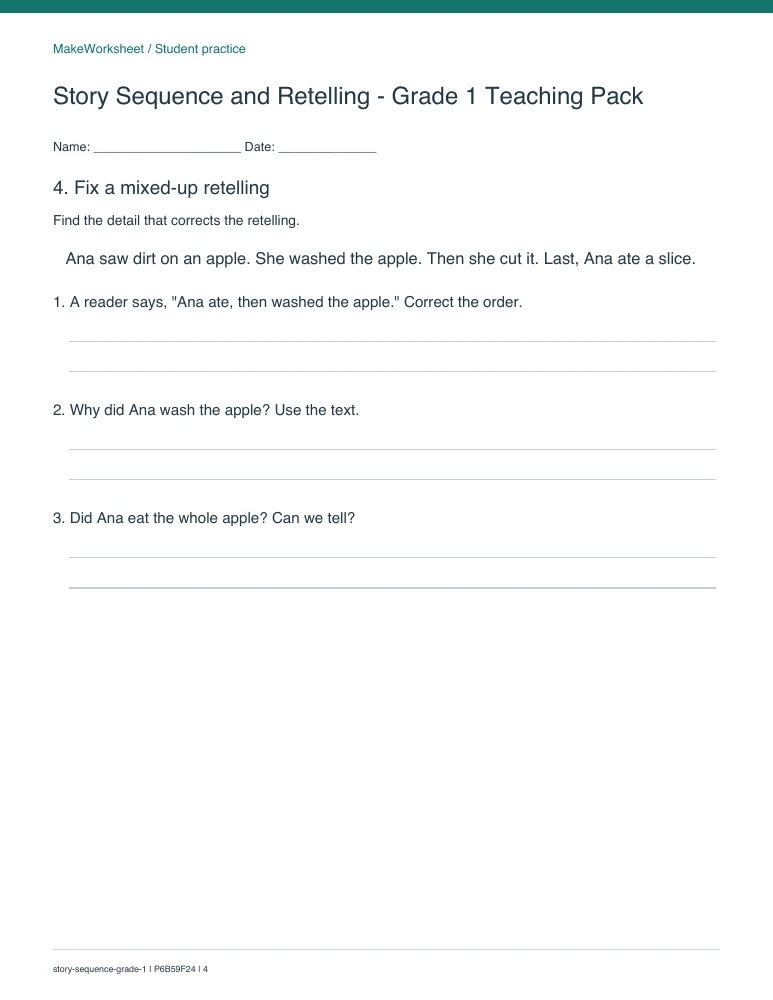
4. Fix a mixed-up retelling

Find the detail that corrects the retelling.

Ana saw dirt on an apple. She washed the apple. Then she cut it. Last, Ana ate a slice.
View this actual PDF page and diagramsFix a mixed-up retelling - actual student PDF page
  1. A reader says, "Ana ate, then washed the apple." Correct the order.
  2. Why did Ana wash the apple? Use the text.
  3. Did Ana eat the whole apple? Can we tell?
Show answers and response criteria
  1. Ana washed the apple, cut it, then ate a slice.
  2. It had dirt on it.
  3. No. The text says one slice; it does not say she ate all of it.

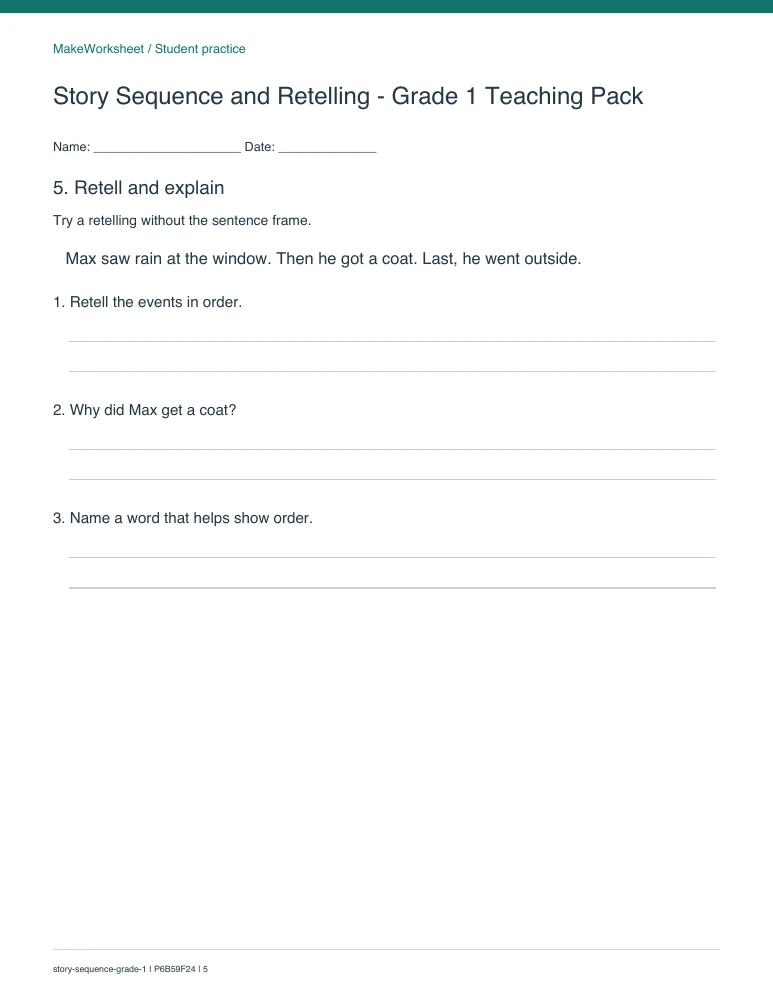
5. Retell and explain

Try a retelling without the sentence frame.

Max saw rain at the window. Then he got a coat. Last, he went outside.
View this actual PDF page and diagramsRetell and explain - actual student PDF page
  1. Retell the events in order.
  2. Why did Max get a coat?
  3. Name a word that helps show order.
Show answers and response criteria
  1. Max sees rain; gets a coat; goes outside.
  2. It was raining; accept a supported explanation.
  3. Then or last.