Skip to content
← All teaching packs

Inference from Actions and Details - Grade 4 Teaching Pack

Make a plausible inference, cite textual details, and distinguish inference from certainty.

5 student sheets · 3 guide & answer pages · Letter / A4

Download ready-to-print PDFs

No account needed. Give students the student edition; the complete file includes answers after the practice pages. English reading texts stay in English in the Chinese support edition.

Actual student PDF first page: Inference from Actions and Details - Grade 4 Teaching Pack
Preview rendered from the actual first PDF page. Download includes the later stages.

Choose your starting point

Locate explicit details and explain how a detail supports an idea.

  1. Begin with the start check. Model or read aloud when support is needed, then retry.
  2. Use the supported page to connect a model and method, then try independent practice.
  3. Use application for explanation and checking. Discuss the exit page to choose a next step; one score does not establish mastery.

Try three short sessions of 15-20 minutes. Allow drawing, oral response or adult scribing when appropriate; listen to English sounds for phonics tasks.

Watch for: An inference must fit the text; several supported interpretations can be acceptable.

Explore the related learning unit →

Original editorial content and automated checks; independent specialist review is not recorded. Editorial policy

PC255F87 · 2026-10-24

Full activities and answer criteria

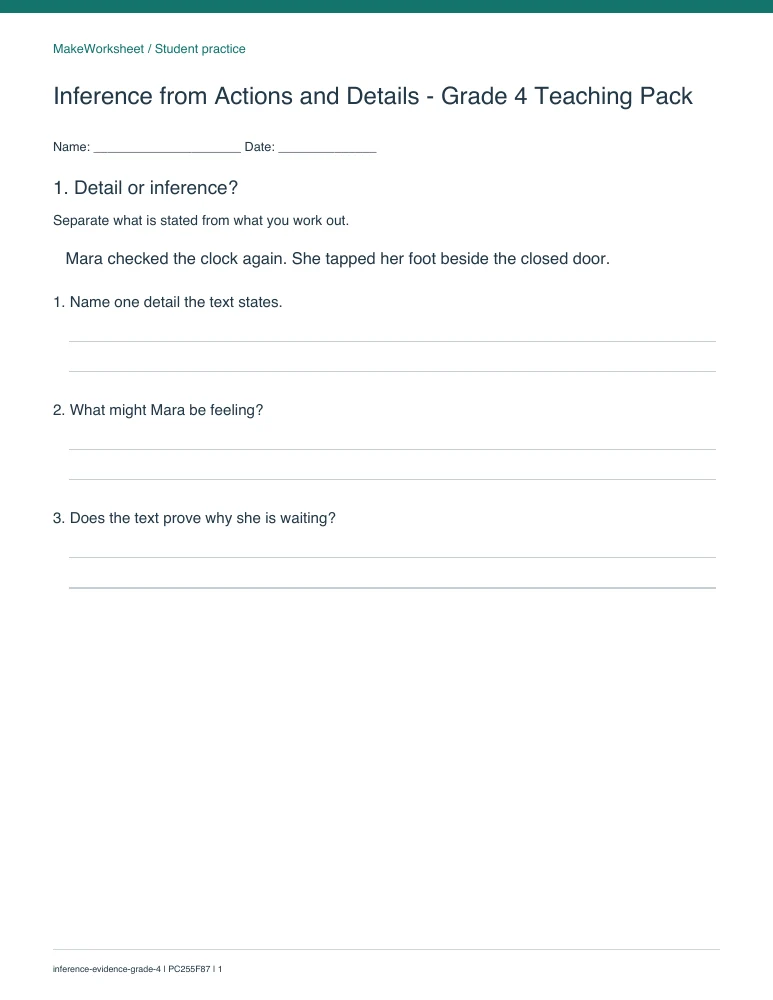
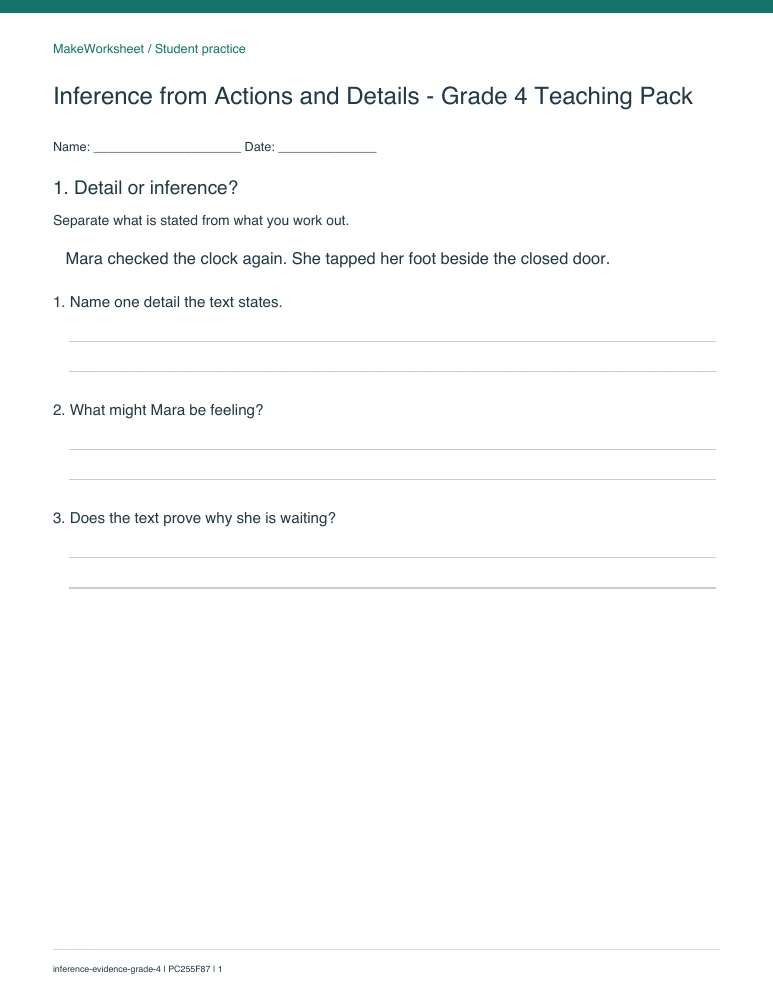
1. Detail or inference?

Separate what is stated from what you work out.

Mara checked the clock again. She tapped her foot beside the closed door.
View this actual PDF page and diagramsDetail or inference? - actual student PDF page
  1. Name one detail the text states.
  2. What might Mara be feeling?
  3. Does the text prove why she is waiting?
Show answers and response criteria
  1. Mara checks the clock or taps her foot.
  2. Possibly impatient or anxious; accept a supported alternative.
  3. No; the reason is not stated.

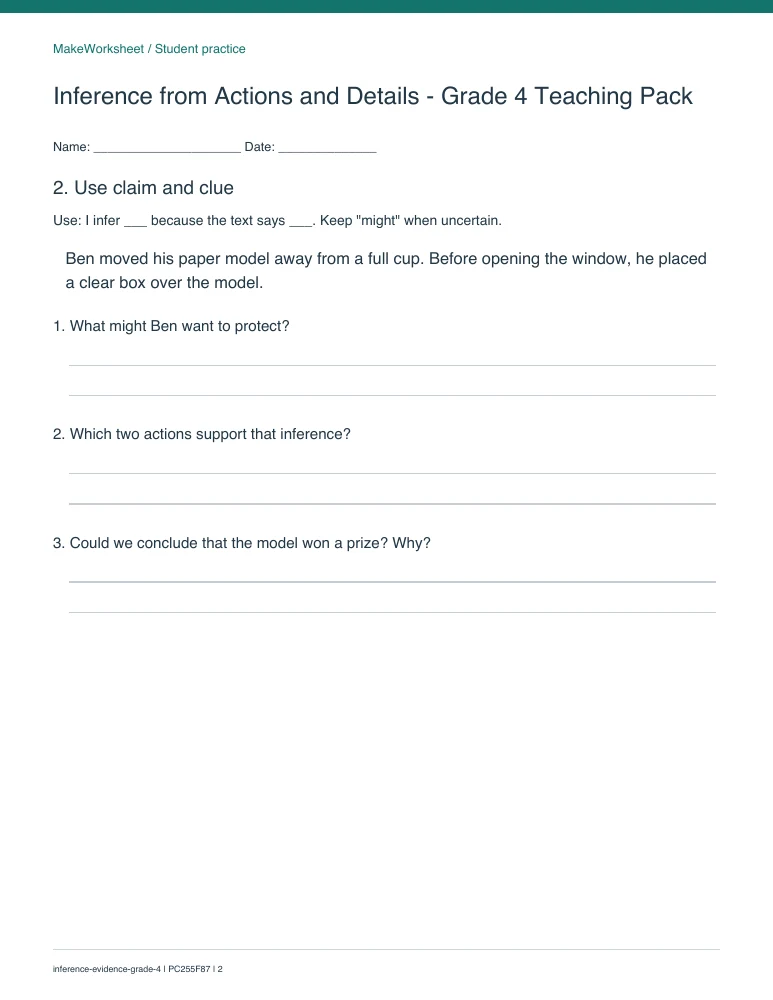
2. Use claim and clue

Use: I infer ___ because the text says ___. Keep "might" when uncertain.

Ben moved his paper model away from a full cup. Before opening the window, he placed a clear box over the model.
View this actual PDF page and diagramsUse claim and clue - actual student PDF page
  1. What might Ben want to protect?
  2. Which two actions support that inference?
  3. Could we conclude that the model won a prize? Why?
Show answers and response criteria
  1. The paper model.
  2. He moves it away from the cup and covers it before opening the window.
  3. No; no detail supports a prize.

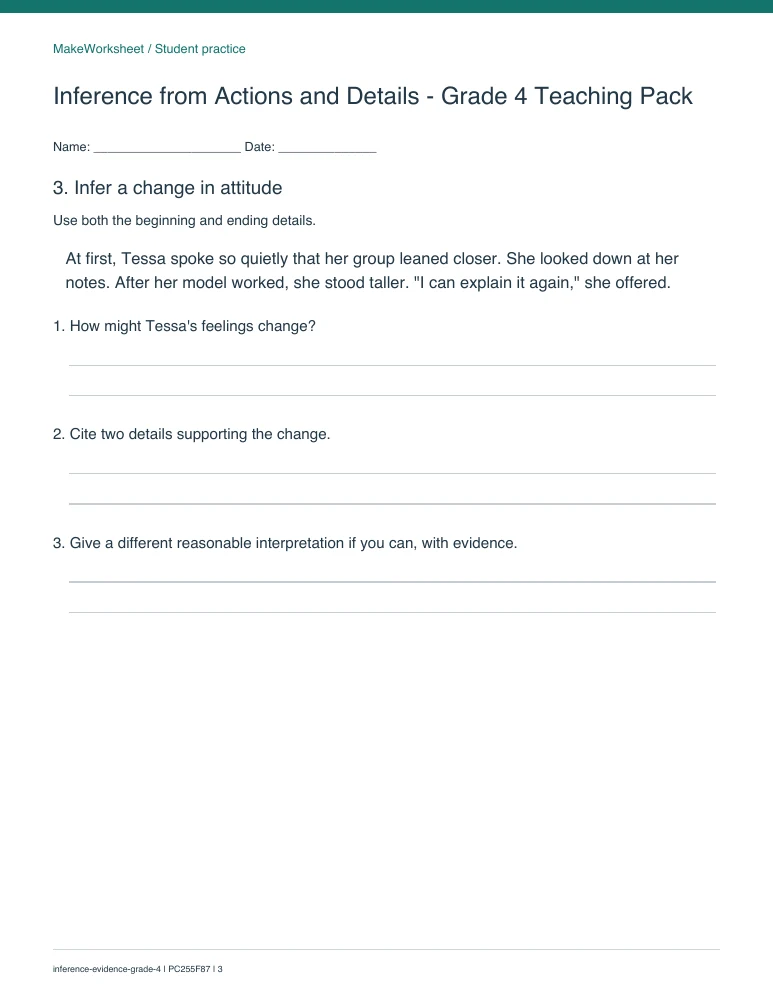
3. Infer a change in attitude

Use both the beginning and ending details.

At first, Tessa spoke so quietly that her group leaned closer. She looked down at her notes. After her model worked, she stood taller. "I can explain it again," she offered.
View this actual PDF page and diagramsInfer a change in attitude - actual student PDF page
  1. How might Tessa's feelings change?
  2. Cite two details supporting the change.
  3. Give a different reasonable interpretation if you can, with evidence.
Show answers and response criteria
  1. From hesitant or nervous to more confident or relieved.
  2. Starts with quiet voice and looking down; later stands taller and offers to explain again.
  3. Accept an interpretation consistent with both parts; no single feeling word is required.

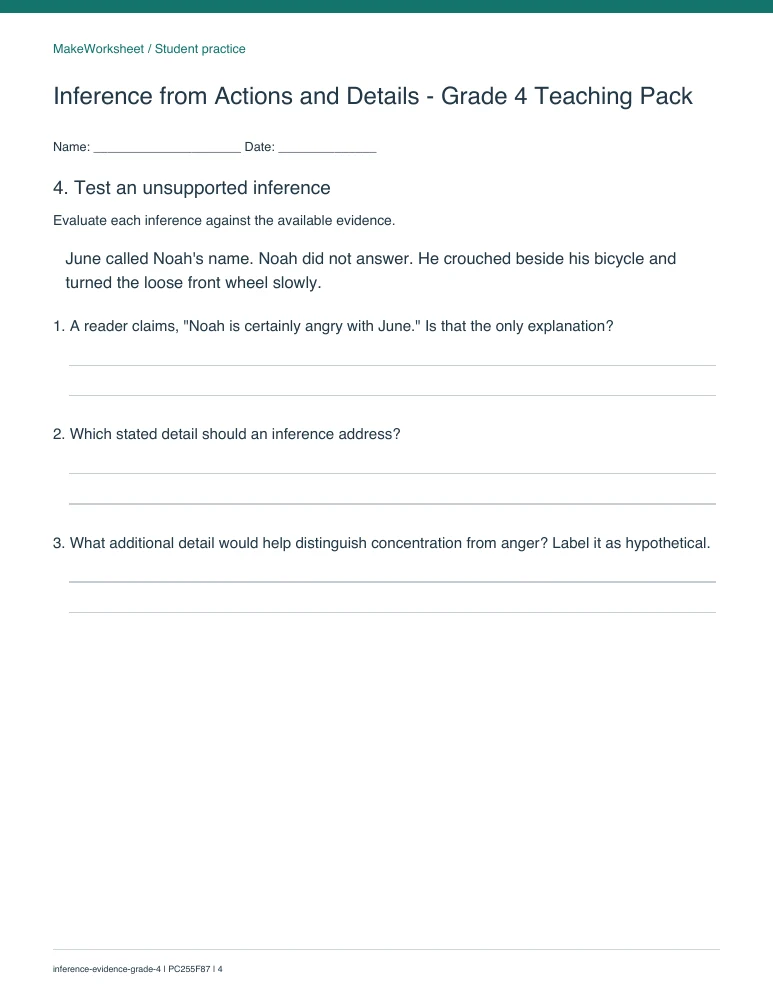
4. Test an unsupported inference

Evaluate each inference against the available evidence.

June called Noah's name. Noah did not answer. He crouched beside his bicycle and turned the loose front wheel slowly.
View this actual PDF page and diagramsTest an unsupported inference - actual student PDF page
  1. A reader claims, "Noah is certainly angry with June." Is that the only explanation?
  2. Which stated detail should an inference address?
  3. What additional detail would help distinguish concentration from anger? Label it as hypothetical.
Show answers and response criteria
  1. No. Noah may be concentrating, worried, or upset; anger at June is not established.
  2. Noah does not answer while checking the loose wheel.
  3. For example, he later says he did not hear because he was fixing it. Accept relevant hypothetical evidence.

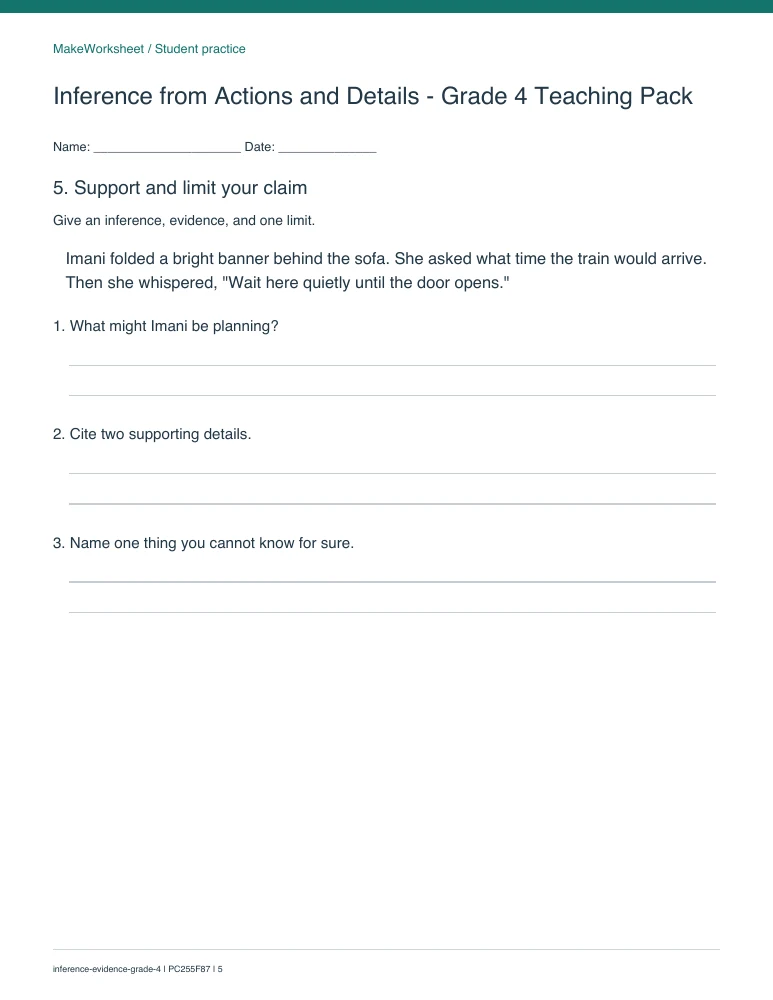
5. Support and limit your claim

Give an inference, evidence, and one limit.

Imani folded a bright banner behind the sofa. She asked what time the train would arrive. Then she whispered, "Wait here quietly until the door opens."
View this actual PDF page and diagramsSupport and limit your claim - actual student PDF page
  1. What might Imani be planning?
  2. Cite two supporting details.
  3. Name one thing you cannot know for sure.
Show answers and response criteria
  1. A welcome, celebration, or surprise for the returning person; accept a supported interpretation.
  2. Hides a banner; asks when the train arrives; asks others to wait quietly. Any two.
  3. The exact occasion, identity of the traveler, or their reaction.