Skip to content
← All teaching packs

Facts Opinions and Evidence - Grade 3 Teaching Pack

Distinguish checkable statements from preferences and identify what evidence would verify a claim.

5 student sheets · 3 guide & answer pages · Letter / A4

Download ready-to-print PDFs

No account needed. Give students the student edition; the complete file includes answers after the practice pages. English reading texts stay in English in the Chinese support edition.

Actual student PDF first page: Facts Opinions and Evidence - Grade 3 Teaching Pack
Preview rendered from the actual first PDF page. Download includes the later stages.

Choose your starting point

Find explicit details in a paragraph and explain a personal preference.

  1. Begin with the start check. Model or read aloud when support is needed, then retry.
  2. Use the supported page to connect a model and method, then try independent practice.
  3. Use application for explanation and checking. Discuss the exit page to choose a next step; one score does not establish mastery.

Try three short sessions of 15-20 minutes. Allow drawing, oral response or adult scribing when appropriate; listen to English sounds for phonics tasks.

Watch for: Checkable does not mean already verified; a statement may be factual in type but still need checking.

Explore the related learning unit →

Original editorial content and automated checks; independent specialist review is not recorded. Editorial policy

P5E50ED0 · 2026-10-24
Full activities and answer criteria

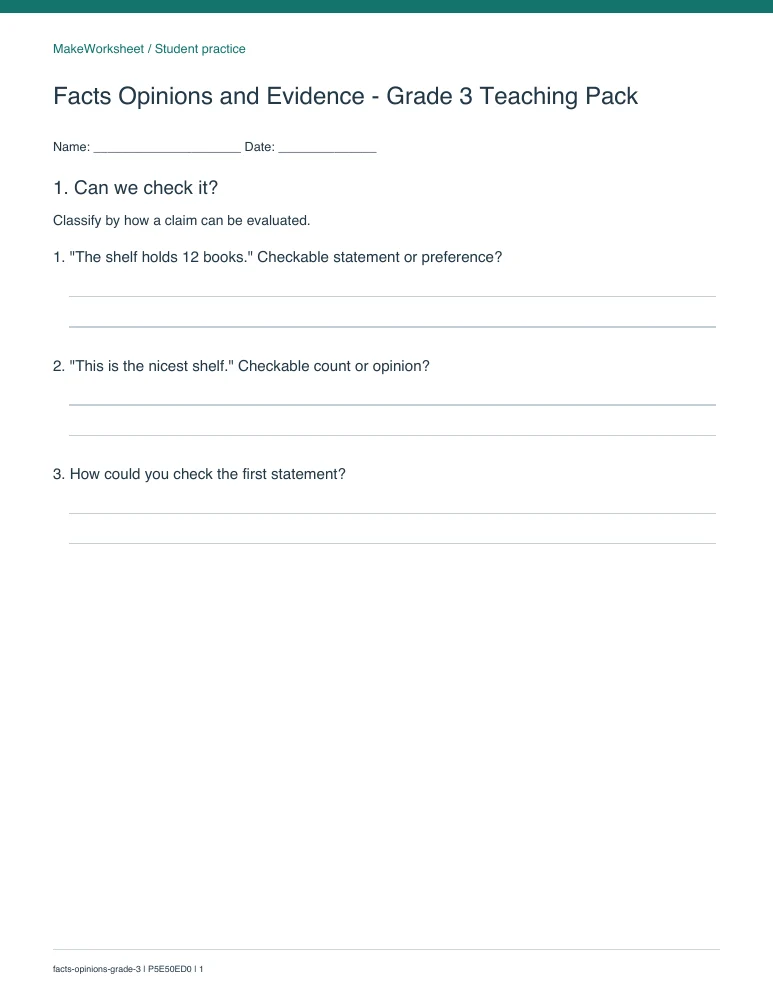
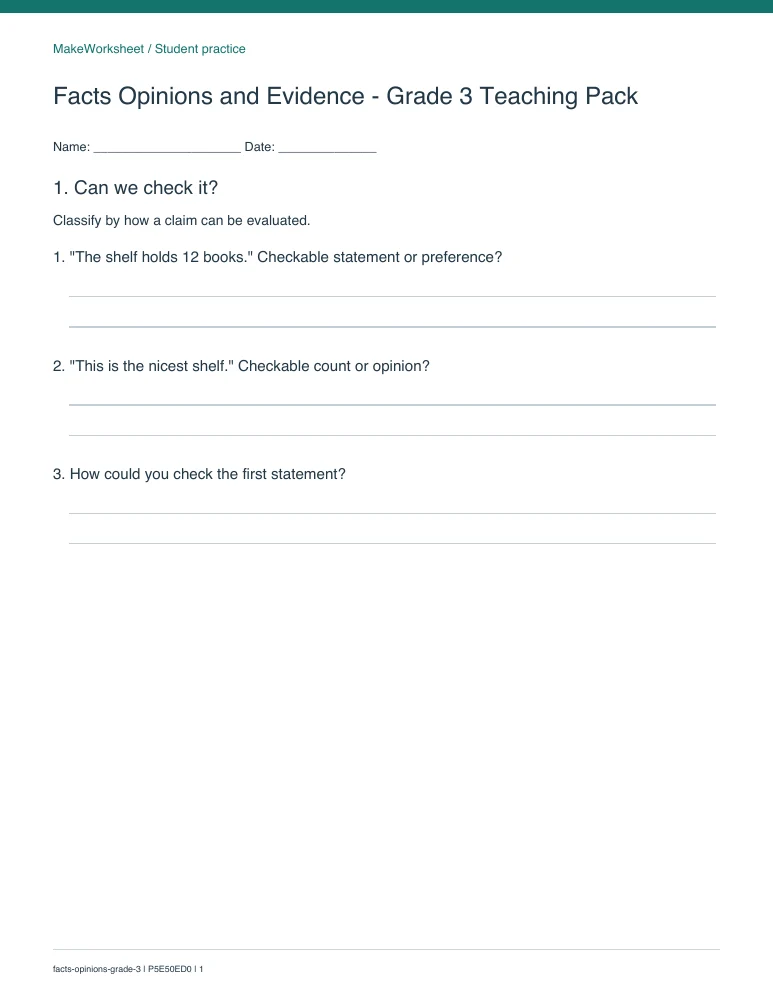
1. Can we check it?

Classify by how a claim can be evaluated.

View this actual PDF page and diagramsCan we check it? - actual student PDF page
  1. "The shelf holds 12 books." Checkable statement or preference?
  2. "This is the nicest shelf." Checkable count or opinion?
  3. How could you check the first statement?
Show answers and response criteria
  1. Checkable statement.
  2. Opinion.
  3. Count the books on the specified shelf at that time.

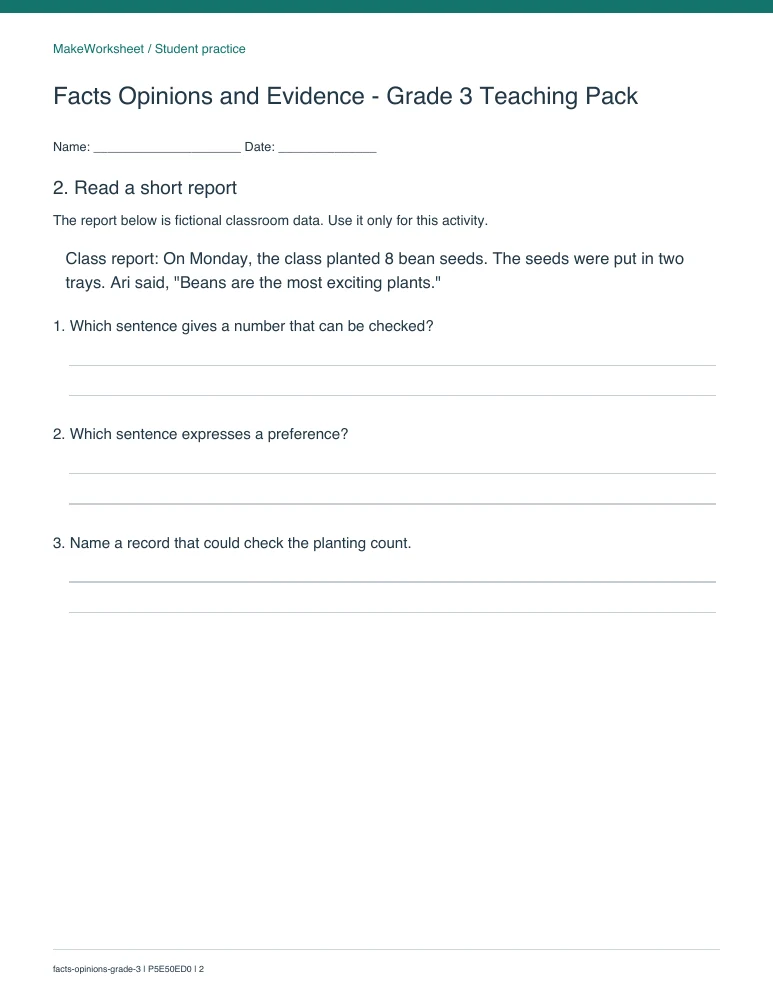
2. Read a short report

The report below is fictional classroom data. Use it only for this activity.

Class report: On Monday, the class planted 8 bean seeds. The seeds were put in two trays. Ari said, "Beans are the most exciting plants."
View this actual PDF page and diagramsRead a short report - actual student PDF page
  1. Which sentence gives a number that can be checked?
  2. Which sentence expresses a preference?
  3. Name a record that could check the planting count.
Show answers and response criteria
  1. The class planted 8 seeds.
  2. Beans are the most exciting plants.
  3. A dated planting log or a clear photograph of the planting.

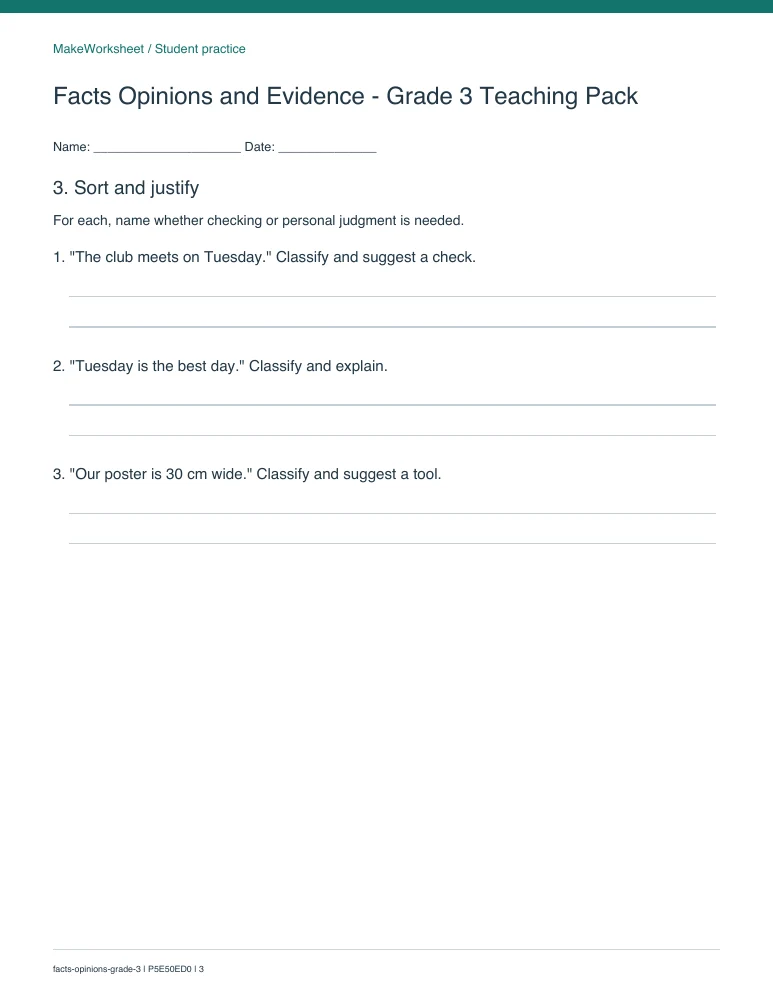
3. Sort and justify

For each, name whether checking or personal judgment is needed.

View this actual PDF page and diagramsSort and justify - actual student PDF page
  1. "The club meets on Tuesday." Classify and suggest a check.
  2. "Tuesday is the best day." Classify and explain.
  3. "Our poster is 30 cm wide." Classify and suggest a tool.
Show answers and response criteria
  1. Checkable; inspect the current club schedule.
  2. Opinion; best depends on preference or criteria.
  3. Checkable; use a ruler or tape measure.

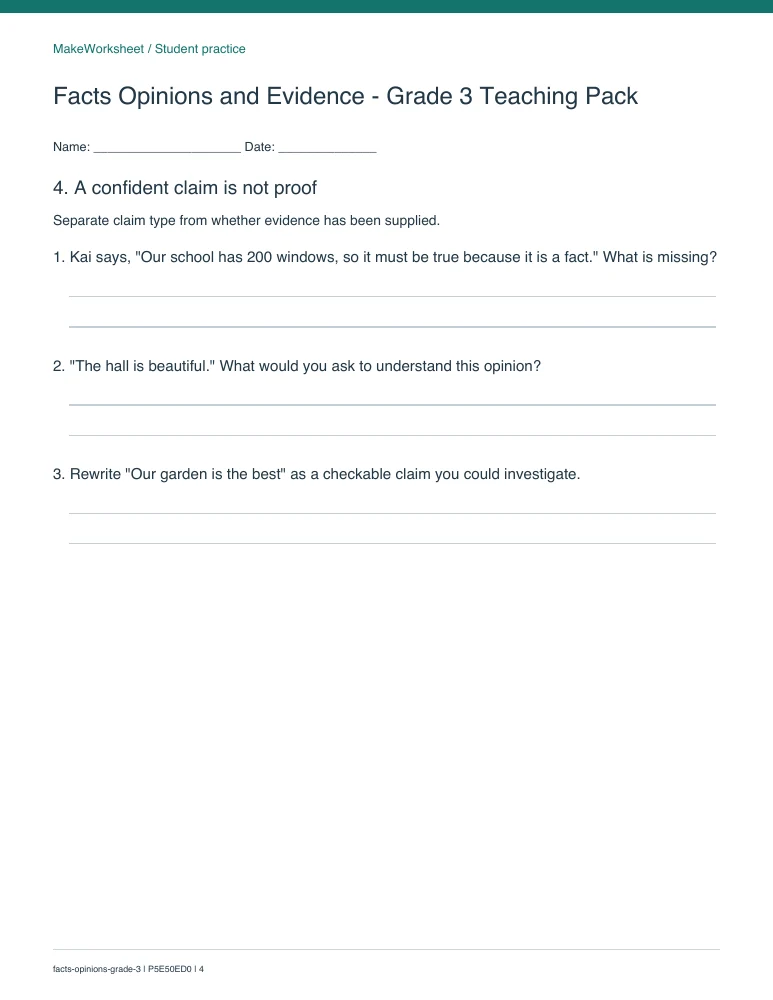
4. A confident claim is not proof

Separate claim type from whether evidence has been supplied.

View this actual PDF page and diagramsA confident claim is not proof - actual student PDF page
  1. Kai says, "Our school has 200 windows, so it must be true because it is a fact." What is missing?
  2. "The hall is beautiful." What would you ask to understand this opinion?
  3. Rewrite "Our garden is the best" as a checkable claim you could investigate.
Show answers and response criteria
  1. Evidence, such as a reliable count. Checkability alone does not prove 200.
  2. Ask what features or criteria make the speaker think so.
  3. For example, our garden contains 6 tomato plants. This is a proposed claim, not verified data.

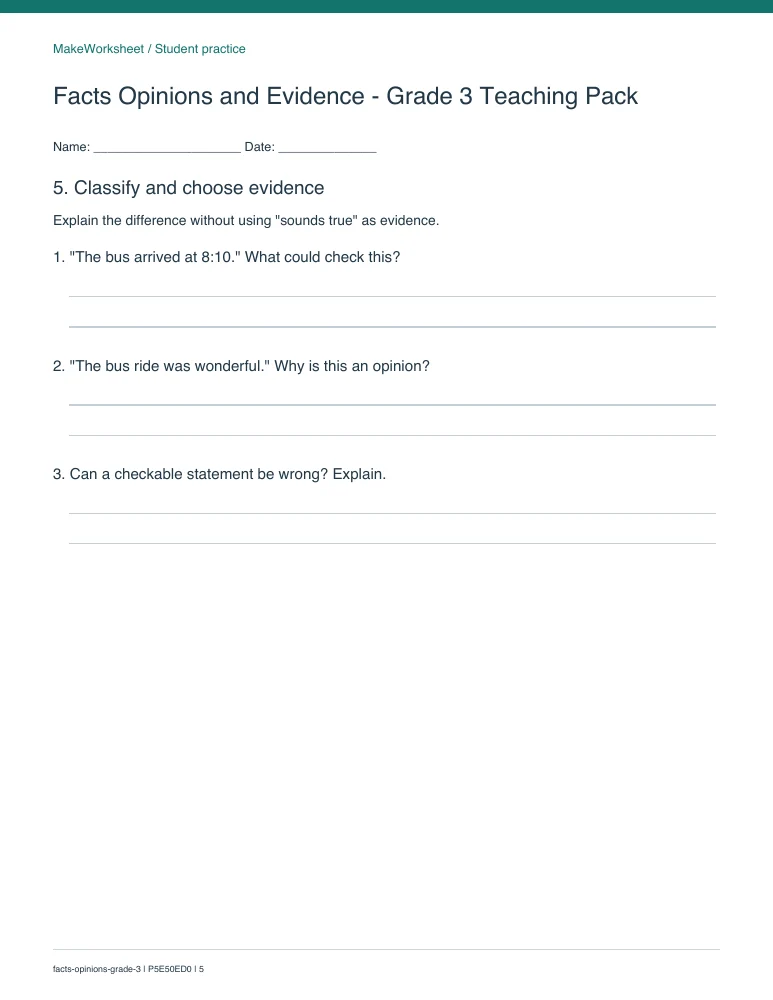
5. Classify and choose evidence

Explain the difference without using "sounds true" as evidence.

View this actual PDF page and diagramsClassify and choose evidence - actual student PDF page
  1. "The bus arrived at 8:10." What could check this?
  2. "The bus ride was wonderful." Why is this an opinion?
  3. Can a checkable statement be wrong? Explain.
Show answers and response criteria
  1. A time-stamped arrival record or reliable observation.
  2. Wonderful is an evaluation that can differ between people.
  3. Yes. It can be checked and found unsupported or false.