Skip to content
← All teaching packs

Addition Within Ten - Grade 1 Teaching Pack

Connect combining groups, drawings, and addition equations within ten.

5 student sheets · 3 guide & answer pages · Letter / A4

Download ready-to-print PDFs

No account needed. Give students the student edition; the complete file includes answers after the practice pages. English reading texts stay in English in the Chinese support edition.

Actual student PDF first page: Addition Within Ten - Grade 1 Teaching Pack
Preview rendered from the actual first PDF page. Download includes the later stages.

Choose your starting point

Count forward to ten and recognize numerals 0-10.

  1. Begin with the start check. Model or read aloud when support is needed, then retry.
  2. Use the supported page to connect a model and method, then try independent practice.
  3. Use application for explanation and checking. Discuss the exit page to choose a next step; one score does not establish mastery.

Try three short sessions of 15-20 minutes. Allow drawing, oral response or adult scribing when appropriate; listen to English sounds for phonics tasks.

Watch for: Count both groups, or count on from one group; do not count only the objects added.

Explore the related learning unit →

Original editorial content and automated checks; independent specialist review is not recorded. Editorial policy

P7583E49 · 2026-10-24
Full activities and answer criteria

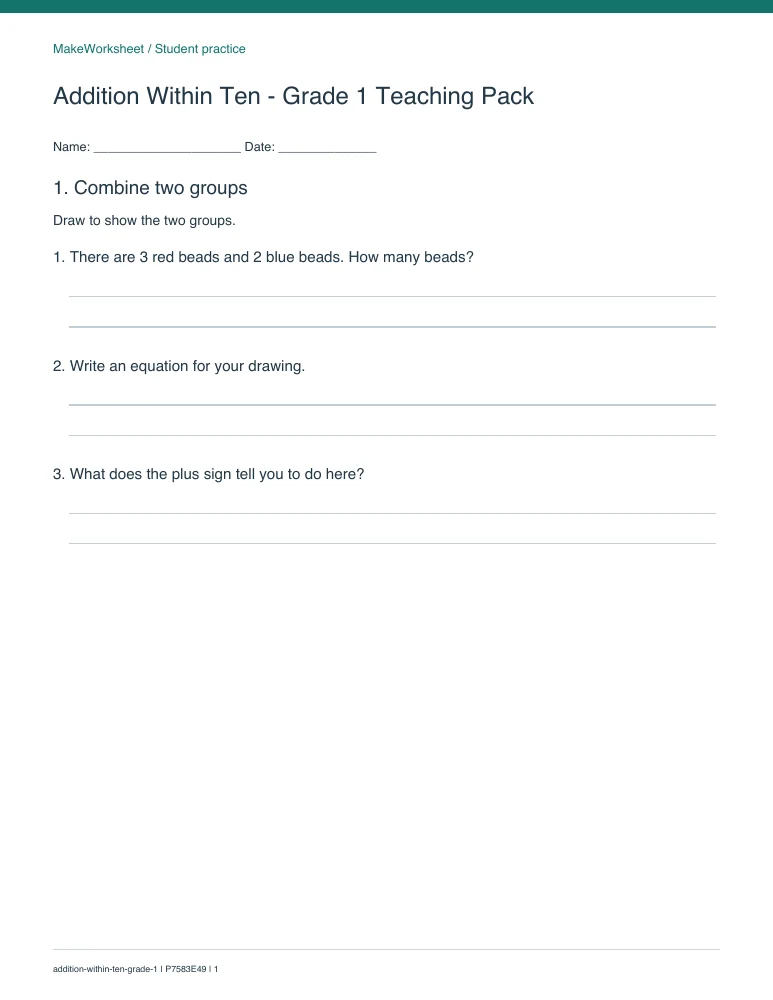
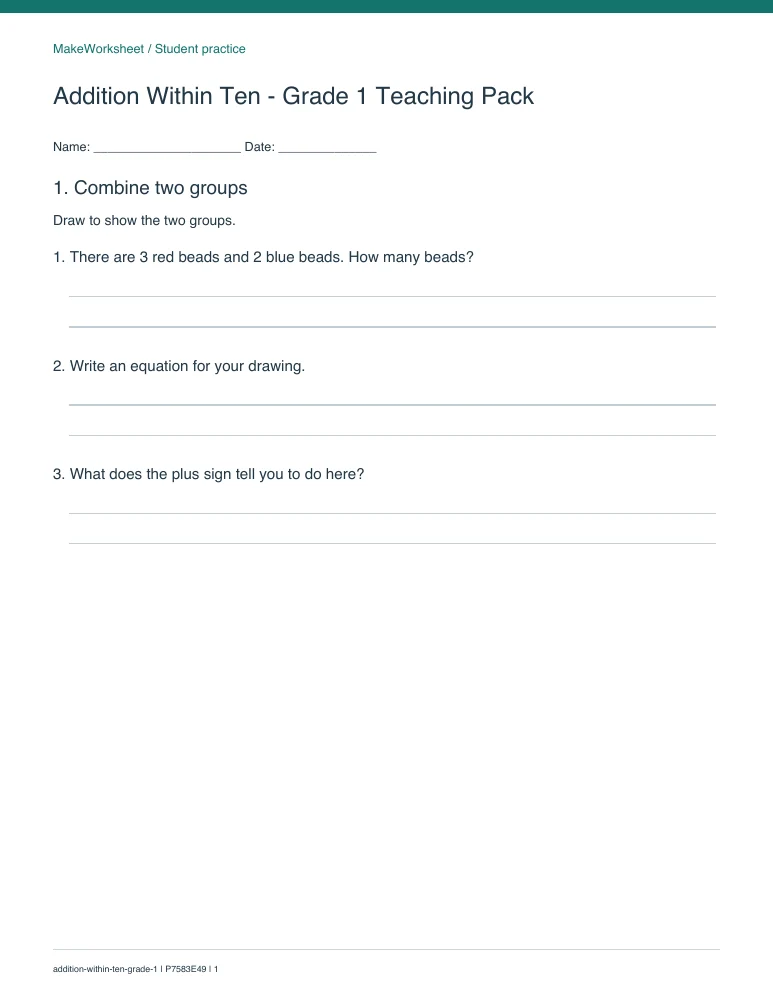
1. Combine two groups

Draw to show the two groups.

View this actual PDF page and diagramsCombine two groups - actual student PDF page
  1. There are 3 red beads and 2 blue beads. How many beads?
  2. Write an equation for your drawing.
  3. What does the plus sign tell you to do here?
Show answers and response criteria
  1. 5
  2. 3 + 2 = 5; 2 + 3 = 5 also accepted.
  3. Combine the two groups.

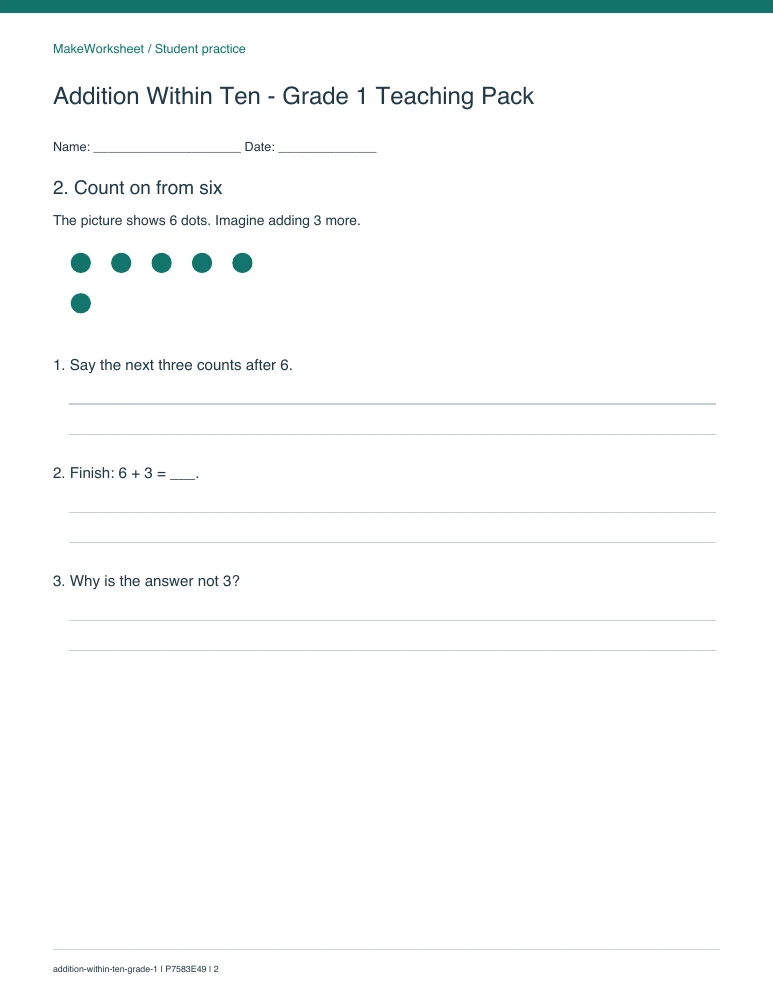
2. Count on from six

The picture shows 6 dots. Imagine adding 3 more.

View this actual PDF page and diagramsCount on from six - actual student PDF page
  1. Say the next three counts after 6.
  2. Finish: 6 + 3 = ___.
  3. Why is the answer not 3?
Show answers and response criteria
  1. 7, 8, 9
  2. 9
  3. The total includes the original 6 as well.

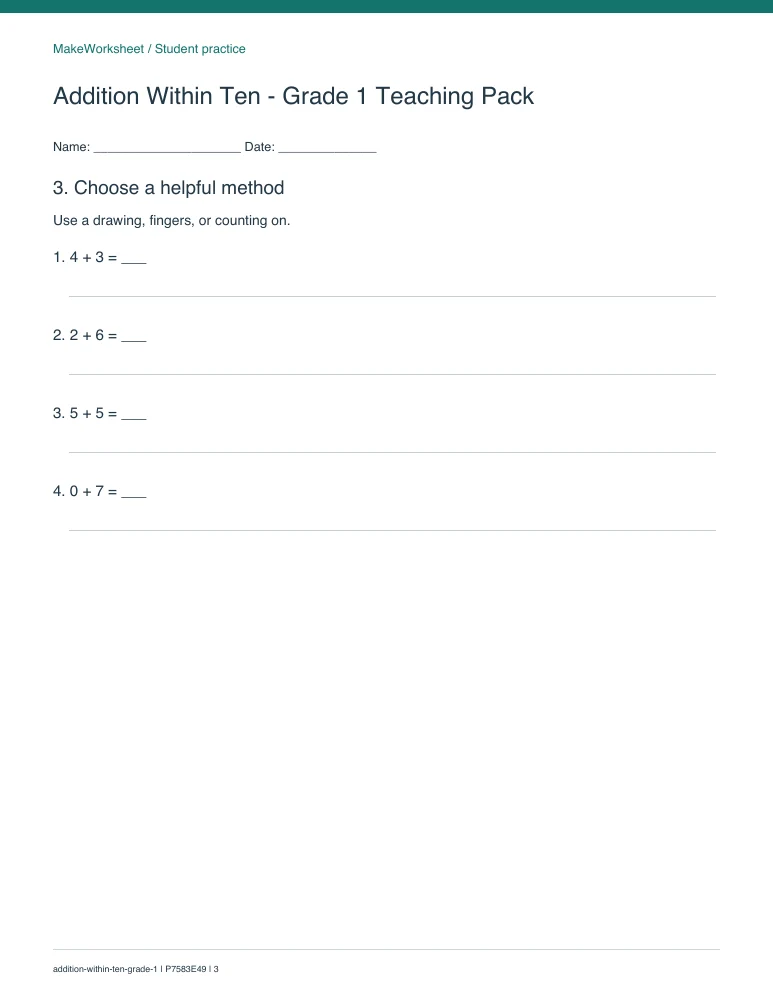
3. Choose a helpful method

Use a drawing, fingers, or counting on.

View this actual PDF page and diagramsChoose a helpful method - actual student PDF page
  1. 4 + 3 = ___
  2. 2 + 6 = ___
  3. 5 + 5 = ___
  4. 0 + 7 = ___
Show answers and response criteria
  1. 7
  2. 8
  3. 10
  4. 7

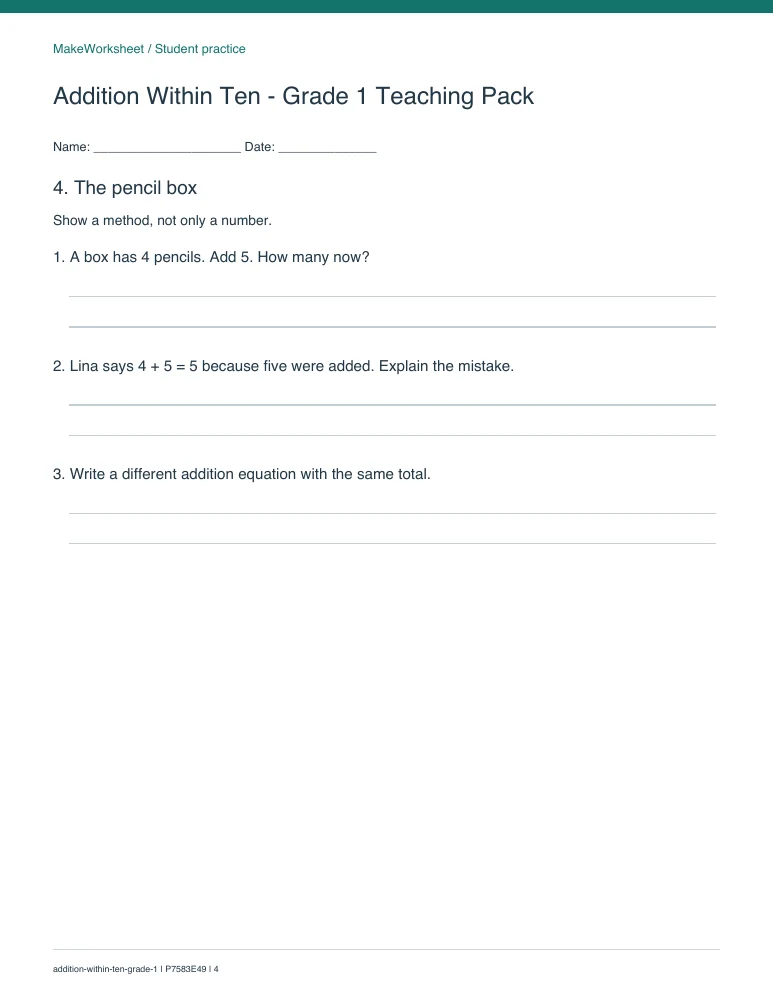
4. The pencil box

Show a method, not only a number.

View this actual PDF page and diagramsThe pencil box - actual student PDF page
  1. A box has 4 pencils. Add 5. How many now?
  2. Lina says 4 + 5 = 5 because five were added. Explain the mistake.
  3. Write a different addition equation with the same total.
Show answers and response criteria
  1. 9
  2. She left out the first 4; the total is 9.
  3. For example, 6 + 3 = 9.

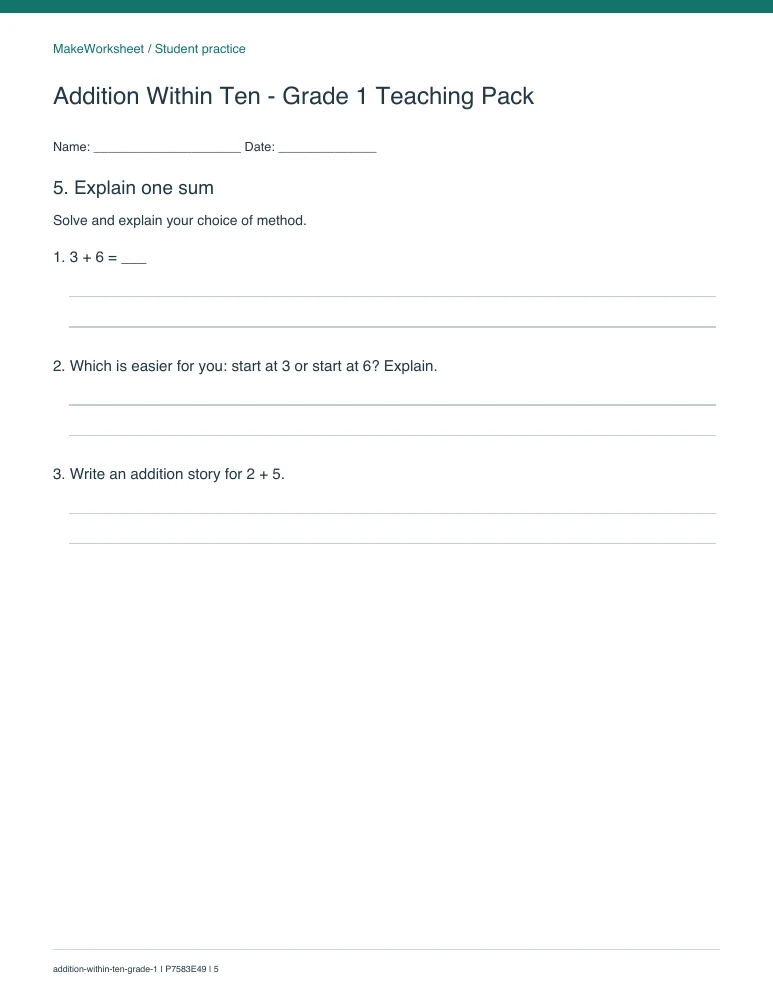
5. Explain one sum

Solve and explain your choice of method.

View this actual PDF page and diagramsExplain one sum - actual student PDF page
  1. 3 + 6 = ___
  2. Which is easier for you: start at 3 or start at 6? Explain.
  3. Write an addition story for 2 + 5.
Show answers and response criteria
  1. 9
  2. Either with a valid method; starting at 6 takes three counts.
  3. Two groups of 2 and 5 combined, total 7.