Skip to content
← All teaching packs

Equal Parts and Equivalent Fractions - Grade 3 Teaching Pack

Name a fraction of an equal-part whole and explain simple equivalent fractions using the same-sized whole.

5 student sheets · 3 guide & answer pages · Letter / A4

Download ready-to-print PDFs

No account needed. Give students the student edition; the complete file includes answers after the practice pages. English reading texts stay in English in the Chinese support edition.

Actual student PDF first page: Equal Parts and Equivalent Fractions - Grade 3 Teaching Pack
Preview rendered from the actual first PDF page. Download includes the later stages.

Choose your starting point

Recognize a whole and compare equal-sized pieces.

  1. Begin with the start check. Model or read aloud when support is needed, then retry.
  2. Use the supported page to connect a model and method, then try independent practice.
  3. Use application for explanation and checking. Discuss the exit page to choose a next step; one score does not establish mastery.

Try three short sessions of 15-20 minutes. Allow drawing, oral response or adult scribing when appropriate; listen to English sounds for phonics tasks.

Watch for: Fraction pieces must be equal and comparisons must use the same-sized whole.

Explore the related learning unit →

Original editorial content and automated checks; independent specialist review is not recorded. Editorial policy

P8C000E3 · 2026-10-24
Full activities and answer criteria

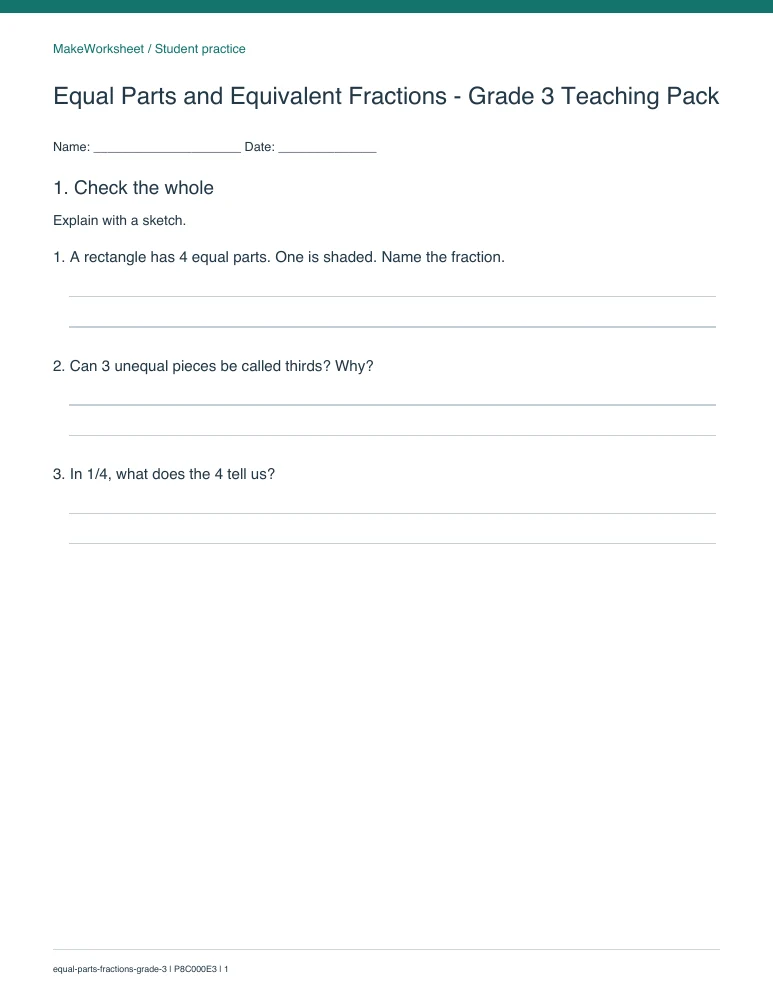
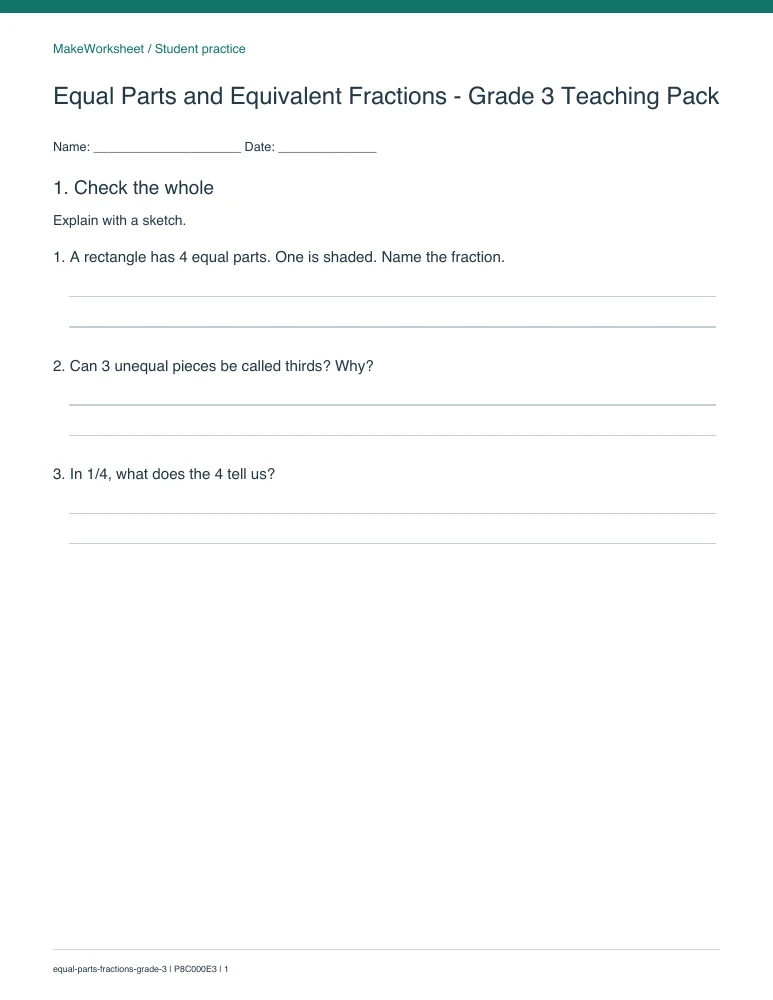
1. Check the whole

Explain with a sketch.

View this actual PDF page and diagramsCheck the whole - actual student PDF page
  1. A rectangle has 4 equal parts. One is shaded. Name the fraction.
  2. Can 3 unequal pieces be called thirds? Why?
  3. In 1/4, what does the 4 tell us?
Show answers and response criteria
  1. 1/4
  2. No; thirds require three equal parts of one whole.
  3. The whole has four equal parts.

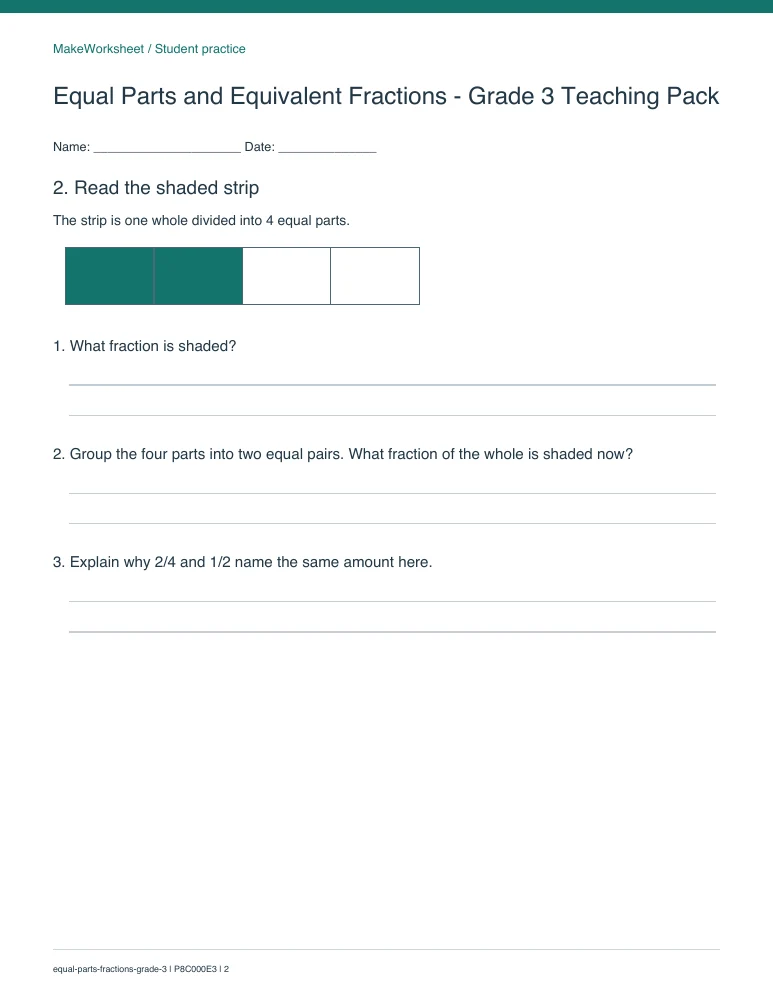
2. Read the shaded strip

The strip is one whole divided into 4 equal parts.

View this actual PDF page and diagramsRead the shaded strip - actual student PDF page
  1. What fraction is shaded?
  2. Group the four parts into two equal pairs. What fraction of the whole is shaded now?
  3. Explain why 2/4 and 1/2 name the same amount here.
Show answers and response criteria
  1. 2/4
  2. 1/2
  3. The shaded region is unchanged; only the partition grouping changes.

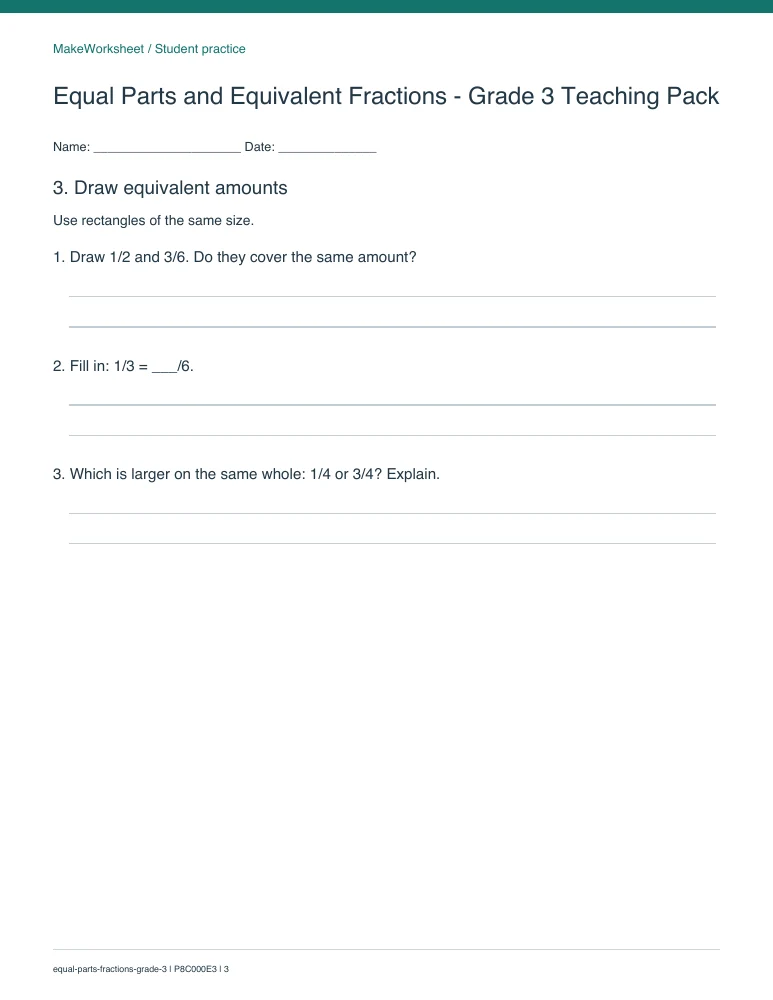
3. Draw equivalent amounts

Use rectangles of the same size.

View this actual PDF page and diagramsDraw equivalent amounts - actual student PDF page
  1. Draw 1/2 and 3/6. Do they cover the same amount?
  2. Fill in: 1/3 = ___/6.
  3. Which is larger on the same whole: 1/4 or 3/4? Explain.
Show answers and response criteria
  1. Yes, with equal-sized wholes and equal partitions.
  2. 2
  3. 3/4; it has three of the same-sized fourths instead of one.

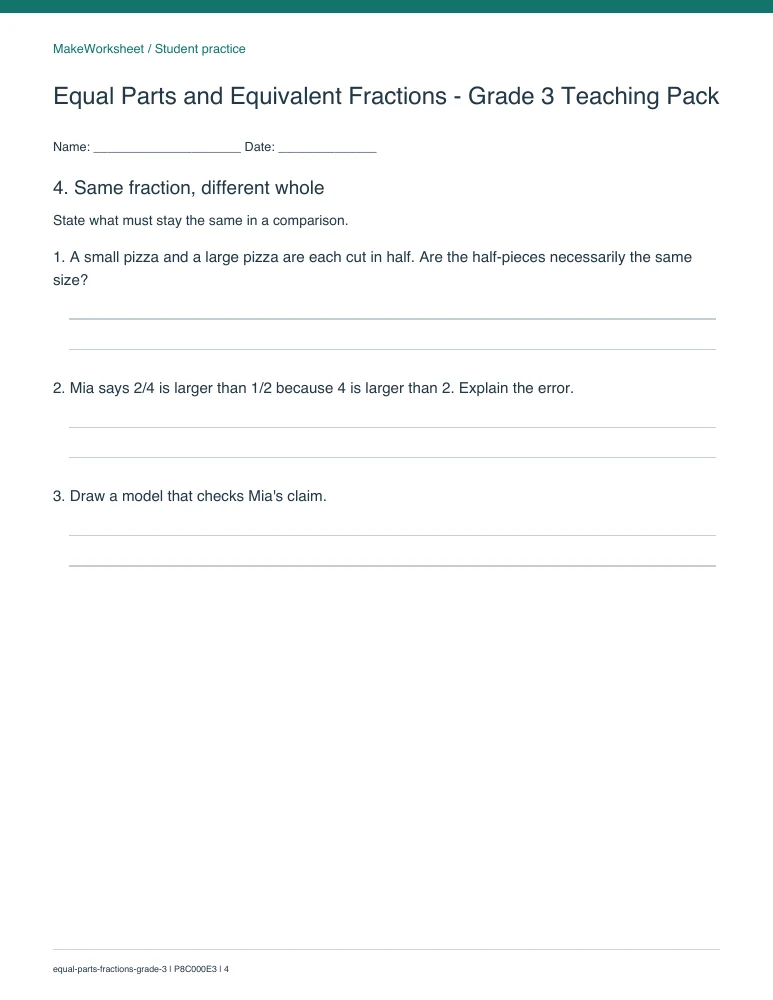
4. Same fraction, different whole

State what must stay the same in a comparison.

View this actual PDF page and diagramsSame fraction, different whole - actual student PDF page
  1. A small pizza and a large pizza are each cut in half. Are the half-pieces necessarily the same size?
  2. Mia says 2/4 is larger than 1/2 because 4 is larger than 2. Explain the error.
  3. Draw a model that checks Mia's claim.
Show answers and response criteria
  1. No; the wholes differ in size.
  2. For equal-sized wholes, 2/4 = 1/2. Denominator size alone does not compare amounts.
  3. Two equal-sized wholes with equal shading for 2/4 and 1/2.

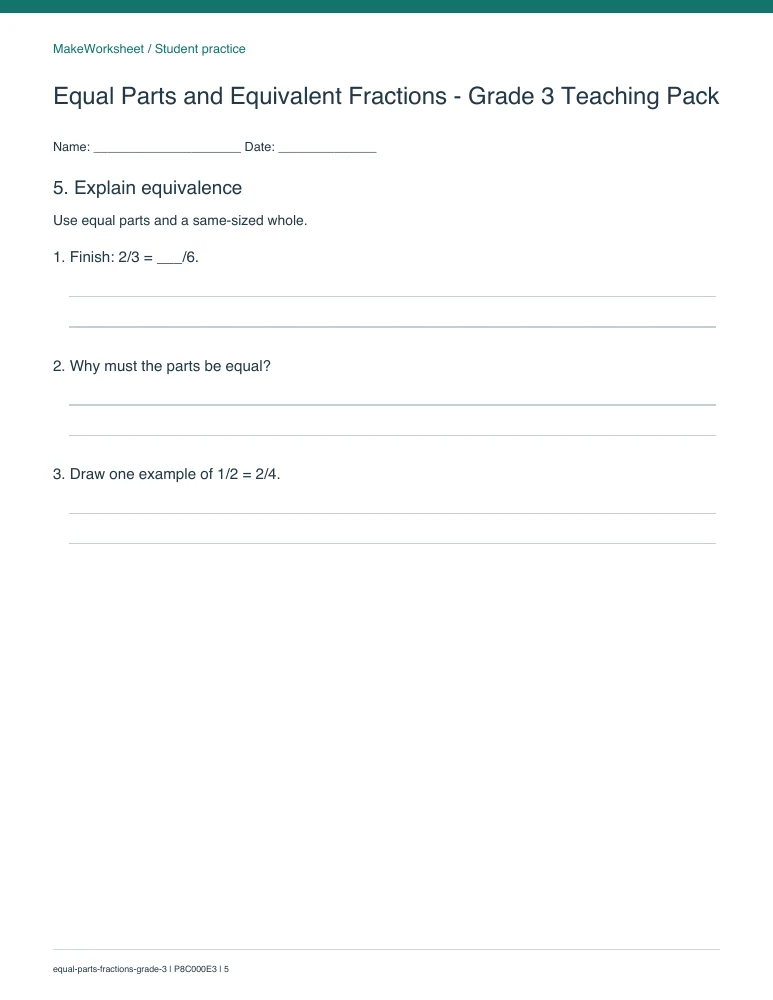
5. Explain equivalence

Use equal parts and a same-sized whole.

View this actual PDF page and diagramsExplain equivalence - actual student PDF page
  1. Finish: 2/3 = ___/6.
  2. Why must the parts be equal?
  3. Draw one example of 1/2 = 2/4.
Show answers and response criteria
  1. 4
  2. The denominator counts equal shares; unequal shares do not define that fraction.
  3. Same-sized wholes, equal partitions, matching shaded area.