Downloads contain the original practice. Use the workbench above for new questions and custom printing.
Teaching guide, sample answers and curriculum references
Before you begin
Identify an explicit feature of each animal in the passage.
How to use this worksheet
- Model the target skill: identify compare and contrast organizational text structure in informational reading. Use the first task as a guided example before asking for an independent response.
- Check readiness first: Identify an explicit feature of each animal in the passage.
- Discuss an incorrect response using this distinction: A comparison must discuss the same feature for both subjects; two unrelated details are not a useful contrast.
A common mistake to discuss
A comparison must discuss the same feature for both subjects; two unrelated details are not a useful contrast.
What to practice next
Compare the animals using one shared category and evidence for each.
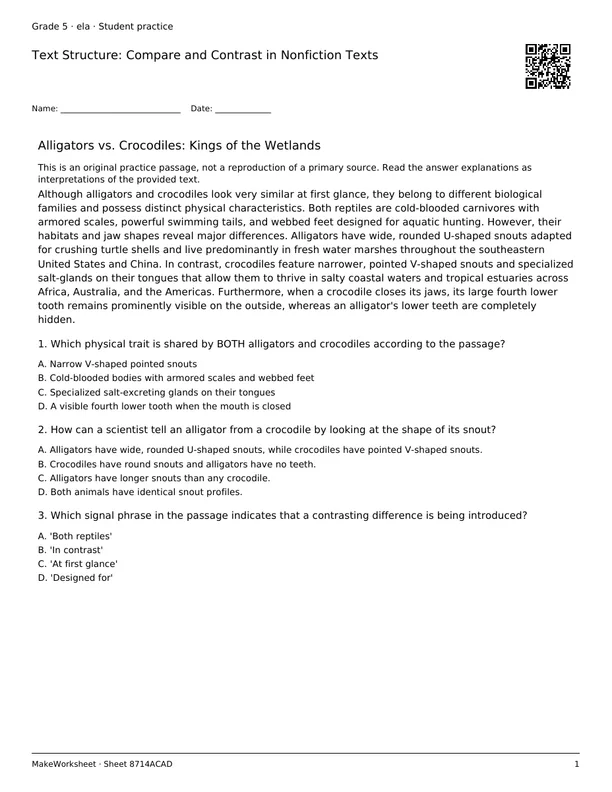
This is an original practice passage, not a reproduction of a primary source. Read the answer explanations as interpretations of the provided text.
Read the practice passage: Alligators vs. Crocodiles: Kings of the Wetlands
Although alligators and crocodiles look very similar at first glance, they belong to different biological families and possess distinct physical characteristics. Both reptiles are cold-blooded carnivores with armored scales, powerful swimming tails, and webbed feet designed for aquatic hunting. However, their habitats and jaw shapes reveal major differences. Alligators have wide, rounded U-shaped snouts adapted for crushing turtle shells and live predominantly in fresh water marshes throughout the southeastern United States and China. In contrast, crocodiles feature narrower, pointed V-shaped snouts and specialized salt-glands on their tongues that allow them to thrive in salty coastal waters and tropical estuaries across Africa, Australia, and the Americas. Furthermore, when a crocodile closes its jaws, its large fourth lower tooth remains prominently visible on the outside, whereas an alligator's lower teeth are completely hidden.
Sample question and answer
Which physical trait is shared by BOTH alligators and crocodiles according to the passage?
- A. Narrow V-shaped pointed snouts
- B. Cold-blooded bodies with armored scales and webbed feet
- C. Specialized salt-excreting glands on their tongues
- D. A visible fourth lower tooth when the mouth is closed
Answer: B. The text states: 'Both reptiles are cold-blooded carnivores with armored scales, powerful swimming tails, and webbed feet.'
Intended curriculum references: CCSS.ELA-LITERACY.RI.5.5. These references describe learning goals; they are not endorsements.
Published 2026-10-02; updated 2026-10-02. Original MakeWorksheet practice. Automated consistency checks support publication; independent subject-specialist review is not recorded. Read our editorial policy.