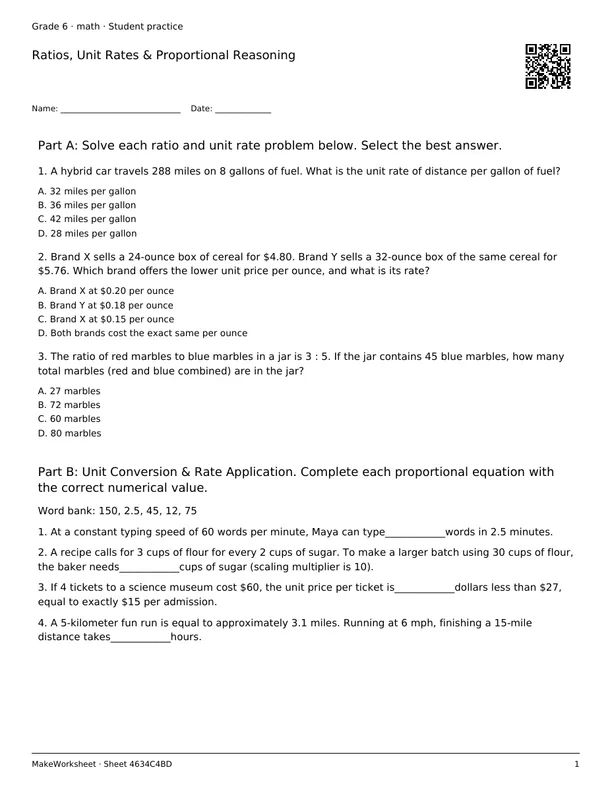
Downloads contain the original practice. Use the workbench above for new questions and custom printing.
Teaching guide, sample answers and curriculum references
Before you begin
Summarize a paragraph without adding outside information.
How to use this worksheet
- Model the target skill: determine a central idea of an informational text and explain how it is conveyed through particular details. Use the first task as a guided example before asking for an independent response.
- Check readiness first: Summarize a paragraph without adding outside information.
- Discuss an incorrect response using this distinction: The discovery of a hydrothermal vent is a detail; the central idea needs to explain the broader point about these ecosystems.
A common mistake to discuss
The discovery of a hydrothermal vent is a detail; the central idea needs to explain the broader point about these ecosystems.
What to practice next
Write a central-idea sentence and connect two pieces of evidence to it.
This is an original practice passage, not a reproduction of a primary source. Read the answer explanations as interpretations of the provided text.
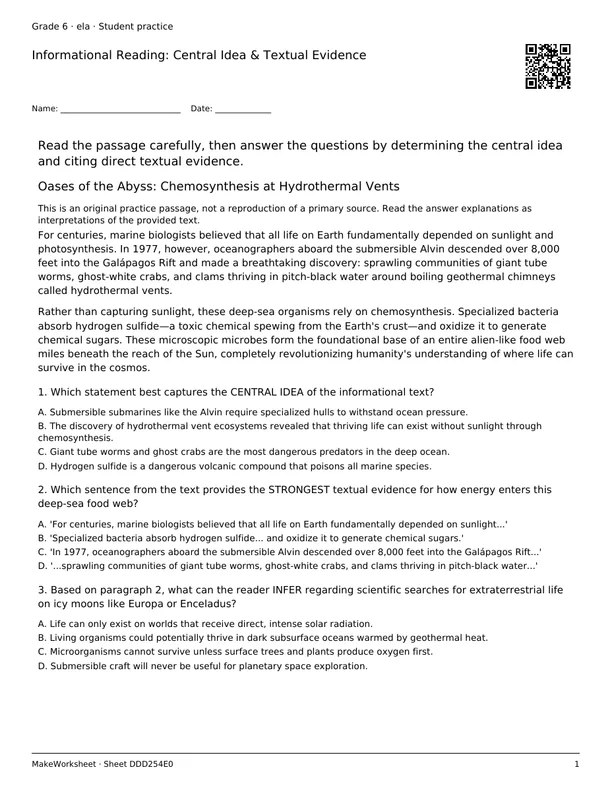
Read the practice passage: Oases of the Abyss: Chemosynthesis at Hydrothermal Vents
For centuries, marine biologists believed that all life on Earth fundamentally depended on sunlight and photosynthesis. In 1977, however, oceanographers aboard the submersible Alvin descended over 8,000 feet into the Galápagos Rift and made a breathtaking discovery: sprawling communities of giant tube worms, ghost-white crabs, and clams thriving in pitch-black water around boiling geothermal chimneys called hydrothermal vents.
Rather than capturing sunlight, these deep-sea organisms rely on chemosynthesis. Specialized bacteria absorb hydrogen sulfide—a toxic chemical spewing from the Earth's crust—and oxidize it to generate chemical sugars. These microscopic microbes form the foundational base of an entire alien-like food web miles beneath the reach of the Sun, completely revolutionizing humanity's understanding of where life can survive in the cosmos.
Sample question and answer
Which statement best captures the CENTRAL IDEA of the informational text?
- A. Submersible submarines like the Alvin require specialized hulls to withstand ocean pressure.
- B. The discovery of hydrothermal vent ecosystems revealed that thriving life can exist without sunlight through chemosynthesis.
- C. Giant tube worms and ghost crabs are the most dangerous predators in the deep ocean.
- D. Hydrogen sulfide is a dangerous volcanic compound that poisons all marine species.
Answer: B. The entire passage centers on the landmark 1977 discovery that revolutionized biology by demonstrating life powered by chemical synthesis rather than sunlight.
Intended curriculum references: CCSS.ELA-LITERACY.RI.6.1 · CCSS.ELA-LITERACY.RI.6.2. These references describe learning goals; they are not endorsements.
Published 2026-10-02; updated 2026-10-02. Original MakeWorksheet practice. Automated consistency checks support publication; independent subject-specialist review is not recorded. Read our editorial policy.