Downloads contain the original practice. Use the workbench above for new questions and custom printing.
Teaching guide, sample answers and curriculum references
Before you begin
Recognize an event and describe what happens before or after it.
How to use this worksheet
- Model the target skill: analyze cause-and-effect relationships in scientific informational texts. Use the first task as a guided example before asking for an independent response.
- Check readiness first: Recognize an event and describe what happens before or after it.
- Discuss an incorrect response using this distinction: An event occurring afterward is not automatically caused by the earlier event.
A common mistake to discuss
An event occurring afterward is not automatically caused by the earlier event.
What to practice next
Draw a cause-to-effect chain supported by the earthquake passage.
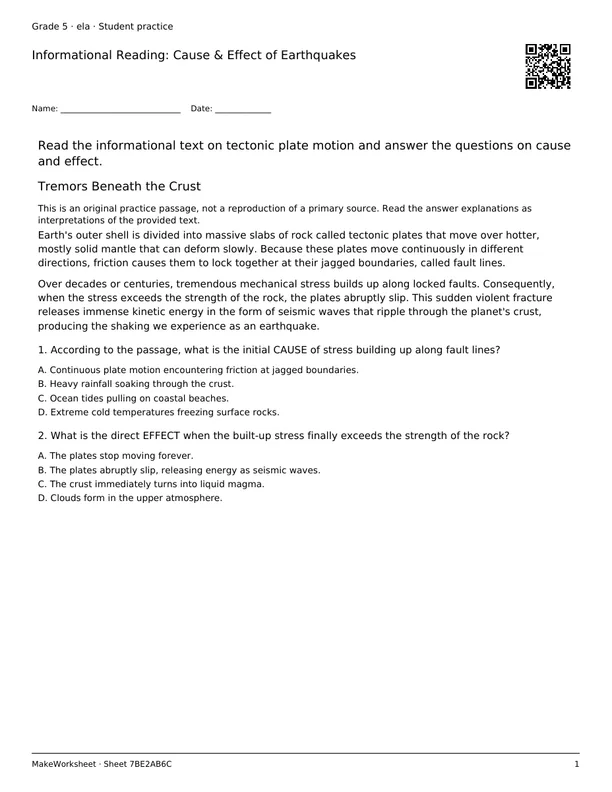
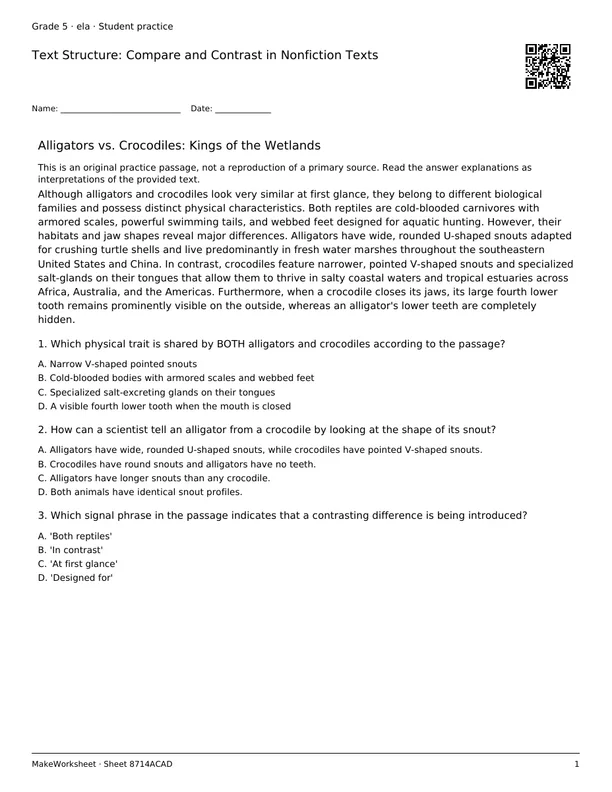
This is an original practice passage, not a reproduction of a primary source. Read the answer explanations as interpretations of the provided text.
Read the practice passage: Tremors Beneath the Crust
Earth's outer shell is divided into massive slabs of rock called tectonic plates that move over hotter, mostly solid mantle that can deform slowly. Because these plates move continuously in different directions, friction causes them to lock together at their jagged boundaries, called fault lines.
Over decades or centuries, tremendous mechanical stress builds up along locked faults. Consequently, when the stress exceeds the strength of the rock, the plates abruptly slip. This sudden violent fracture releases immense kinetic energy in the form of seismic waves that ripple through the planet's crust, producing the shaking we experience as an earthquake.
Sample question and answer
According to the passage, what is the initial CAUSE of stress building up along fault lines?
- A. Continuous plate motion encountering friction at jagged boundaries.
- B. Heavy rainfall soaking through the crust.
- C. Ocean tides pulling on coastal beaches.
- D. Extreme cold temperatures freezing surface rocks.
Answer: A. Paragraph 1 explicitly explains: 'Because these plates move continuously in different directions, friction causes them to lock together at their jagged boundaries... stress builds up.'
Intended curriculum references: CCSS.ELA-LITERACY.RI.5.5. These references describe learning goals; they are not endorsements.
Published 2026-10-02; updated 2026-10-02. Original MakeWorksheet practice. Automated consistency checks support publication; independent subject-specialist review is not recorded. Read our editorial policy.