Downloads contain the original practice. Use the workbench above for new questions and custom printing.
Teaching guide, sample answers and curriculum references
Before you begin
Identify literal meaning before interpreting imagery and figurative language.
How to use this worksheet
- Model the target skill: determine the meaning of words and phrases as they are used in a text, including figurative and connotative meanings. Use the first task as a guided example before asking for an independent response.
- Check readiness first: Identify literal meaning before interpreting imagery and figurative language.
- Discuss an incorrect response using this distinction: Naming a metaphor does not explain its effect; connect the comparison to mood or meaning in the scene.
A common mistake to discuss
Naming a metaphor does not explain its effect; connect the comparison to mood or meaning in the scene.
What to practice next
Explain how replacing one image would change the passage's tone.
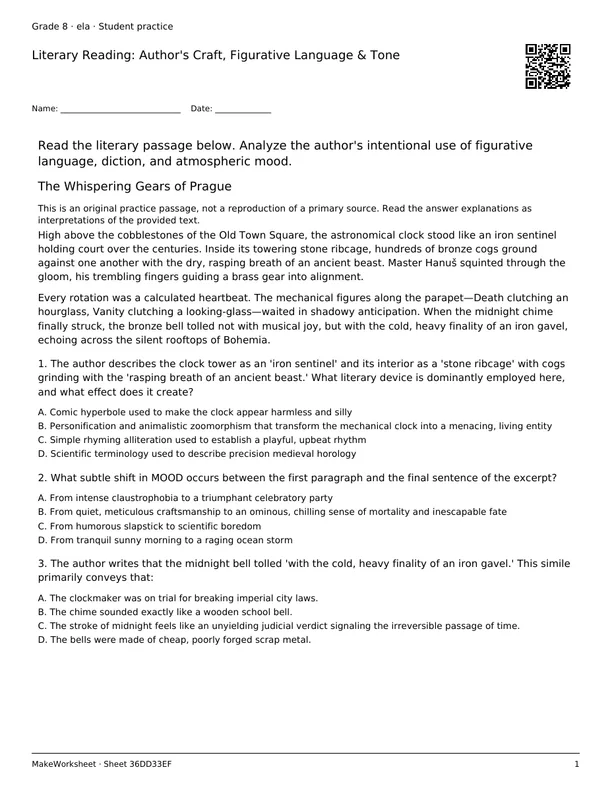
This is an original practice passage, not a reproduction of a primary source. Read the answer explanations as interpretations of the provided text.
Read the practice passage: The Whispering Gears of Prague
High above the cobblestones of the Old Town Square, the astronomical clock stood like an iron sentinel holding court over the centuries. Inside its towering stone ribcage, hundreds of bronze cogs ground against one another with the dry, rasping breath of an ancient beast. Master Hanuš squinted through the gloom, his trembling fingers guiding a brass gear into alignment.
Every rotation was a calculated heartbeat. The mechanical figures along the parapet—Death clutching an hourglass, Vanity clutching a looking-glass—waited in shadowy anticipation. When the midnight chime finally struck, the bronze bell tolled not with musical joy, but with the cold, heavy finality of an iron gavel, echoing across the silent rooftops of Bohemia.
Sample question and answer
The author describes the clock tower as an 'iron sentinel' and its interior as a 'stone ribcage' with cogs grinding with the 'rasping breath of an ancient beast.' What literary device is dominantly employed here, and what effect does it create?
- A. Comic hyperbole used to make the clock appear harmless and silly
- B. Personification and animalistic zoomorphism that transform the mechanical clock into a menacing, living entity
- C. Simple rhyming alliteration used to establish a playful, upbeat rhythm
- D. Scientific terminology used to describe precision medieval horology
Answer: B. Describing the clock using biological anatomy ('ribcage', 'rasping breath', 'heartbeat', 'sentinel') personifies the machine as an imposing, living creature.
Intended curriculum references: CCSS.ELA-LITERACY.RL.8.4. These references describe learning goals; they are not endorsements.
Published 2026-10-02; updated 2026-10-02. Original MakeWorksheet practice. Automated consistency checks support publication; independent subject-specialist review is not recorded. Read our editorial policy.