Downloads contain the original practice. Use the workbench above for new questions and custom printing.
Teaching guide, sample answers and curriculum references
Before you begin
Distinguish an author's claim, a reason and evidence offered for that reason.
How to use this worksheet
- Model the target skill: trace and evaluate the argument and specific claims in a text, assessing whether the reasoning is sound. Use the first task as a guided example before asking for an independent response.
- Check readiness first: Distinguish an author's claim, a reason and evidence offered for that reason.
- Discuss an incorrect response using this distinction: A statistic in a passage is not automatically credible. This practice survey is invented; identify what would need independent verification.
A common mistake to discuss
A statistic in a passage is not automatically credible. This practice survey is invented; identify what would need independent verification.
What to practice next
Explain what source, methods and comparison data would be needed to evaluate the claimed benefit.
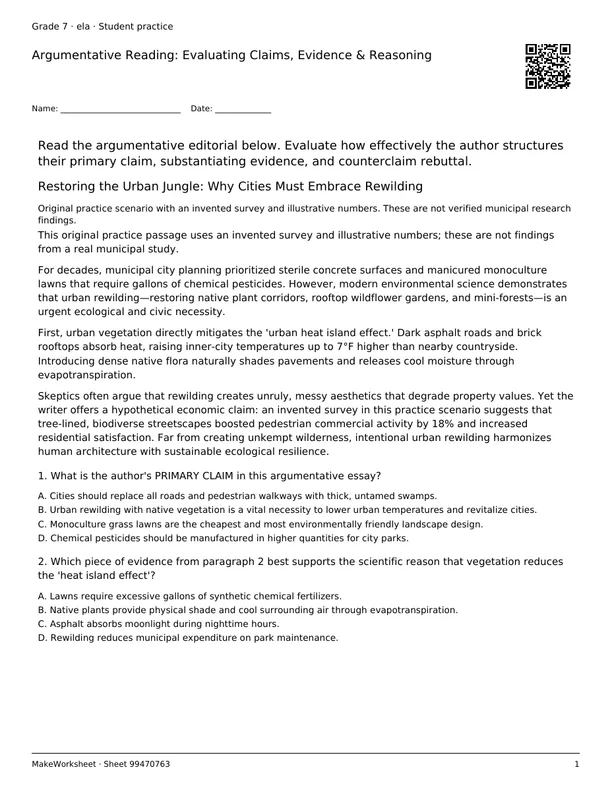
Original practice scenario with an invented survey and illustrative numbers. These are not verified municipal research findings.
Read the practice passage: Restoring the Urban Jungle: Why Cities Must Embrace Rewilding
This original practice passage uses an invented survey and illustrative numbers; these are not findings from a real municipal study.
For decades, municipal city planning prioritized sterile concrete surfaces and manicured monoculture lawns that require gallons of chemical pesticides. However, modern environmental science demonstrates that urban rewilding—restoring native plant corridors, rooftop wildflower gardens, and mini-forests—is an urgent ecological and civic necessity.
First, urban vegetation directly mitigates the 'urban heat island effect.' Dark asphalt roads and brick rooftops absorb heat, raising inner-city temperatures up to 7°F higher than nearby countryside. Introducing dense native flora naturally shades pavements and releases cool moisture through evapotranspiration.
Skeptics often argue that rewilding creates unruly, messy aesthetics that degrade property values. Yet the writer offers a hypothetical economic claim: an invented survey in this practice scenario suggests that tree-lined, biodiverse streetscapes boosted pedestrian commercial activity by 18% and increased residential satisfaction. Far from creating unkempt wilderness, intentional urban rewilding harmonizes human architecture with sustainable ecological resilience.
Sample question and answer
What is the author's PRIMARY CLAIM in this argumentative essay?
- A. Cities should replace all roads and pedestrian walkways with thick, untamed swamps.
- B. Urban rewilding with native vegetation is a vital necessity to lower urban temperatures and revitalize cities.
- C. Monoculture grass lawns are the cheapest and most environmentally friendly landscape design.
- D. Chemical pesticides should be manufactured in higher quantities for city parks.
Answer: B. The author clearly states their thesis in paragraph 1: 'urban rewilding—restoring native plant corridors... is an urgent ecological and civic necessity.'
Intended curriculum references: CCSS.ELA-LITERACY.RI.7.8. These references describe learning goals; they are not endorsements.
Published 2026-10-02; updated 2026-10-02. Original MakeWorksheet practice. Automated consistency checks support publication; independent subject-specialist review is not recorded. Read our editorial policy.