Downloads contain the original practice. Use the workbench above for new questions and custom printing.
Teaching guide, sample answers and curriculum references
Before you begin
Distinguish a force from an object's motion and recognize balanced forces.
How to use this worksheet
- Model the target skill: apply Newton's First Law (inertia) to explain why objects resist changes to their state of motion. Use the first task as a guided example before asking for an independent response.
- Check readiness first: Distinguish a force from an object's motion and recognize balanced forces.
- Discuss an incorrect response using this distinction: Action and reaction forces act on different objects; they do not cancel as a pair on a single object.
A common mistake to discuss
Action and reaction forces act on different objects; they do not cancel as a pair on a single object.
What to practice next
Draw a force diagram for one object and explain the net force.
Sample question and answer
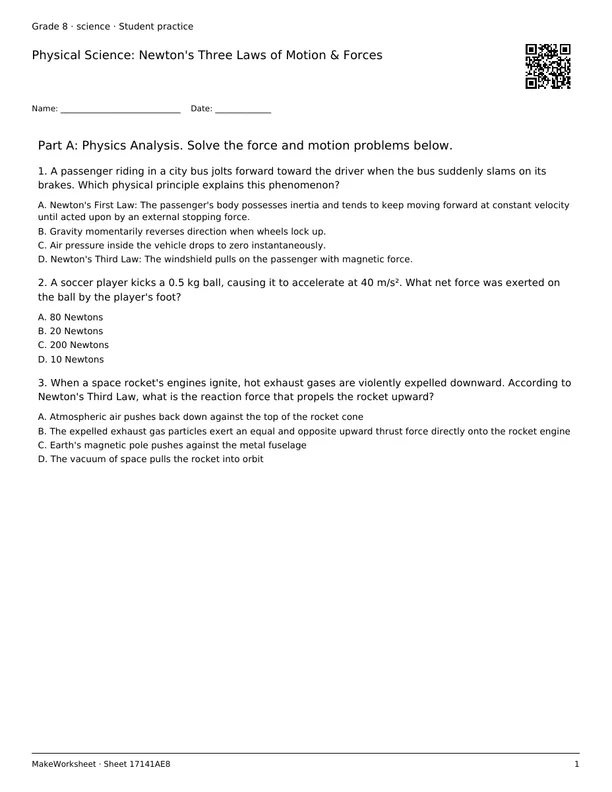
A passenger riding in a city bus jolts forward toward the driver when the bus suddenly slams on its brakes. Which physical principle explains this phenomenon?
- A. Newton's First Law: The passenger's body possesses inertia and tends to keep moving forward at constant velocity until acted upon by an external stopping force.
- B. Gravity momentarily reverses direction when wheels lock up.
- C. Air pressure inside the vehicle drops to zero instantaneously.
- D. Newton's Third Law: The windshield pulls on the passenger with magnetic force.
Answer: A. Newton's First Law states an object in motion remains in motion at constant velocity unless an unbalanced external force acts upon it. The passenger's body continues moving forward due to inertia.
Intended curriculum references: NGSS.MS-PS2-1 · NGSS.MS-PS2-2. These references describe learning goals; they are not endorsements.
Published 2026-10-02; updated 2026-10-02. Original MakeWorksheet practice. Automated consistency checks support publication; independent subject-specialist review is not recorded. Read our editorial policy.