Downloads contain the original practice. Use the workbench above for new questions and custom printing.
Teaching guide, sample answers and curriculum references
Before you begin
Distinguish a claim from the evidence or appeal supporting it.
How to use this worksheet
- Model the target skill: differentiate among ethos (ethical authority), pathos (emotional appeal), and logos (logical reasoning and empirical evidence). Use the first task as a guided example before asking for an independent response.
- Check readiness first: Distinguish a claim from the evidence or appeal supporting it.
- Discuss an incorrect response using this distinction: A speaker's claimed credentials are an appeal to credibility, not independent proof that a conclusion is correct.
A common mistake to discuss
A speaker's claimed credentials are an appeal to credibility, not independent proof that a conclusion is correct.
What to practice next
Mark one appeal and explain how it tries to influence the stated audience.
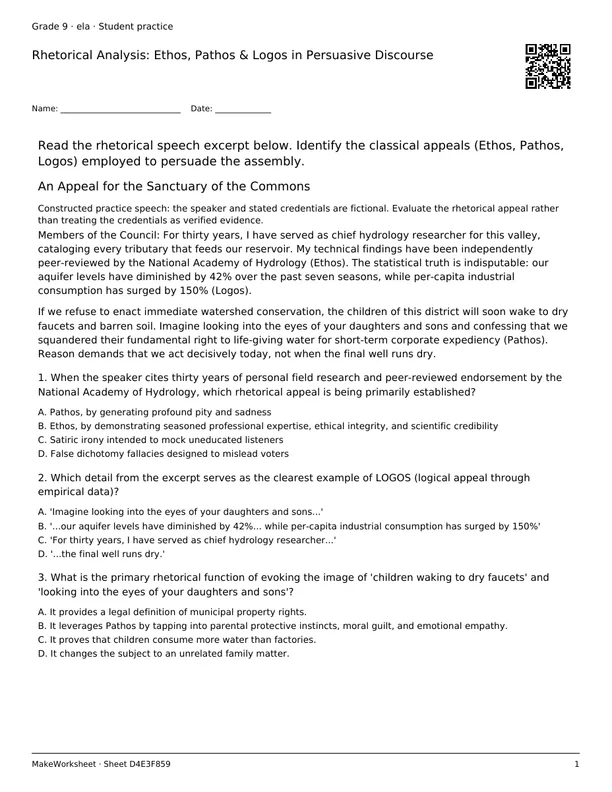
Constructed practice speech: the speaker and stated credentials are fictional. Evaluate the rhetorical appeal rather than treating the credentials as verified evidence.
Read the practice passage: An Appeal for the Sanctuary of the Commons
Members of the Council: For thirty years, I have served as chief hydrology researcher for this valley, cataloging every tributary that feeds our reservoir. My technical findings have been independently peer-reviewed by the National Academy of Hydrology (Ethos). The statistical truth is indisputable: our aquifer levels have diminished by 42% over the past seven seasons, while per-capita industrial consumption has surged by 150% (Logos).
If we refuse to enact immediate watershed conservation, the children of this district will soon wake to dry faucets and barren soil. Imagine looking into the eyes of your daughters and sons and confessing that we squandered their fundamental right to life-giving water for short-term corporate expediency (Pathos). Reason demands that we act decisively today, not when the final well runs dry.
Sample question and answer
When the speaker cites thirty years of personal field research and peer-reviewed endorsement by the National Academy of Hydrology, which rhetorical appeal is being primarily established?
- A. Pathos, by generating profound pity and sadness
- B. Ethos, by demonstrating seasoned professional expertise, ethical integrity, and scientific credibility
- C. Satiric irony intended to mock uneducated listeners
- D. False dichotomy fallacies designed to mislead voters
Answer: B. Ethos appeals to the speaker's credibility, character, and qualification. Highlighting 30 years of research and peer-reviewed standing firmly builds the speaker's authoritative ethos.
Intended curriculum references: CCSS.ELA-LITERACY.RI.9-10.6 · CCSS.ELA-LITERACY.RI.9-10.8. These references describe learning goals; they are not endorsements.
Published 2026-10-02; updated 2026-10-02. Original MakeWorksheet practice. Automated consistency checks support publication; independent subject-specialist review is not recorded. Read our editorial policy.