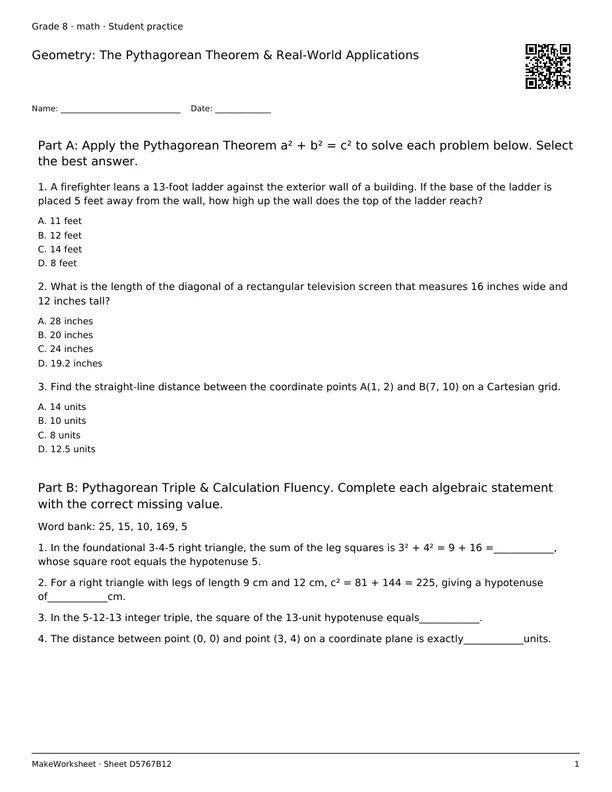
1.A firefighter leans a 13-foot ladder against the exterior wall of a building. If the base of the ladder is placed 5 feet away from the wall, how high up the wall does the top of the ladder reach?
A11 feet
B12 feet
C14 feet
D8 feet
Working
Calculate hypotenuse lengths, missing legs, and distance on coordinate grids using a² + b² = c² with complete step-by-step solutions.
The same content with a different order. No new questions are added. Choose “Save as PDF” in your browser’s print window to keep a copy.
0 practice pages · 0 answer pages. Pages are added automatically when needed. Question content and answer keys stay together.
Grade 8 · math · Matching answer key included · US Letter and A4
Downloads contain the original practice. Use the workbench above for new questions and custom printing.
Identify a right triangle and square and square-root numbers.
The hypotenuse is opposite the right angle; it is not always the side drawn horizontally or the side called x.
Check that a computed side length satisfies the original squared relationship.
A firefighter leans a 13-foot ladder against the exterior wall of a building. If the base of the ladder is placed 5 feet away from the wall, how high up the wall does the top of the ladder reach?
Answer: B. Here the hypotenuse c = 13 ft and one leg a = 5 ft. a² + b² = c² => 5² + b² = 13² => 25 + b² = 169 => b² = 144 => b = √144 = 12 feet.
Intended curriculum references: CCSS.MATH.CONTENT.8.G.B.7 · CCSS.MATH.CONTENT.8.G.B.8. These references describe learning goals; they are not endorsements.
Published 2026-10-02; updated 2026-10-02. Original MakeWorksheet practice. Automated consistency checks support publication; independent subject-specialist review is not recorded. Read our editorial policy.
 Practice preview
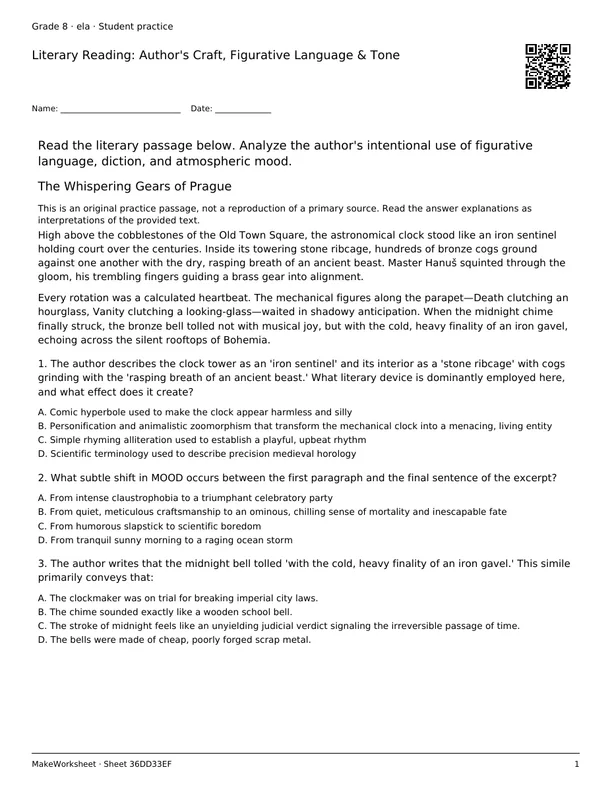
Analyze figurative language, extended metaphors, sensory imagery, and shifts in atmospheric tone in complex narrative fiction.
 Practice preview
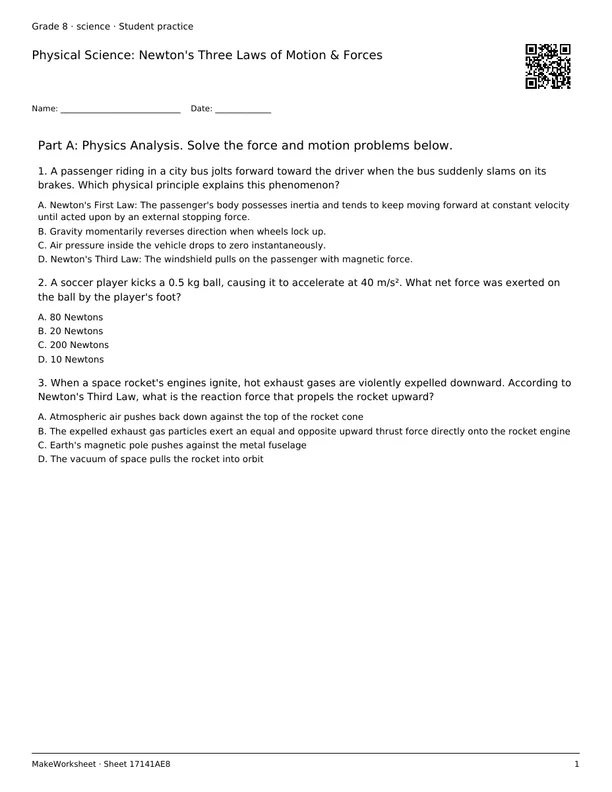
Investigate net force, inertia, acceleration with F = ma, and equal action-reaction force pairs through real-world mechanics scenarios.
 Practice preview
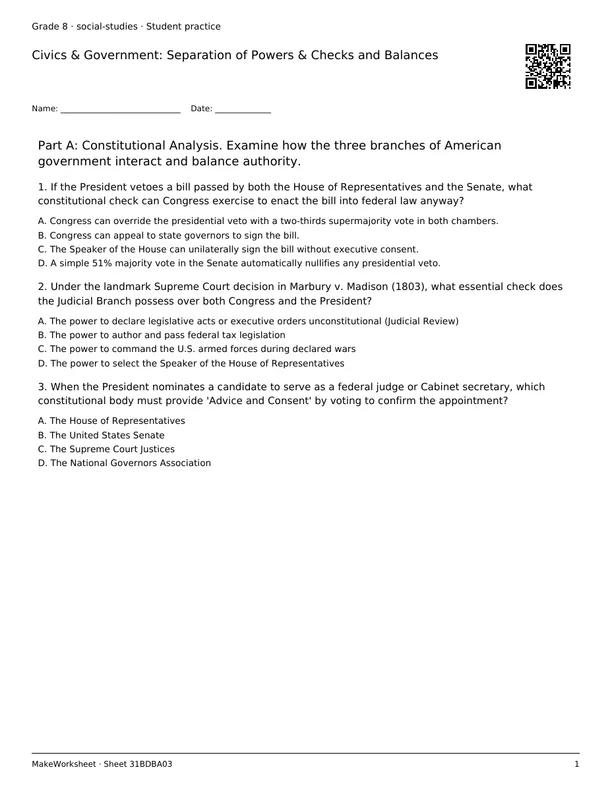
Examine the constitutional framework of American government: Legislative, Executive, and Judicial branches and their reciprocal oversight powers.