Downloads contain the original practice. Use the workbench above for new questions and custom printing.
Teaching guide, sample answers and curriculum references
Before you begin
Name the three branches and identify a basic responsibility of each.
How to use this worksheet
- Model the target skill: distinguish the distinct constitutional powers vested in the Legislative, Executive, and Judicial branches. Use the first task as a guided example before asking for an independent response.
- Check readiness first: Name the three branches and identify a basic responsibility of each.
- Discuss an incorrect response using this distinction: Separation of powers and checks on another branch are related concepts with different functions.
A common mistake to discuss
Separation of powers and checks on another branch are related concepts with different functions.
What to practice next
Describe a check and explain which branches exercise and receive it.
Sample question and answer
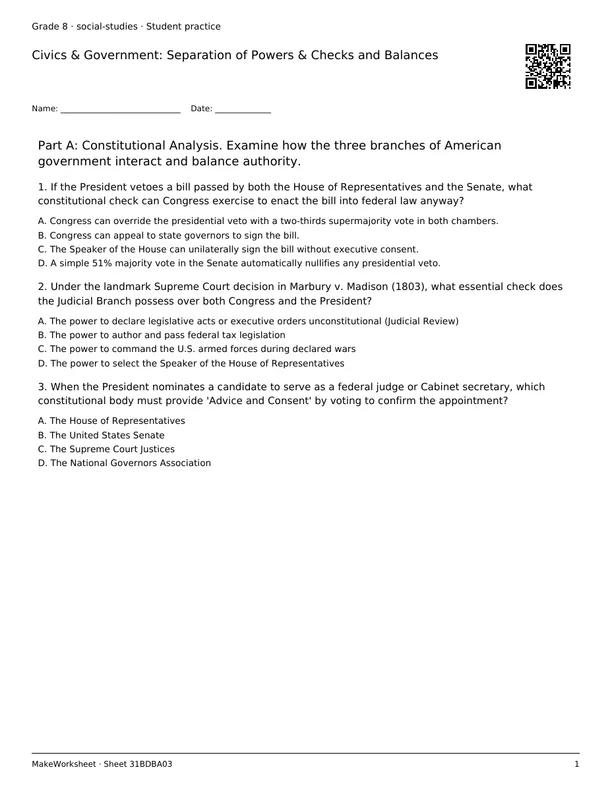
If the President vetoes a bill passed by both the House of Representatives and the Senate, what constitutional check can Congress exercise to enact the bill into federal law anyway?
- A. Congress can override the presidential veto with a two-thirds supermajority vote in both chambers.
- B. Congress can appeal to state governors to sign the bill.
- C. The Speaker of the House can unilaterally sign the bill without executive consent.
- D. A simple 51% majority vote in the Senate automatically nullifies any presidential veto.
Answer: A. Article I, Section 7 of the U.S. Constitution provides that Congress may override an executive veto if two-thirds of both the House and Senate vote in favor.
Intended curriculum references: C3.D2.Civ.1.6-8 · C3.D2.Civ.4.6-8. These references describe learning goals; they are not endorsements.
Published 2026-10-02; updated 2026-10-02. Original MakeWorksheet practice. Automated consistency checks support publication; independent subject-specialist review is not recorded. Read our editorial policy.