Downloads contain the original practice. Use the workbench above for new questions and custom printing.
Teaching guide, sample answers and curriculum references
Before you begin
Understand the dramatic situation and distinguish a character's belief from the narrator's judgment.
How to use this worksheet
- Model the target skill: determine a theme or central idea of a literary text and analyze in detail its development over the course of the text. Use the first task as a guided example before asking for an independent response.
- Check readiness first: Understand the dramatic situation and distinguish a character's belief from the narrator's judgment.
- Discuss an incorrect response using this distinction: A theme is a developed idea about conflict, not a one-word topic such as justice.
A common mistake to discuss
A theme is a developed idea about conflict, not a one-word topic such as justice.
What to practice next
Compare how another character might respond to the same conflict and support the comparison with text.
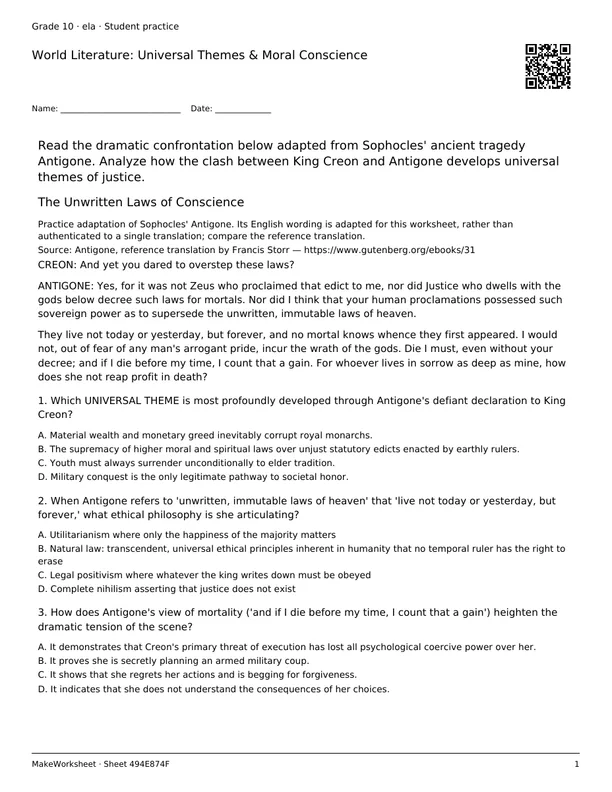
Practice adaptation of Sophocles' Antigone. Its English wording is adapted for this worksheet, rather than authenticated to a single translation; compare the reference translation.
Source reference: Antigone, reference translation by Francis Storr.
Read the practice passage: The Unwritten Laws of Conscience
CREON: And yet you dared to overstep these laws?
ANTIGONE: Yes, for it was not Zeus who proclaimed that edict to me, nor did Justice who dwells with the gods below decree such laws for mortals. Nor did I think that your human proclamations possessed such sovereign power as to supersede the unwritten, immutable laws of heaven.
They live not today or yesterday, but forever, and no mortal knows whence they first appeared. I would not, out of fear of any man's arrogant pride, incur the wrath of the gods. Die I must, even without your decree; and if I die before my time, I count that a gain. For whoever lives in sorrow as deep as mine, how does she not reap profit in death?
Sample question and answer
Which UNIVERSAL THEME is most profoundly developed through Antigone's defiant declaration to King Creon?
- A. Material wealth and monetary greed inevitably corrupt royal monarchs.
- B. The supremacy of higher moral and spiritual laws over unjust statutory edicts enacted by earthly rulers.
- C. Youth must always surrender unconditionally to elder tradition.
- D. Military conquest is the only legitimate pathway to societal honor.
Answer: B. Antigone explicitly contrasts Creon's temporary mortal decree with the eternal, unwritten laws of divine justice, illustrating the universal theme of individual moral conscience resisting state oppression.
Intended curriculum references: CCSS.ELA-LITERACY.RL.9-10.2 · CCSS.ELA-LITERACY.RL.9-10.6. These references describe learning goals; they are not endorsements.
Published 2026-10-02; updated 2026-10-02. Original MakeWorksheet practice. Automated consistency checks support publication; independent subject-specialist review is not recorded. Read our editorial policy.