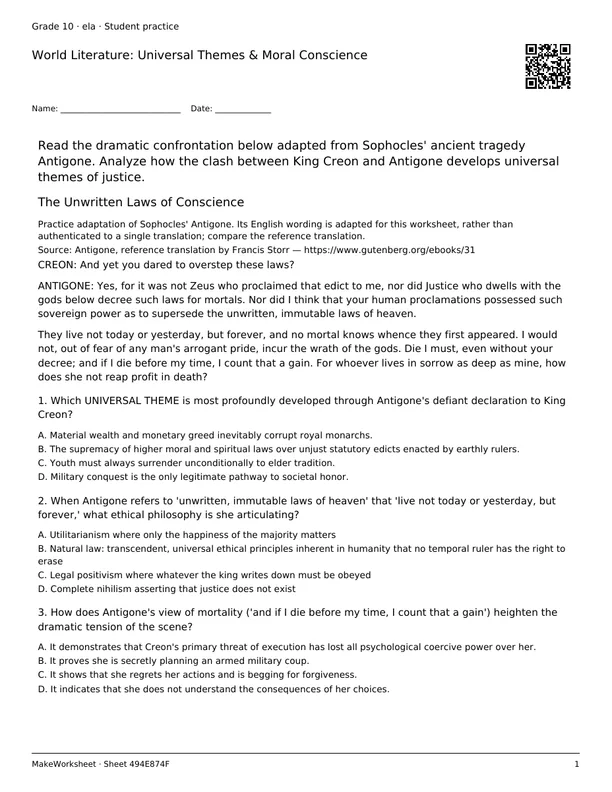
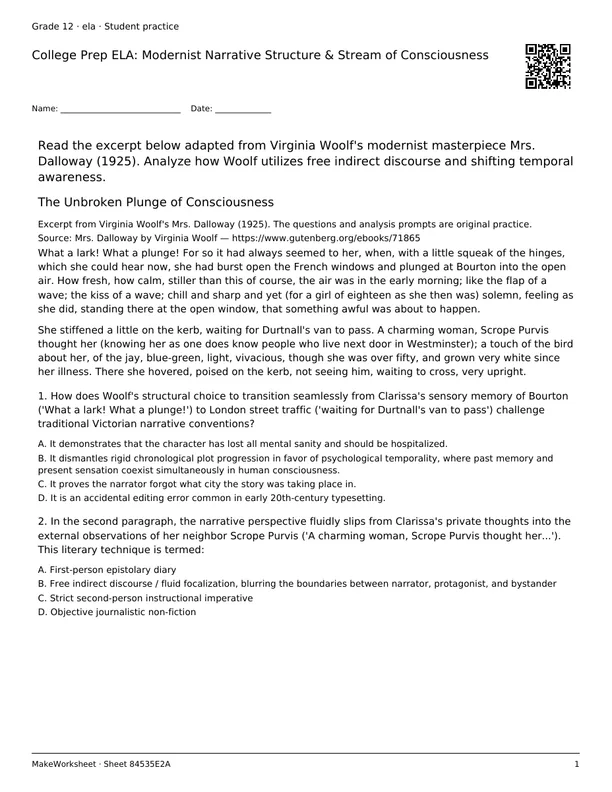
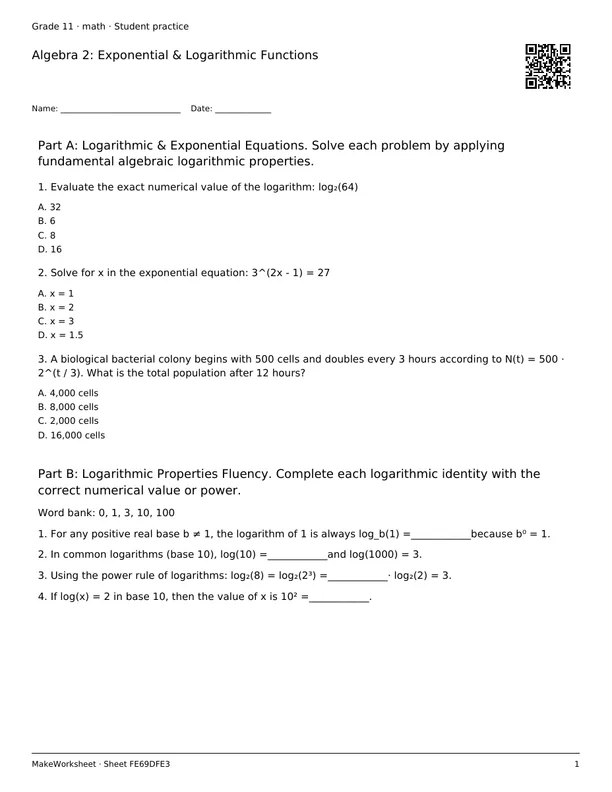
Downloads contain the original practice. Use the workbench above for new questions and custom printing.
Teaching guide, sample answers and curriculum references
Before you begin
Recognize the purpose and historical setting of the 1848 Declaration of Sentiments.
How to use this worksheet
- Model the target skill: analyze foundational 18th- and 19th-century U.S. documents of historical and literary significance for their themes, purposes, and rhetorical features. Use the first task as a guided example before asking for an independent response.
- Check readiness first: Recognize the purpose and historical setting of the 1848 Declaration of Sentiments.
- Discuss an incorrect response using this distinction: Echoing a founding document is a rhetorical choice; it does not mean the two documents make identical demands.
A common mistake to discuss
Echoing a founding document is a rhetorical choice; it does not mean the two documents make identical demands.
What to practice next
Explain how one repeated phrase connects the audience's existing beliefs to a new claim.
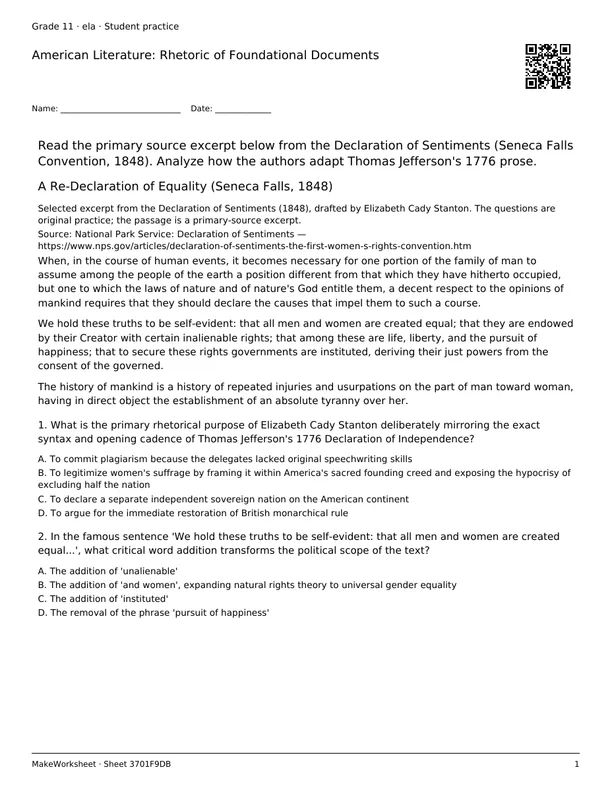
Selected excerpt from the Declaration of Sentiments (1848), drafted by Elizabeth Cady Stanton. The questions are original practice; the passage is a primary-source excerpt.
Source reference: National Park Service: Declaration of Sentiments.
Read the practice passage: A Re-Declaration of Equality (Seneca Falls, 1848)
When, in the course of human events, it becomes necessary for one portion of the family of man to assume among the people of the earth a position different from that which they have hitherto occupied, but one to which the laws of nature and of nature's God entitle them, a decent respect to the opinions of mankind requires that they should declare the causes that impel them to such a course.
We hold these truths to be self-evident: that all men and women are created equal; that they are endowed by their Creator with certain inalienable rights; that among these are life, liberty, and the pursuit of happiness; that to secure these rights governments are instituted, deriving their just powers from the consent of the governed.
The history of mankind is a history of repeated injuries and usurpations on the part of man toward woman, having in direct object the establishment of an absolute tyranny over her.
Sample question and answer
What is the primary rhetorical purpose of Elizabeth Cady Stanton deliberately mirroring the exact syntax and opening cadence of Thomas Jefferson's 1776 Declaration of Independence?
- A. To commit plagiarism because the delegates lacked original speechwriting skills
- B. To legitimize women's suffrage by framing it within America's sacred founding creed and exposing the hypocrisy of excluding half the nation
- C. To declare a separate independent sovereign nation on the American continent
- D. To argue for the immediate restoration of British monarchical rule
Answer: B. By intentionally borrowing Jefferson's revered revolutionary prose, Stanton forces the audience to recognize women's civil rights as an overdue fulfillment of the nation's core founding promises.
Intended curriculum references: CCSS.ELA-LITERACY.RI.11-12.8 · CCSS.ELA-LITERACY.RI.11-12.9. These references describe learning goals; they are not endorsements.
Published 2026-10-02; updated 2026-10-02. Original MakeWorksheet practice. Automated consistency checks support publication; independent subject-specialist review is not recorded. Read our editorial policy.