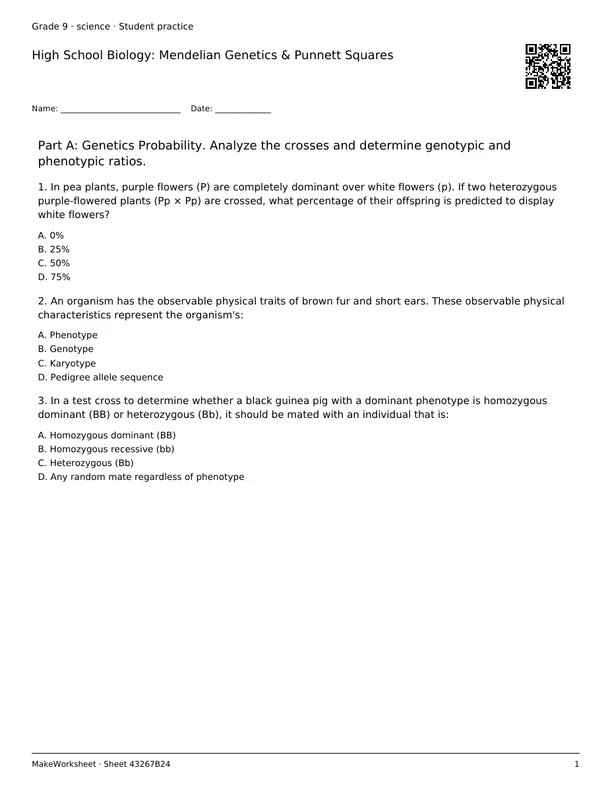
1.In pea plants, purple flowers (P) are completely dominant over white flowers (p). If two heterozygous purple-flowered plants (Pp × Pp) are crossed, what percentage of their offspring is predicted to display white flowers?
A0%
B25%
C50%
D75%
Calculate phenotypic and genotypic probabilities, analyze monohybrid and dihybrid crosses, and apply Mendel's laws of inheritance with diagrams.
The same content with a different order. No new questions are added. Choose “Save as PDF” in your browser’s print window to keep a copy.
0 practice pages · 0 answer pages. Pages are added automatically when needed. Question content and answer keys stay together.
Grade 9 · science · Matching answer key included · US Letter and A4
Downloads contain the original practice. Use the workbench above for new questions and custom printing.
Identify alleles and distinguish genotype from phenotype in a simple inheritance model.
A Punnett square gives possible outcomes and probabilities, not a guaranteed sequence of children.
Explain a probability using the parental allele combinations in the square.
In pea plants, purple flowers (P) are completely dominant over white flowers (p). If two heterozygous purple-flowered plants (Pp × Pp) are crossed, what percentage of their offspring is predicted to display white flowers?
Answer: B. A Pp × Pp Punnett square produces: 1 PP (purple), 2 Pp (purple), 1 pp (white). The homozygous recessive pp genotype represents 1 out of 4 (25%) of offspring.
Intended curriculum references: NGSS.HS-LS3-2 · NGSS.HS-LS3-3. These references describe learning goals; they are not endorsements.
Published 2026-10-02; updated 2026-10-02. Original MakeWorksheet practice. Automated consistency checks support publication; independent subject-specialist review is not recorded. Read our editorial policy.
 Practice preview
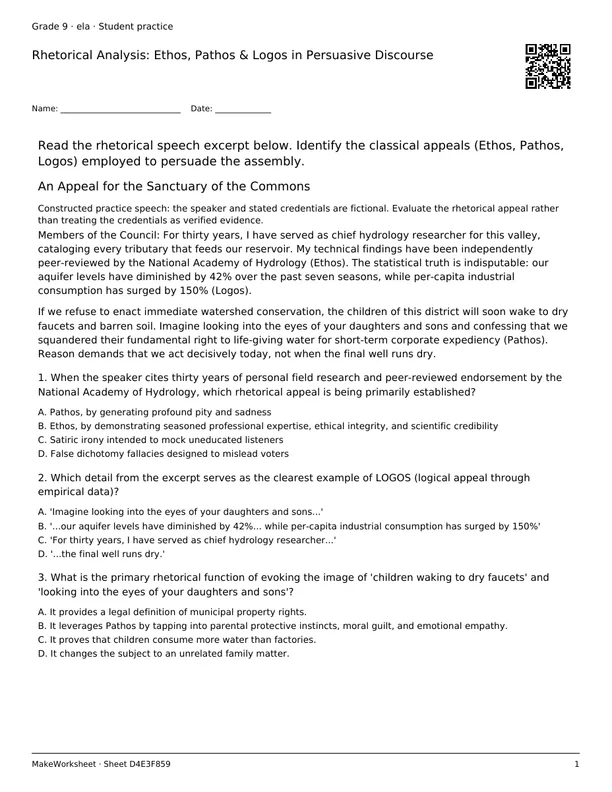
Deconstruct classical Aristotelian rhetorical appeals in historical speeches and analyze how speakers establish credibility, logic, and emotion.
 Practice preview
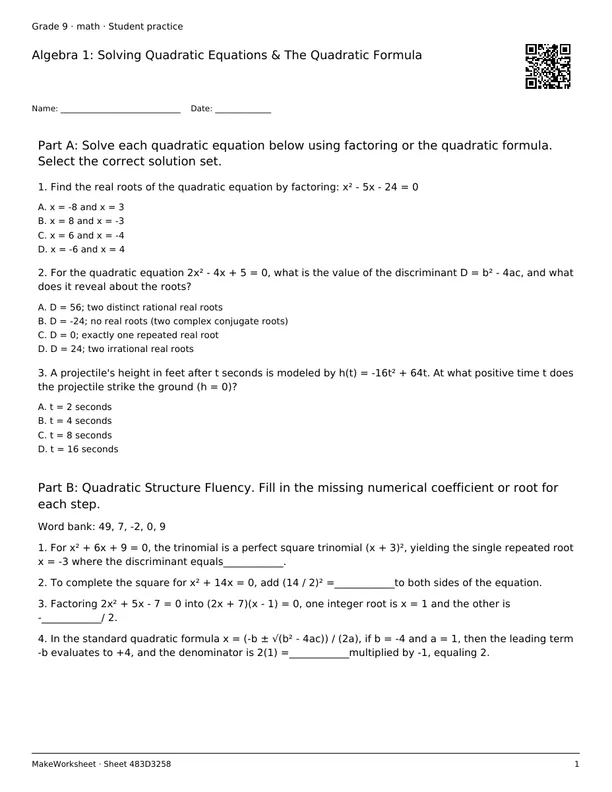
Master factoring trinomials, evaluating the discriminant, and applying the quadratic formula with complete worked step-by-step solutions.
 Practice preview
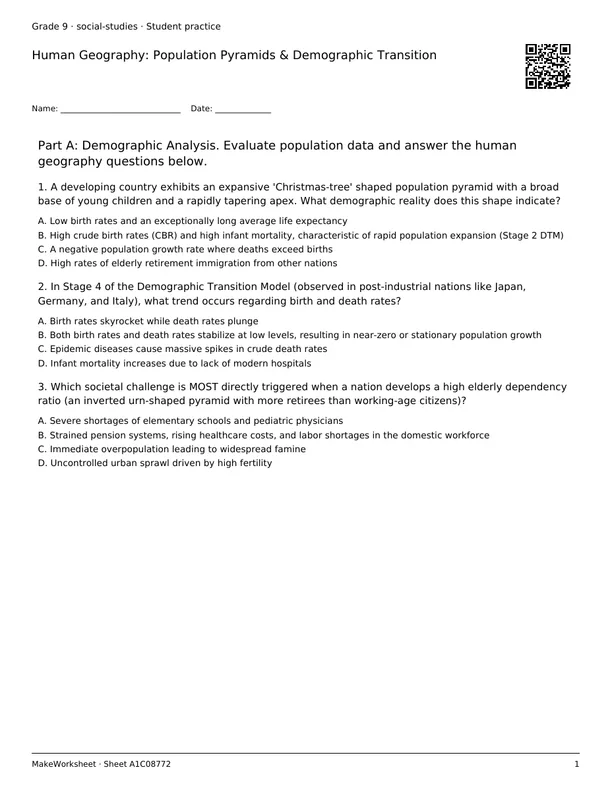
Analyze age-sex population pyramids, birth and death rates, dependency ratios, and the five stages of the Demographic Transition Model (DTM).