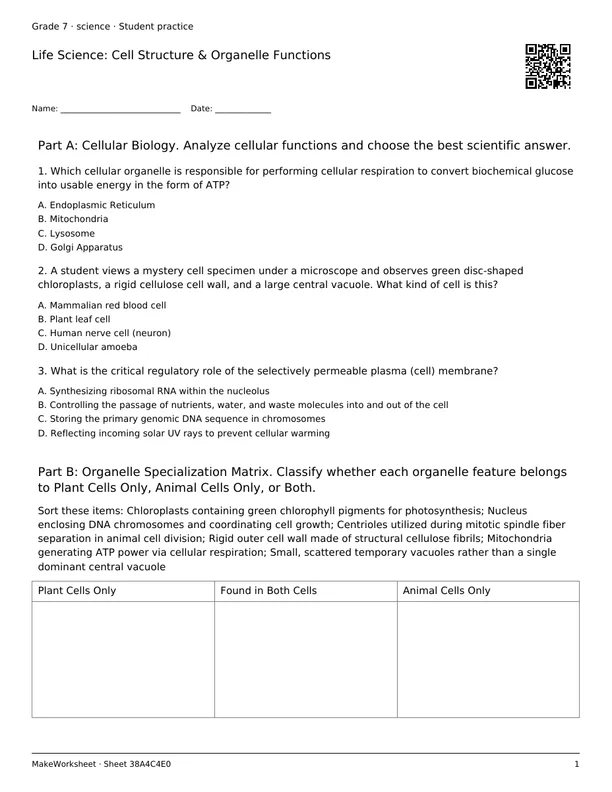
1.Which cellular organelle is responsible for performing cellular respiration to convert biochemical glucose into usable energy in the form of ATP?
AEndoplasmic Reticulum
BMitochondria
CLysosome
DGolgi Apparatus
Investigate eukaryotic cell anatomy. Compare plant and animal organelles including mitochondria, chloroplasts, nucleus, and ribosomes with diagrams.
The same content with a different order. No new questions are added. Choose “Save as PDF” in your browser’s print window to keep a copy.
0 practice pages · 0 answer pages. Pages are added automatically when needed. Question content and answer keys stay together.
Grade 7 · science · Matching answer key included · US Letter and A4
Downloads contain the original practice. Use the workbench above for new questions and custom printing.
Distinguish a cell from a whole organism and identify a labeled cell model.
Plant cells also have mitochondria; organelles are not all unique to one cell type.
Compare two cell diagrams and justify an organelle's role rather than memorizing its position.
Which cellular organelle is responsible for performing cellular respiration to convert biochemical glucose into usable energy in the form of ATP?
Answer: B. Mitochondria are often called the powerhouses of eukaryotic cells because they perform aerobic respiration, generating ATP energy for cellular metabolic activities.
Intended curriculum references: NGSS.MS-LS1-2. These references describe learning goals; they are not endorsements.
Published 2026-10-02; updated 2026-10-02. Original MakeWorksheet practice. Automated consistency checks support publication; independent subject-specialist review is not recorded. Read our editorial policy.
 Practice preview
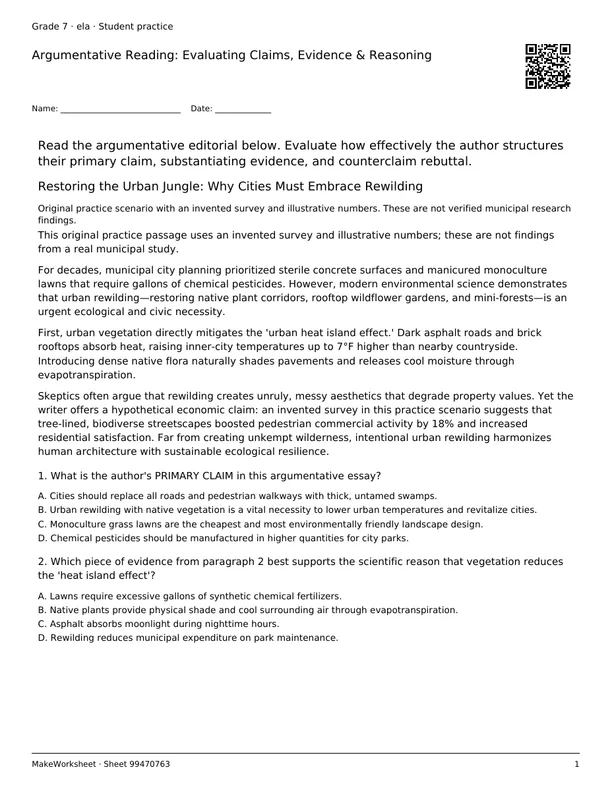
Trace and evaluate an author's argument. Distinguish sound reasoning and credible empirical evidence from unsupported rhetorical claims.
 Practice preview
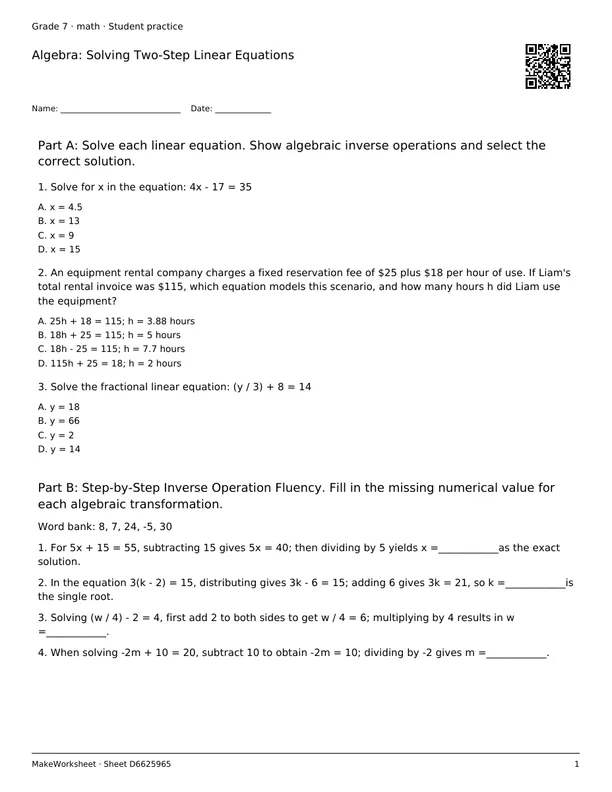
Master inverse operations, isolate unknown variables, and solve multi-step linear equations in real-world word contexts with full answer key.
 Practice preview
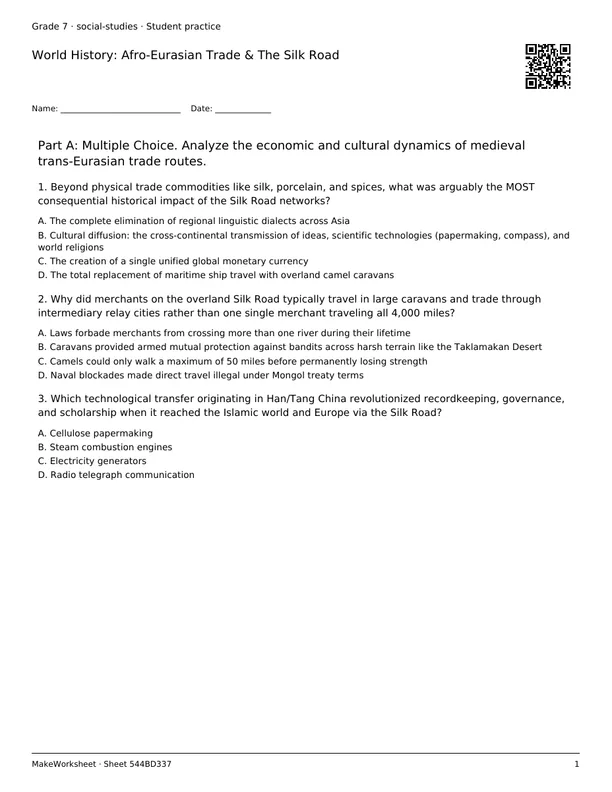
Examine the trans-Eurasian trade routes connecting China, Central Asia, the Middle East, and Europe. Explore cultural diffusion, technology, and economic exchange.