Downloads contain the original practice. Use the workbench above for new questions and custom printing.
Teaching guide, sample answers and curriculum references
Before you begin
Distinguish narrator, character viewpoint and the time of an event.
How to use this worksheet
- Model the target skill: analyze how an author's choices concerning how to structure specific parts of a text contribute to its overall structure and meaning as well as its aesthetic impact. Use the first task as a guided example before asking for an independent response.
- Check readiness first: Distinguish narrator, character viewpoint and the time of an event.
- Discuss an incorrect response using this distinction: A shift into memory changes narrative time without necessarily changing the setting of the present action.
A common mistake to discuss
A shift into memory changes narrative time without necessarily changing the setting of the present action.
What to practice next
Write a claim about one shift in consciousness and support it with a short quotation.
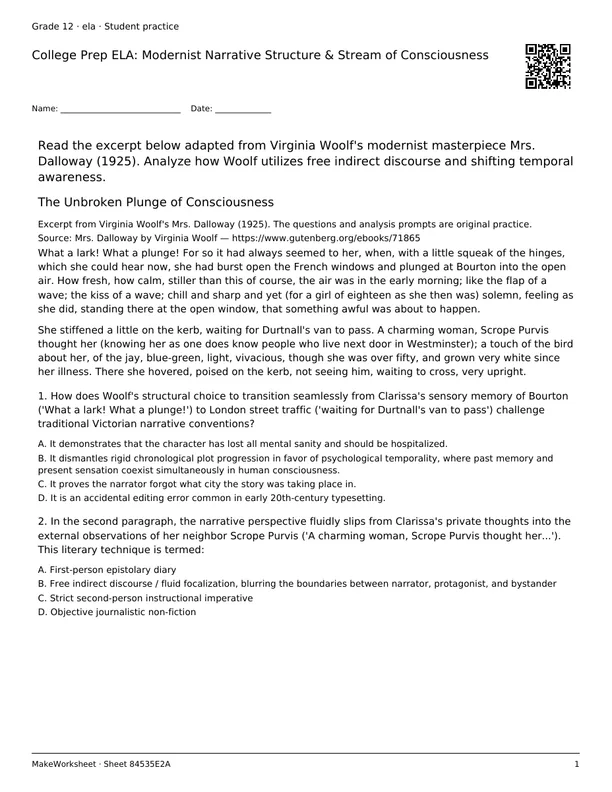
Excerpt from Virginia Woolf's Mrs. Dalloway (1925). The questions and analysis prompts are original practice.
Source reference: Mrs. Dalloway by Virginia Woolf.
Read the practice passage: The Unbroken Plunge of Consciousness
What a lark! What a plunge! For so it had always seemed to her, when, with a little squeak of the hinges, which she could hear now, she had burst open the French windows and plunged at Bourton into the open air. How fresh, how calm, stiller than this of course, the air was in the early morning; like the flap of a wave; the kiss of a wave; chill and sharp and yet (for a girl of eighteen as she then was) solemn, feeling as she did, standing there at the open window, that something awful was about to happen.
She stiffened a little on the kerb, waiting for Durtnall's van to pass. A charming woman, Scrope Purvis thought her (knowing her as one does know people who live next door in Westminster); a touch of the bird about her, of the jay, blue-green, light, vivacious, though she was over fifty, and grown very white since her illness. There she hovered, poised on the kerb, not seeing him, waiting to cross, very upright.
Sample question and answer
How does Woolf's structural choice to transition seamlessly from Clarissa's sensory memory of Bourton ('What a lark! What a plunge!') to London street traffic ('waiting for Durtnall's van to pass') challenge traditional Victorian narrative conventions?
- A. It demonstrates that the character has lost all mental sanity and should be hospitalized.
- B. It dismantles rigid chronological plot progression in favor of psychological temporality, where past memory and present sensation coexist simultaneously in human consciousness.
- C. It proves the narrator forgot what city the story was taking place in.
- D. It is an accidental editing error common in early 20th-century typesetting.
Answer: B. Modernist literature subverts linear chronological time by mimicking the natural fluidity of the human mind, blending vivid sensory memories with immediate physical reality.
Intended curriculum references: CCSS.ELA-LITERACY.RL.11-12.1 · CCSS.ELA-LITERACY.RL.11-12.5. These references describe learning goals; they are not endorsements.
Published 2026-10-02; updated 2026-10-02. Original MakeWorksheet practice. Automated consistency checks support publication; independent subject-specialist review is not recorded. Read our editorial policy.