Downloads contain the original practice. Use the workbench above for new questions and custom printing.
Teaching guide, sample answers and curriculum references
Before you begin
Identify reactants and products in a simplified chemical process.
How to use this worksheet
- Model the target skill: construct and revise an explanation based on evidence for how carbon, hydrogen, and oxygen from sugar molecules combine with other elements to form amino acids and other large carbon-based molecules. Use the first task as a guided example before asking for an independent response.
- Check readiness first: Identify reactants and products in a simplified chemical process.
- Discuss an incorrect response using this distinction: Plants also carry out cellular respiration; photosynthesis does not replace it.
A common mistake to discuss
Plants also carry out cellular respiration; photosynthesis does not replace it.
What to practice next
Compare where energy enters or leaves each process using labeled inputs and outputs.
Sample question and answer
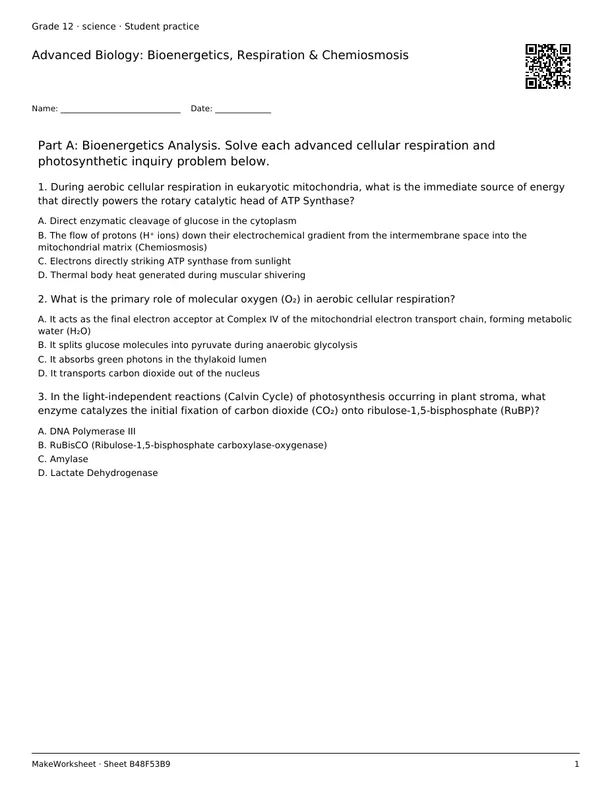
During aerobic cellular respiration in eukaryotic mitochondria, what is the immediate source of energy that directly powers the rotary catalytic head of ATP Synthase?
- A. Direct enzymatic cleavage of glucose in the cytoplasm
- B. The flow of protons (H⁺ ions) down their electrochemical gradient from the intermembrane space into the mitochondrial matrix (Chemiosmosis)
- C. Electrons directly striking ATP synthase from sunlight
- D. Thermal body heat generated during muscular shivering
Answer: B. Peter Mitchell's chemiosmotic hypothesis demonstrated that the electron transport chain pumps H⁺ ions into the intermembrane space; their exergonic diffusion back through ATP synthase generates ATP from ADP and Pi.
Intended curriculum references: NGSS.HS-LS1-5 · NGSS.HS-LS1-7. These references describe learning goals; they are not endorsements.
Published 2026-10-02; updated 2026-10-02. Original MakeWorksheet practice. Automated consistency checks support publication; independent subject-specialist review is not recorded. Read our editorial policy.