Downloads contain the original practice. Use the workbench above for new questions and custom printing.
Teaching guide, sample answers and curriculum references
Before you begin
Distinguish government spending and taxation from central-bank interest-rate tools.
How to use this worksheet
- Model the target skill: distinguish between fiscal policy managed by Congress/the President and monetary policy managed by the Federal Reserve. Use the first task as a guided example before asking for an independent response.
- Check readiness first: Distinguish government spending and taxation from central-bank interest-rate tools.
- Discuss an incorrect response using this distinction: Fiscal policy is not a central bank's monetary policy; identify the decision-maker as well as the tool.
A common mistake to discuss
Fiscal policy is not a central bank's monetary policy; identify the decision-maker as well as the tool.
What to practice next
Compare how two policy tools might affect aggregate demand under the stated conditions.
Sample question and answer
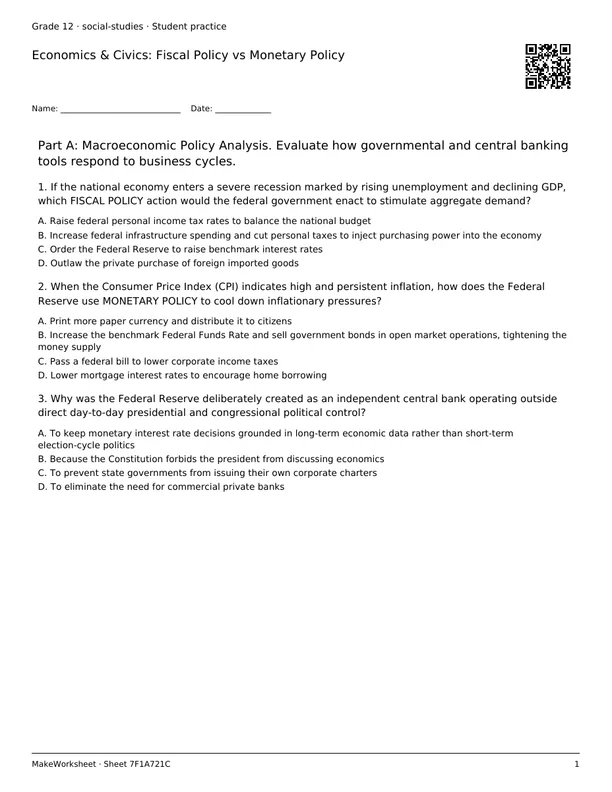
If the national economy enters a severe recession marked by rising unemployment and declining GDP, which FISCAL POLICY action would the federal government enact to stimulate aggregate demand?
- A. Raise federal personal income tax rates to balance the national budget
- B. Increase federal infrastructure spending and cut personal taxes to inject purchasing power into the economy
- C. Order the Federal Reserve to raise benchmark interest rates
- D. Outlaw the private purchase of foreign imported goods
Answer: B. Expansionary fiscal policy, rooted in Keynesian economic theory, combats recessions by increasing government expenditure and reducing taxes to boost consumer demand and employment.
Intended curriculum references: C3.D2.Eco.3.9-12 · C3.D2.Eco.10.9-12. These references describe learning goals; they are not endorsements.
Published 2026-10-02; updated 2026-10-02. Original MakeWorksheet practice. Automated consistency checks support publication; independent subject-specialist review is not recorded. Read our editorial policy.