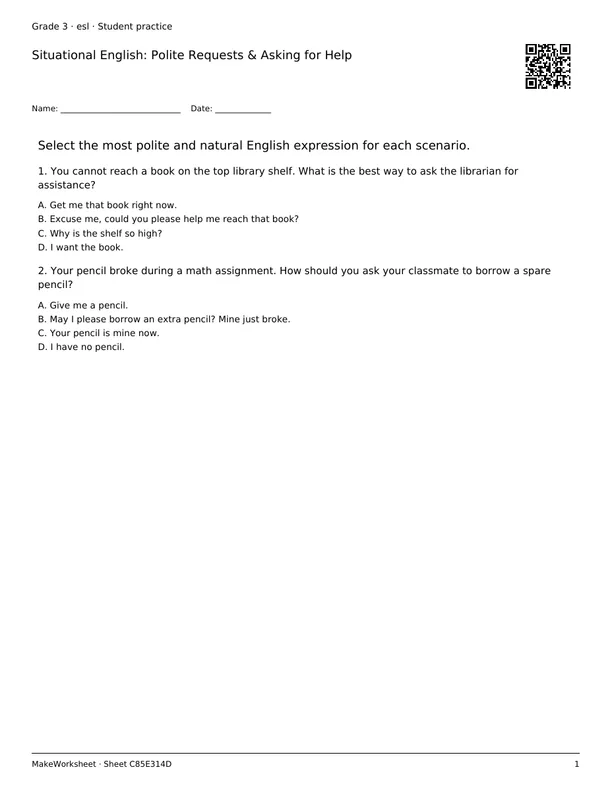
Downloads contain the original practice. Use the workbench above for new questions and custom printing.
Teaching guide, sample answers and curriculum references
Before you begin
Recognize laws and distinguish making, carrying out and interpreting them.
How to use this worksheet
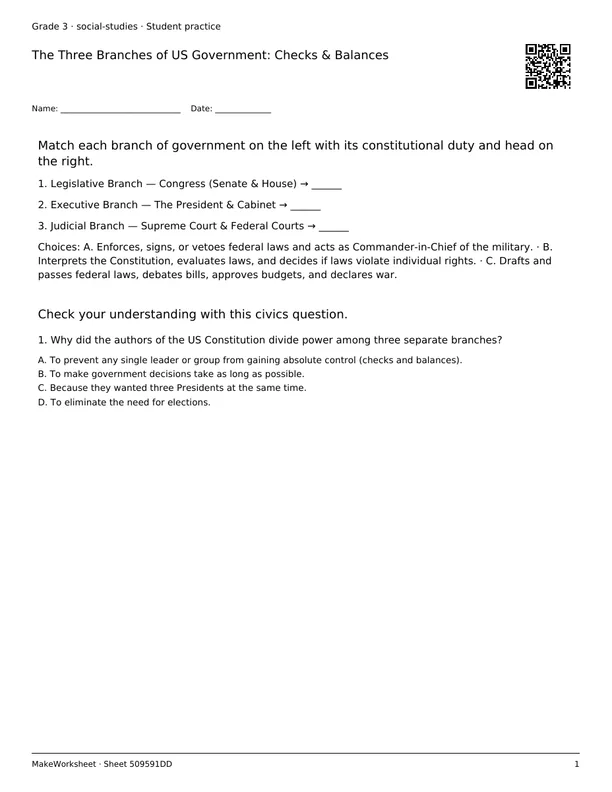
- Model the target skill: identify the 3 branches of US Federal Government: Legislative, Executive, and Judicial. Use the first task as a guided example before asking for an independent response.
- Check readiness first: Recognize laws and distinguish making, carrying out and interpreting them.
- Discuss an incorrect response using this distinction: A branch's power is limited by the others; describing one responsibility does not give it sole control of government.
A common mistake to discuss
A branch's power is limited by the others; describing one responsibility does not give it sole control of government.
What to practice next
Explain one example of how a second branch can check a stated power.
Sample question and answer
Why did the authors of the US Constitution divide power among three separate branches?
- A. To prevent any single leader or group from gaining absolute control (checks and balances).
- B. To make government decisions take as long as possible.
- C. Because they wanted three Presidents at the same time.
- D. To eliminate the need for elections.
Answer: A. Separation of powers and checks and balances ensure that no single person or branch can abuse federal authority.
Intended curriculum references: C3.D2.Civ.5.3-5. These references describe learning goals; they are not endorsements.
Published 2026-10-02; updated 2026-10-02. Original MakeWorksheet practice. Automated consistency checks support publication; independent subject-specialist review is not recorded. Read our editorial policy.