Skip to content
Grade 11historyOriginal practice

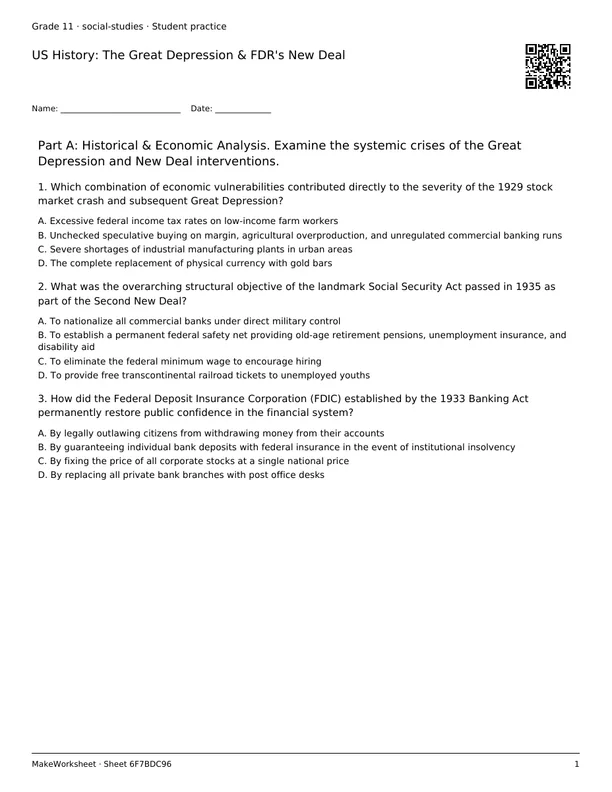
US History: The Great Depression & FDR's New Deal

Analyze economic causes of the 1929 collapse, banking panics, Dust Bowl migration, and President Roosevelt's Relief, Recovery, and Reform programs.

The same content with a different order. No new questions are added. Choose “Save as PDF” in your browser’s print window to keep a copy.

Page layout

0 practice pages · 0 answer pages. Pages are added automatically when needed. Question content and answer keys stay together.

Sheet 6F7BDC96 · questions and answers share this ID

About this practice

Grade 11 · social studies · Matching answer key included · US Letter and A4

Preview the original practiceUS History: The Great Depression & FDR's New Deal: first student practice page

Downloads contain the original practice. Use the workbench above for new questions and custom printing.

Teaching guide, sample answers and curriculum references

Before you begin

Read a historical timeline and distinguish economic conditions from policy responses.

How to use this worksheet

  1. Model the target skill: identify underlying structural vulnerabilities that triggered the 1929 stock market crash and banking collapse. Use the first task as a guided example before asking for an independent response.
  2. Check readiness first: Read a historical timeline and distinguish economic conditions from policy responses.
  3. Discuss an incorrect response using this distinction: A policy's intention and its measured outcome are different; the New Deal included multiple programs with different roles.

A common mistake to discuss

A policy's intention and its measured outcome are different; the New Deal included multiple programs with different roles.

What to practice next

Explain which problem a named program tried to address and what evidence would show its effect.

Sample question and answer

Which combination of economic vulnerabilities contributed directly to the severity of the 1929 stock market crash and subsequent Great Depression?

  • A. Excessive federal income tax rates on low-income farm workers
  • B. Unchecked speculative buying on margin, agricultural overproduction, and unregulated commercial banking runs
  • C. Severe shortages of industrial manufacturing plants in urban areas
  • D. The complete replacement of physical currency with gold bars

Answer: B. Buying on margin (borrowing up to 90% of stock costs), farm debt from post-WWI crop overproduction, and fractional reserve banks failing during liquidity panics collapsed the national economy.

Intended curriculum references: C3.D2.His.3.9-12 · C3.D2.Eco.13.9-12. These references describe learning goals; they are not endorsements.

Published 2026-10-02; updated 2026-10-02. Original MakeWorksheet practice. Automated consistency checks support publication; independent subject-specialist review is not recorded. Read our editorial policy.
Continue practicing

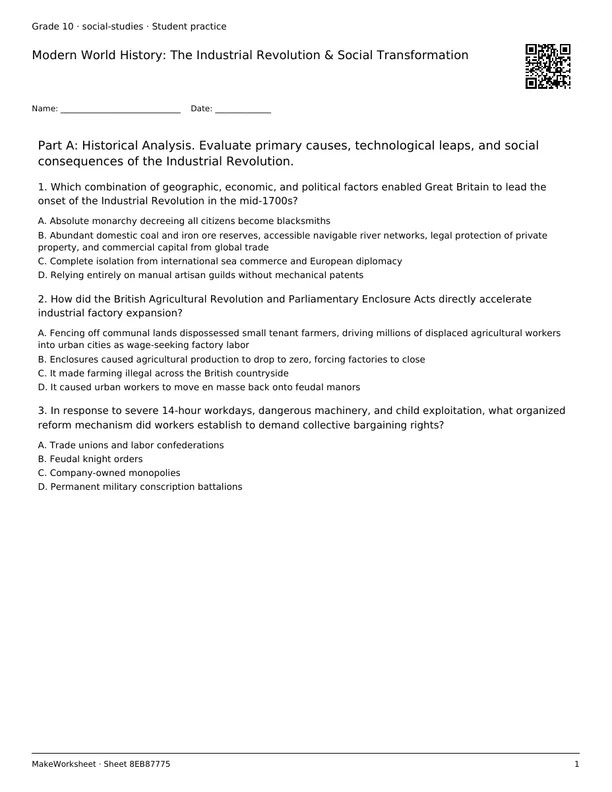
Grade 10
C3.D2.His.1.9-12 Key

Modern World History: The Industrial Revolution & Social Transformation

Analyze steam mechanization, agrarian enclosure acts, rapid urbanization, factory working conditions, and the emergence of modern economic ideologies.

Shuffle this practice
American Literature: Rhetoric of Foundational Documents: first student practice pagePractice preview
Grade 11
RI.11-12.8 Key

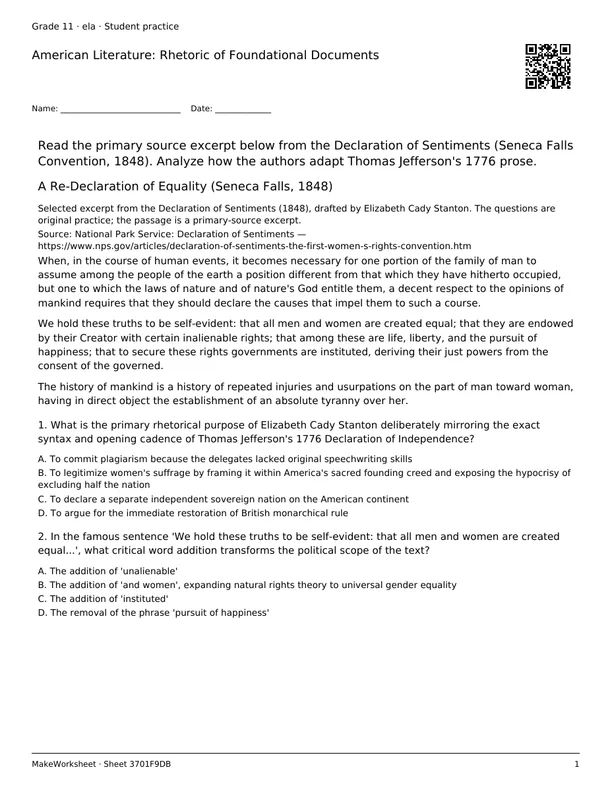
American Literature: Rhetoric of Foundational Documents

Analyze seminal 19th-century American texts. Evaluate how the Declaration of Sentiments (1848) repurposes revolutionary rhetoric to demand civil equality.

Shuffle this practice
Algebra 2: Exponential & Logarithmic Functions: first student practice pagePractice preview
Grade 11
HSF.LE.A.4 Key

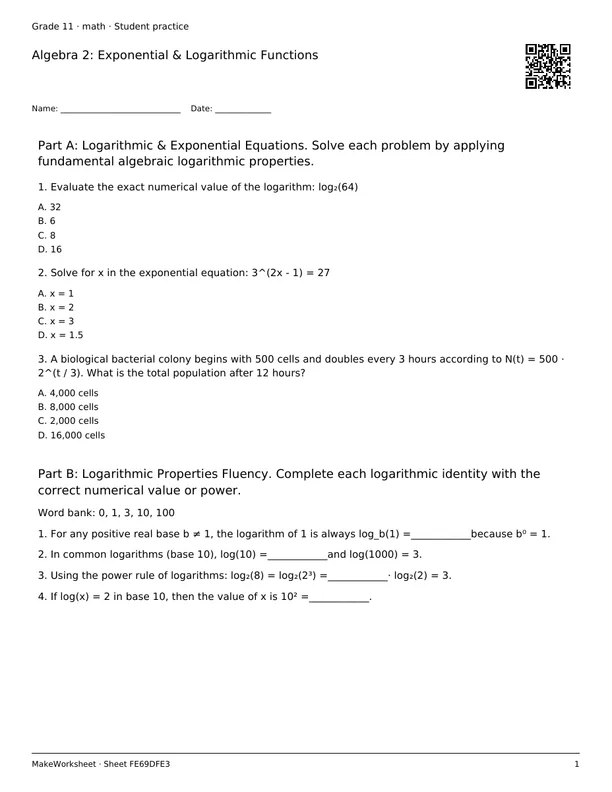
Algebra 2: Exponential & Logarithmic Functions

Evaluate logarithms, apply exponent rules, solve exponential decay and compound interest equations with step-by-step mathematical solutions.

Shuffle this practice
High School Physics: 1D Kinematics & Motion Graph Analysis: first student practice pagePractice preview
Grade 11
NGSS.HS-PS2-1 Key

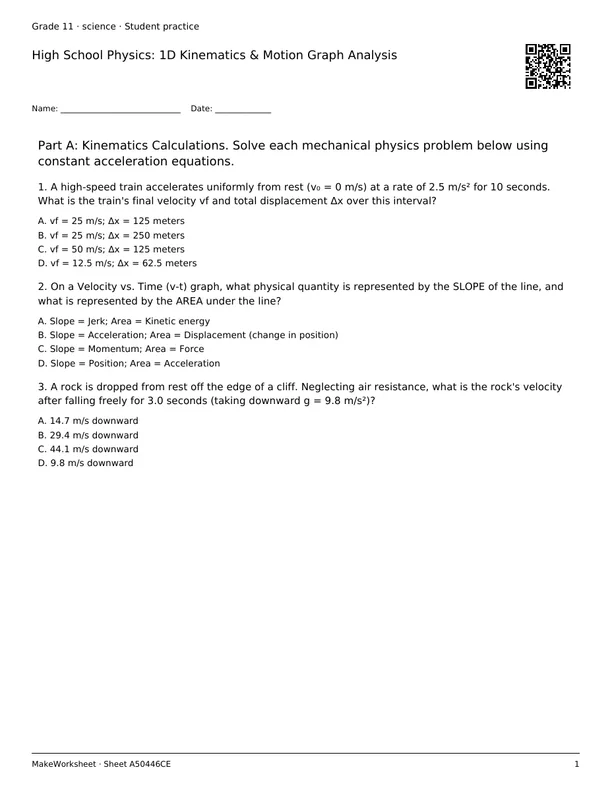
High School Physics: 1D Kinematics & Motion Graph Analysis

Analyze position-time and velocity-time graphs. Solve 1D constant acceleration problems using kinematic equations with step-by-step calculus-aligned reasoning.

Shuffle this practice