Downloads contain the original practice. Use the workbench above for new questions and custom printing.
Teaching guide, sample answers and curriculum references
Before you begin
Read age-group axes and distinguish a count from a percentage.
How to use this worksheet
- Model the target skill: interpret age-sex cohort structures within expansive, constrictive, and stationary population pyramids. Use the first task as a guided example before asking for an independent response.
- Check readiness first: Read age-group axes and distinguish a count from a percentage.
- Discuss an incorrect response using this distinction: A wide bar describes a cohort's size; it does not by itself establish why births, deaths or migration changed.
A common mistake to discuss
A wide bar describes a cohort's size; it does not by itself establish why births, deaths or migration changed.
What to practice next
Compare two age distributions and identify which conclusions need additional evidence.
Sample question and answer
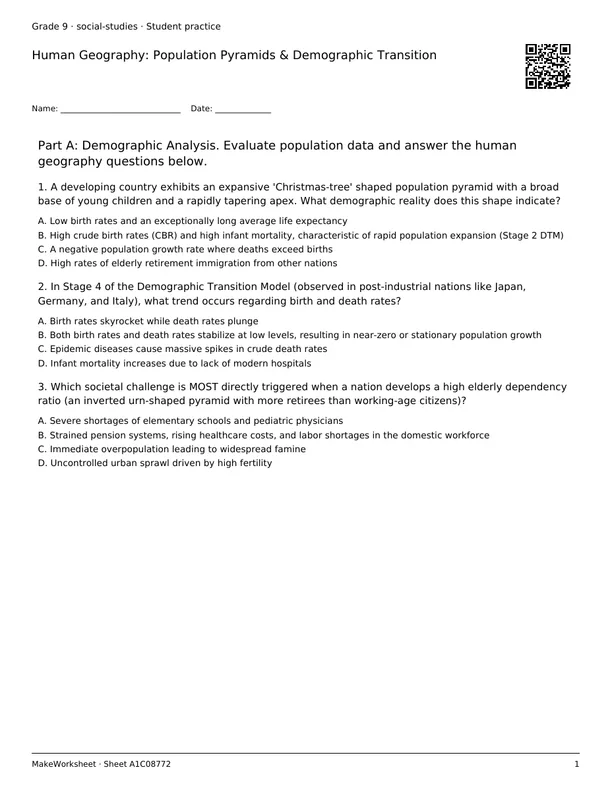
A developing country exhibits an expansive 'Christmas-tree' shaped population pyramid with a broad base of young children and a rapidly tapering apex. What demographic reality does this shape indicate?
- A. Low birth rates and an exceptionally long average life expectancy
- B. High crude birth rates (CBR) and high infant mortality, characteristic of rapid population expansion (Stage 2 DTM)
- C. A negative population growth rate where deaths exceed births
- D. High rates of elderly retirement immigration from other nations
Answer: B. A broad triangular base indicates high birth rates and a high proportion of youth, typical of Stage 2 developing nations experiencing rapid population expansion due to falling death rates.
Intended curriculum references: C3.D2.Geo.7.9-12 · C3.D2.Geo.8.9-12. These references describe learning goals; they are not endorsements.
Published 2026-10-02; updated 2026-10-02. Original MakeWorksheet practice. Automated consistency checks support publication; independent subject-specialist review is not recorded. Read our editorial policy.