Downloads contain the original practice. Use the workbench above for new questions and custom printing.
Teaching guide, sample answers and curriculum references
Before you begin
Recognize how water, farming and settlement are connected.
How to use this worksheet
- Model the target skill: analyze why early civilizations developed along major river systems (Tigris-Euphrates, Nile, Indus, Yellow River). Use the first task as a guided example before asking for an independent response.
- Check readiness first: Recognize how water, farming and settlement are connected.
- Discuss an incorrect response using this distinction: Rivers created benefits and risks; plentiful water did not make floods harmless or social development automatic.
A common mistake to discuss
Rivers created benefits and risks; plentiful water did not make floods harmless or social development automatic.
What to practice next
Compare two river-valley civilizations using a shared category and specific evidence.
Sample question and answer
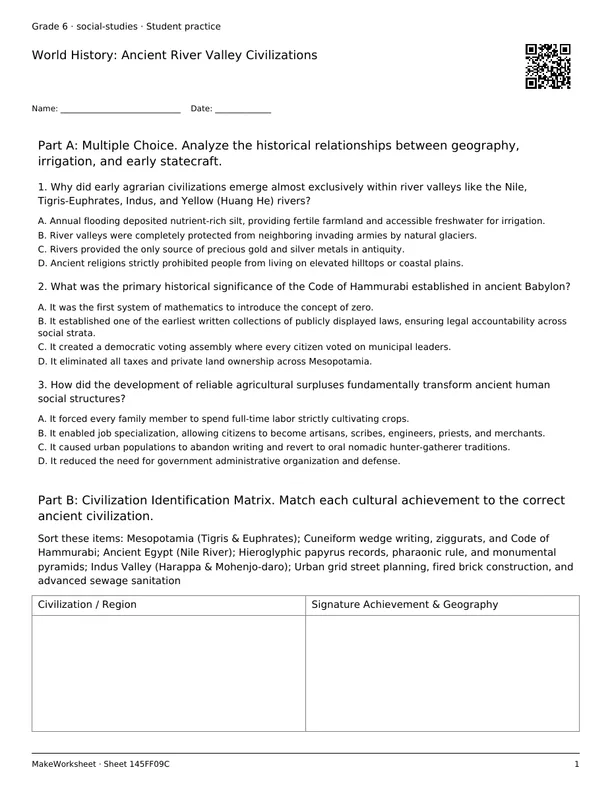
Why did early agrarian civilizations emerge almost exclusively within river valleys like the Nile, Tigris-Euphrates, Indus, and Yellow (Huang He) rivers?
- A. Annual flooding deposited nutrient-rich silt, providing fertile farmland and accessible freshwater for irrigation.
- B. River valleys were completely protected from neighboring invading armies by natural glaciers.
- C. Rivers provided the only source of precious gold and silver metals in antiquity.
- D. Ancient religions strictly prohibited people from living on elevated hilltops or coastal plains.
Answer: A. Annual flood cycles laid down rich alluvial silt, which when combined with engineered irrigation canals, enabled reliable crop surpluses capable of feeding dense cities.
Intended curriculum references: C3.D2.His.1.6-8 · C3.D2.Geo.2.6-8. These references describe learning goals; they are not endorsements.
Published 2026-10-02; updated 2026-10-02. Original MakeWorksheet practice. Automated consistency checks support publication; independent subject-specialist review is not recorded. Read our editorial policy.