Downloads contain the original practice. Use the workbench above for new questions and custom printing.
Teaching guide, sample answers and curriculum references
Before you begin
Distinguish crust, mantle and core and recognize a simple layer model.
How to use this worksheet
- Model the target skill: explain how thermal convection in the asthenosphere drives lithospheric plate movement. Use the first task as a guided example before asking for an independent response.
- Check readiness first: Distinguish crust, mantle and core and recognize a simple layer model.
- Discuss an incorrect response using this distinction: Tectonic plates include crust and uppermost mantle; the mantle is mostly solid rock that deforms over time, not an ocean of liquid magma.
A common mistake to discuss
Tectonic plates include crust and uppermost mantle; the mantle is mostly solid rock that deforms over time, not an ocean of liquid magma.
What to practice next
Connect one plate boundary type to a possible geological event.
Sample question and answer
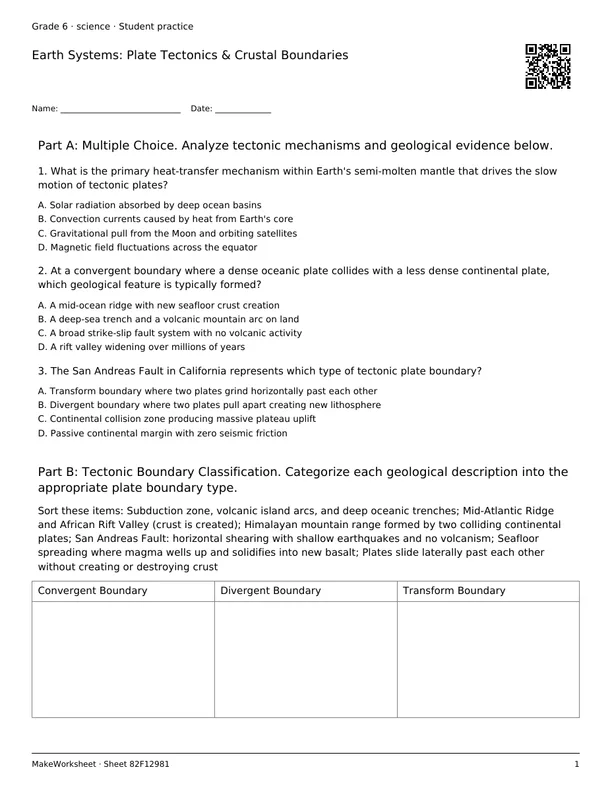
What is the primary heat-transfer mechanism within Earth's semi-molten mantle that drives the slow motion of tectonic plates?
- A. Solar radiation absorbed by deep ocean basins
- B. Convection currents caused by heat from Earth's core
- C. Gravitational pull from the Moon and orbiting satellites
- D. Magnetic field fluctuations across the equator
Answer: B. Unequal heating deep within Earth creates slow-churning convection currents in the plastic asthenosphere that drag the overlying lithospheric plates.
Intended curriculum references: NGSS.MS-ESS2-1 · NGSS.MS-ESS2-2. These references describe learning goals; they are not endorsements.
Published 2026-10-02; updated 2026-10-02. Original MakeWorksheet practice. Automated consistency checks support publication; independent subject-specialist review is not recorded. Read our editorial policy.