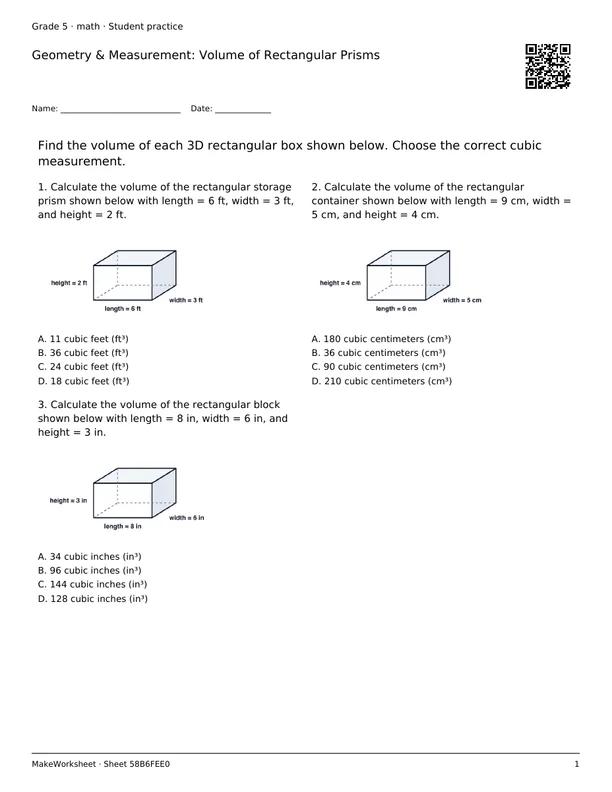
1.Calculate the volume of the rectangular storage prism shown below with length = 6 ft, width = 3 ft, and height = 2 ft.
A11 cubic feet (ft³)
B36 cubic feet (ft³)
C24 cubic feet (ft³)
D18 cubic feet (ft³)
Working
Calculate cubic volume using V = length × width × height with authentic 3D diagrams and step-by-step answer key.
New questions for the same learning goal. Choose “Save as PDF” in your browser’s print window to keep a copy.
0 practice pages · 0 answer pages. Pages are added automatically when needed. Question content and answer keys stay together.
Grade 5 · math · Matching answer key included · US Letter and A4
Downloads contain the original practice. Use the workbench above for new questions and custom printing.
Multiply lengths and distinguish a prism's three dimensions.
Use all three perpendicular dimensions for volume and cubic units; an area calculation uses only two.
Explain the volume as equal layers of unit cubes.
Calculate the volume of the rectangular storage prism shown below with length = 6 ft, width = 3 ft, and height = 2 ft.
Answer: B. Volume = length × width × height = 6 ft × 3 ft × 2 ft = 36 cubic feet (ft³).
The corresponding diagram is shown in the practice preview and PDF.
Intended curriculum references: CCSS.MATH.CONTENT.5.MD.C.5. These references describe learning goals; they are not endorsements.
Published 2026-10-02; updated 2026-10-02. Original MakeWorksheet practice. Automated consistency checks support publication; independent subject-specialist review is not recorded. Read our editorial policy.
 Practice preview
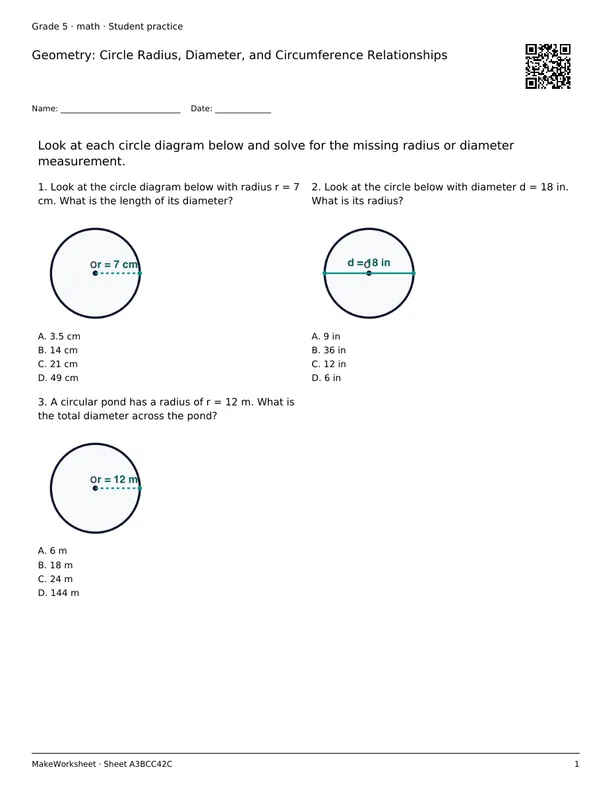
Calculate radius from diameter and diameter from radius using d = 2r. Authentic geometric circle diagrams with complete answer key.
 Practice preview
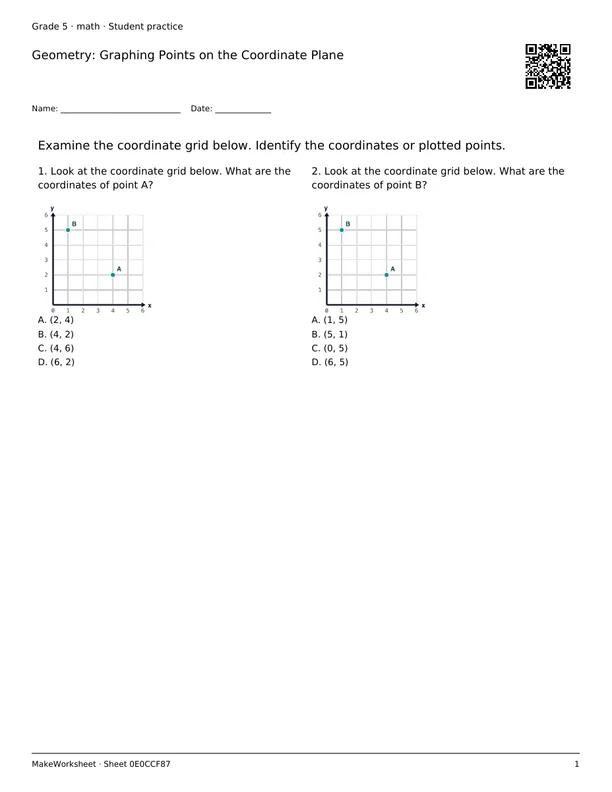
Plot and identify ordered pairs (x, y) on a Cartesian coordinate grid in Quadrant 1. Essential 5th grade geometry with step-by-step answer key.
 Practice preview
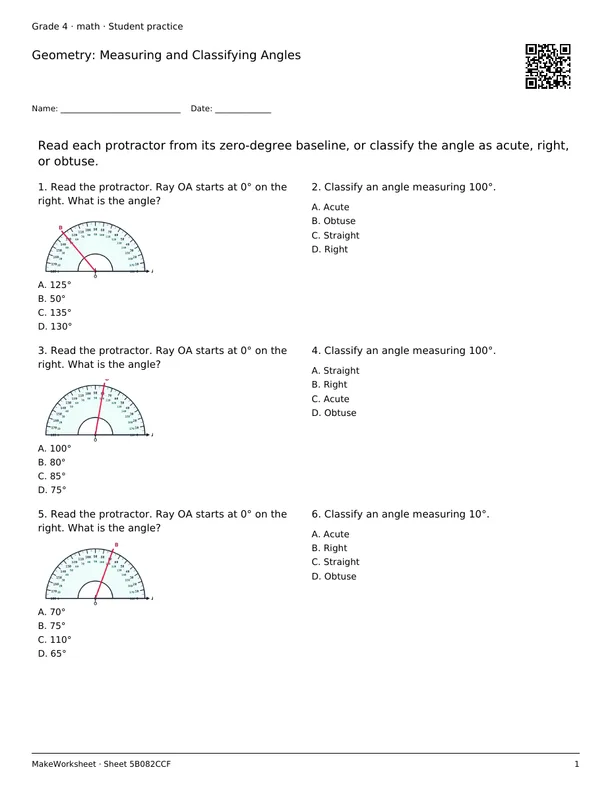
Read protractors and classify acute, right, and obtuse angles with structured practice.
 Practice preview
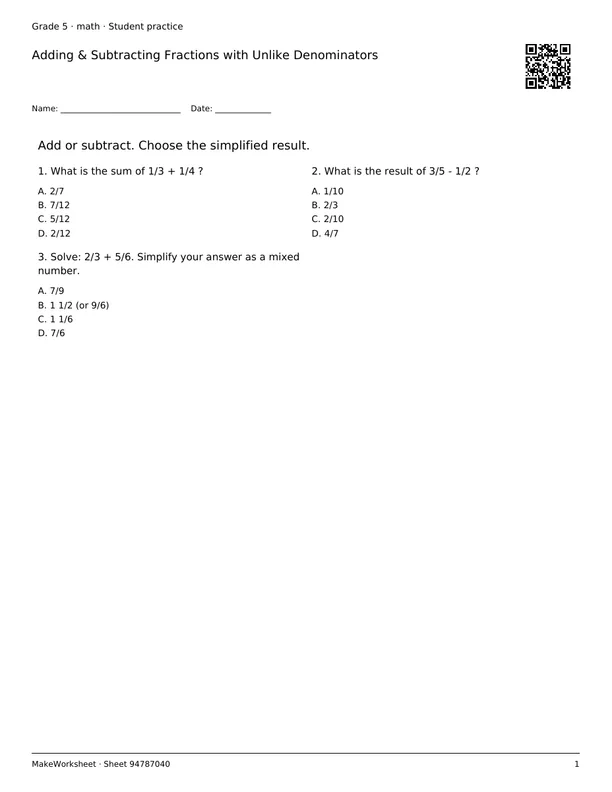
5th grade fraction arithmetic practice. Find common denominators, convert equivalent fractions, and simplify sums to simplest form.