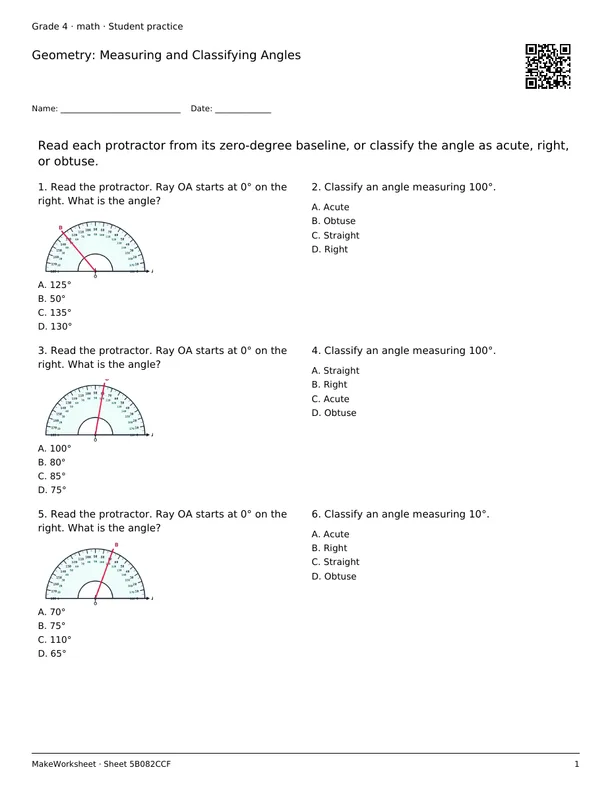
1.Read the protractor. Ray OA starts at 0° on the right. What is the angle?
A125°
B50°
C135°
D130°
Read protractors and classify acute, right, and obtuse angles with structured practice.
New questions for the same learning goal. Choose “Save as PDF” in your browser’s print window to keep a copy.
0 practice pages · 0 answer pages. Pages are added automatically when needed. Question content and answer keys stay together.
Grade 4 · math · Matching answer key included · US Letter and A4
Downloads contain the original practice. Use the workbench above for new questions and custom printing.
Identify an angle's vertex and rays and place a ray on a protractor baseline.
Read the scale that begins at the aligned zero; the other scale may give the supplementary angle.
Estimate whether an angle is acute or obtuse before checking the protractor reading.
Read the protractor. Ray OA starts at 0° on the right. What is the angle?
Answer: D. Start at the right-hand 0° baseline and read toward ray OB: 130°.
The corresponding diagram is shown in the practice preview and PDF.
Intended curriculum references: CCSS.MATH.CONTENT.4.MD.C.6 · CCSS.MATH.CONTENT.4.G.A.1. These references describe learning goals; they are not endorsements.
Published 2026-10-02; updated 2026-10-02. Original MakeWorksheet practice. Automated consistency checks support publication; independent subject-specialist review is not recorded. Read our editorial policy.
 Practice preview
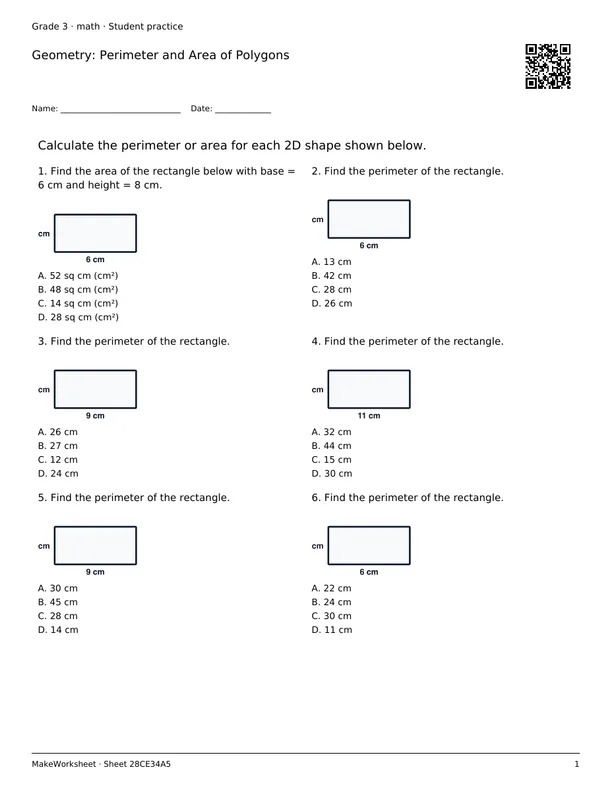
Calculate perimeter by adding outer boundaries and area using base × height from labeled geometric polygon diagrams.
 Practice preview
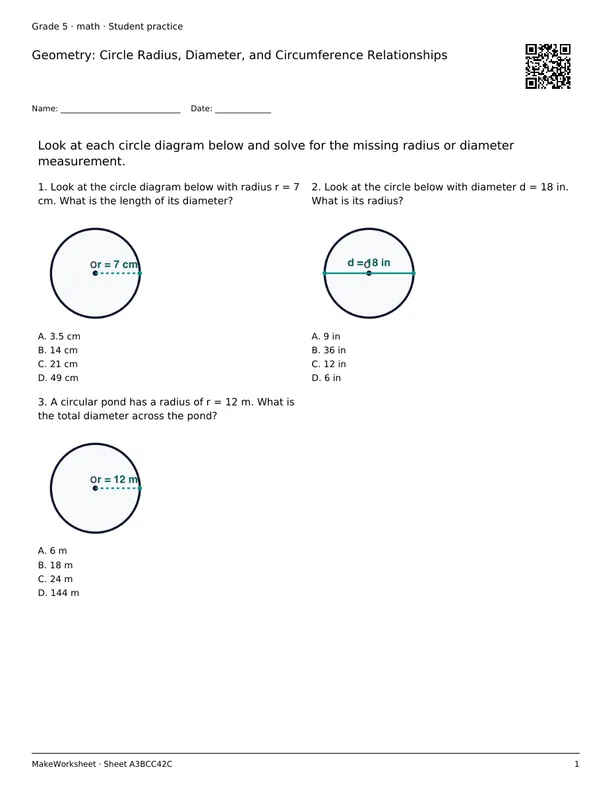
Calculate radius from diameter and diameter from radius using d = 2r. Authentic geometric circle diagrams with complete answer key.
 Practice preview
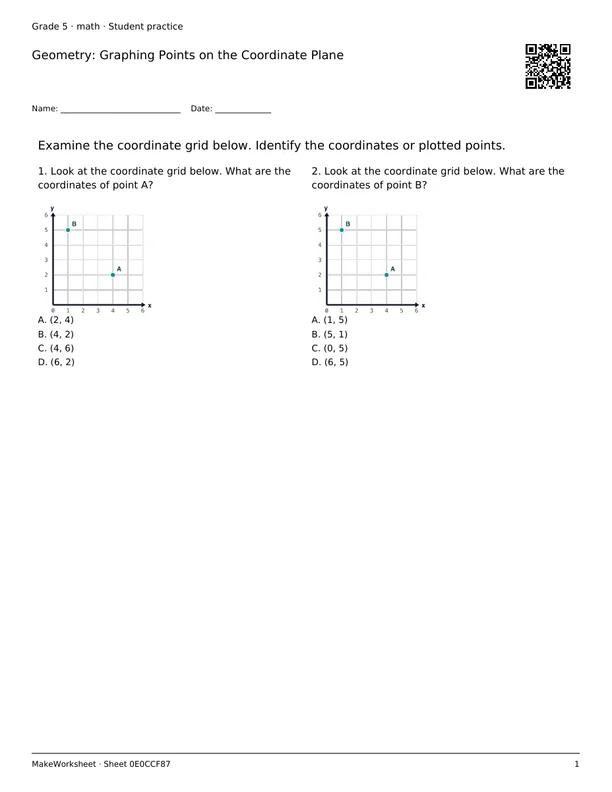
Plot and identify ordered pairs (x, y) on a Cartesian coordinate grid in Quadrant 1. Essential 5th grade geometry with step-by-step answer key.
 Practice preview
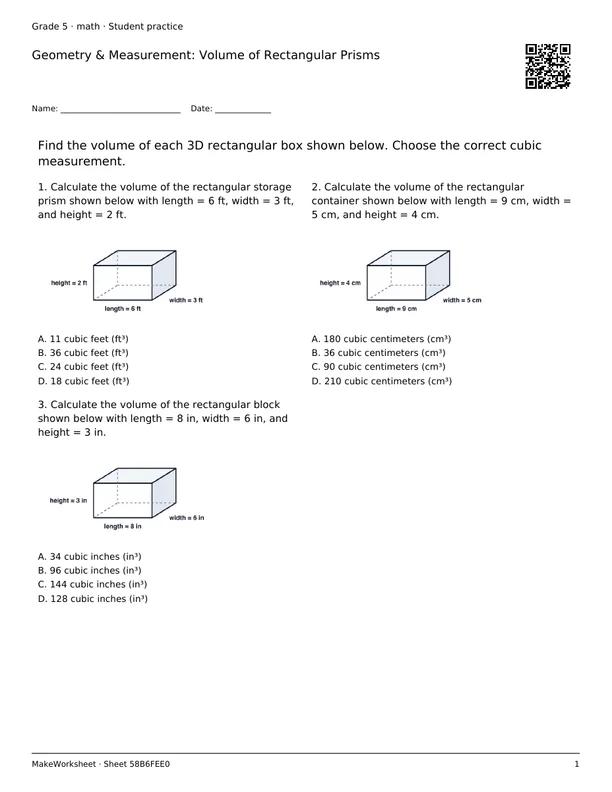
Calculate cubic volume using V = length × width × height with authentic 3D diagrams and step-by-step answer key.