Classify Living and Nonliving Things: Practice Independently
Use multiple characteristics to reason about familiar living and nonliving things. A focused practice activity. Use the linked unit for the learning sequence and teaching guide.
Continue this learning sequence
Unit goals and teaching guide →Adult guidance · About 10 minutes · Pencil, Scissors and glue for the cut-and-paste activity, Adult help with scissors
This is a fixed activity. Customize the layout, then print. Choose “Save as PDF” in your browser’s print window to keep a copy.
Page layout
0 practice pages · 0 answer pages. Pages are added automatically when needed. Question content and answer keys stay together.
About this practice
Kindergarten · science · Matching answer key included · US Letter and A4
Preview the original practice
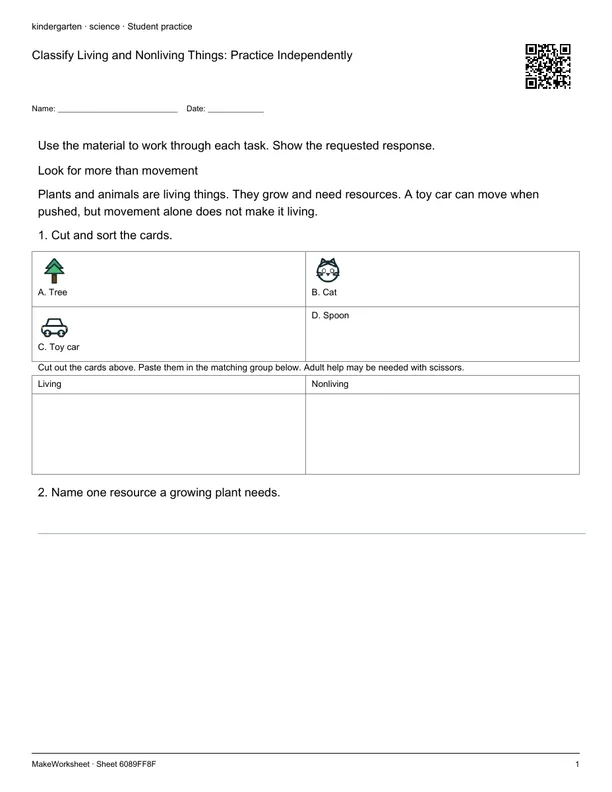
Downloads contain the original practice. Use the workbench above for supported practice variations and custom printing.
Teaching guide, sample answers and curriculum references
Before you begin
Review the key words and representations in Classify Living and Nonliving Things. Use the Explore activity to check readiness before removing support.
How to use this worksheet
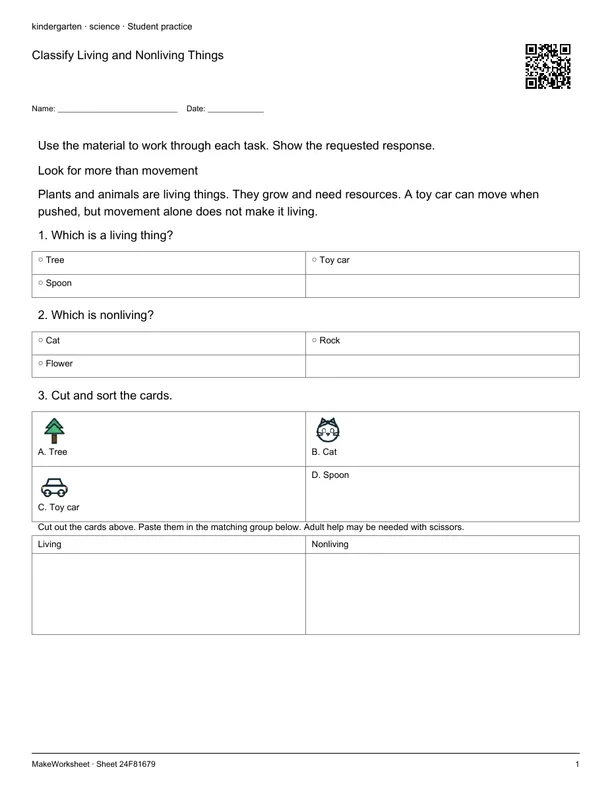
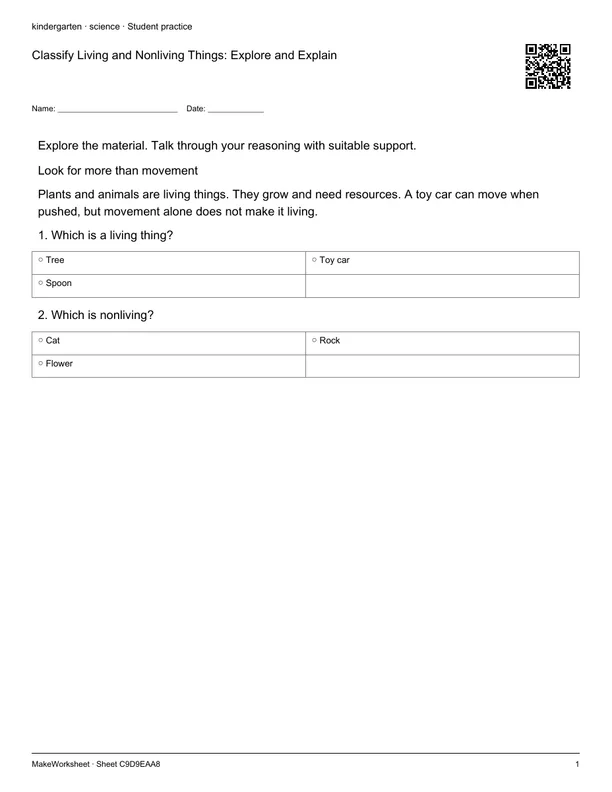
- Begin with: Which is a living thing?
- Connect the response to: Cut and sort the cards.
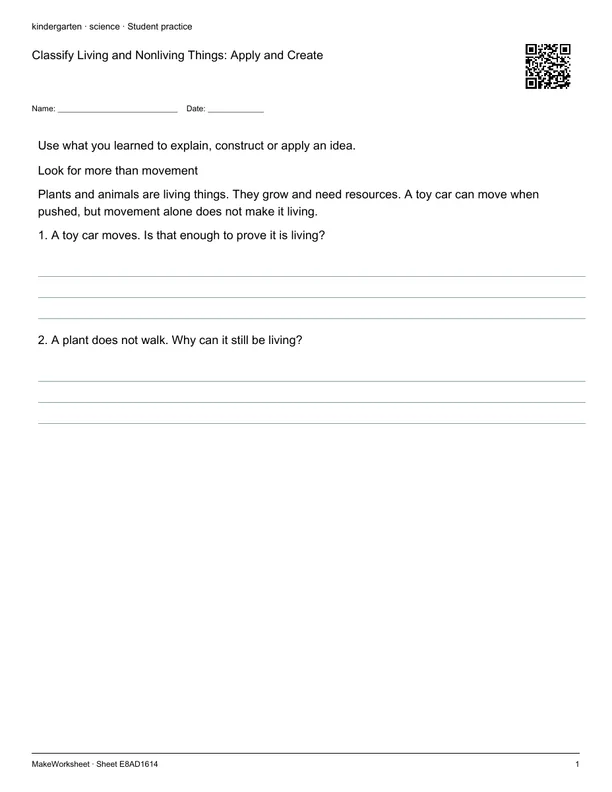
- Ask students to apply the idea: A toy car moves. Is that enough to prove it is living?
A common mistake to discuss
Accepting an answer without checking whether it uses the material and satisfies the requested relationship or criteria.
What to practice next
Continue to Classify Living and Nonliving Things: Apply and Create.
Original instructional material written for this practice.
Published 2026-10-04; updated 2026-10-04. Original MakeWorksheet practice. Automated consistency checks support publication; independent subject-specialist review is not recorded. Read our editorial policy.
Continue practicing
 Practice preview
Classify Living and Nonliving Things: Apply and Create
Apply · Adult guidance · 15 min
Use multiple characteristics to reason about familiar living and nonliving things. A focused apply activity. Use the linked unit for the learning sequence and teaching guide.
 Practice preview
Classify Living and Nonliving Things
Practice · Adult guidance · 25 min
Use multiple characteristics to reason about familiar living and nonliving things. A complete set with exploration, practice and application. Use the linked unit for the learning sequence and teaching guide.
 Practice preview
Classify Living and Nonliving Things: Explore and Explain
Explore · Adult guidance · 10 min
Use multiple characteristics to reason about familiar living and nonliving things. A focused learn activity. Use the linked unit for the learning sequence and teaching guide.
 Practice preview
Living vs. Non-Living Things Sorting Worksheet
Practice · Adult guidance · 15 min
Foundational life science sorting activity. Students classify animals, plants, and objects into Living and Non-Living categories.