social studies · Grade 7
World History: Afro-Eurasian Trade & The Silk Road
Examine the trans-Eurasian trade routes connecting China, Central Asia, the Middle East, and Europe. Explore cultural diffusion, technology, and economic exchange.
Find this activity in the Social Studies map
Explore the knowledge outline and its source scope. This unit supports selected ideas.
Learning goals
- Trace major overland and maritime trade networks connecting Asia, the Mediterranean, and Africa during the Middle Ages
- Analyze how trade facilitated cultural diffusion, spreading religions, philosophy, and technologies like paper and printing
- Evaluate the economic role of oasis trading hubs such as Samarkand, Dunhuang, and Constantinople
Before you begin
Read a route map and recognize exchange between connected communities.
Age and grade do not measure readiness. Adjust reading or adult support to preserve the intended learning goal.
Follow the sequence
1. Practice
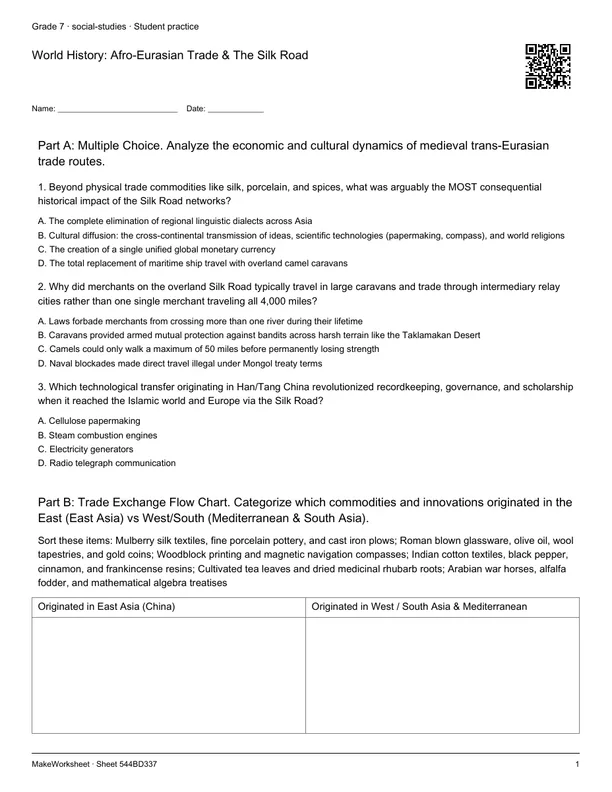 Practice preview
World History: Afro-Eurasian Trade & The Silk Road
Practice · Independent · 15 min
Examine the trans-Eurasian trade routes connecting China, Central Asia, the Middle East, and Europe. Explore cultural diffusion, technology, and economic exchange.
Teaching and response guide
- Model the target skill: trace major overland and maritime trade networks connecting Asia, the Mediterranean, and Africa during the Middle Ages. Use the first task as a guided example before asking for an independent response.
- Check readiness first: Read a route map and recognize exchange between connected communities.
- Discuss an incorrect response using this distinction: The Silk Road was a network of routes rather than one continuous road used by a single group.
Watch for: The Silk Road was a network of routes rather than one continuous road used by a single group.
Check the answer criteria for each task. A supported explanation may have more than one acceptable response. These activities offer evidence to discuss; completing a sheet alone does not establish mastery.