social studies · Grade 10
Modern World History: The Industrial Revolution & Social Transformation
Analyze steam mechanization, agrarian enclosure acts, rapid urbanization, factory working conditions, and the emergence of modern economic ideologies.
Find this activity in the Social Studies map
Explore the knowledge outline and its source scope. This unit supports selected ideas.
Learning goals
- Analyze why Great Britain became the birthplace of the Industrial Revolution in the late 18th century
- Evaluate social and demographic consequences of rapid urbanization and factory labor on working-class families
- Contrast the economic philosophies of Adam Smith's free-market capitalism and Karl Marx's socialist critique
Before you begin
Distinguish production, labor and trade and place industrialization in its historical setting.
Age and grade do not measure readiness. Adjust reading or adult support to preserve the intended learning goal.
Follow the sequence
1. Practice
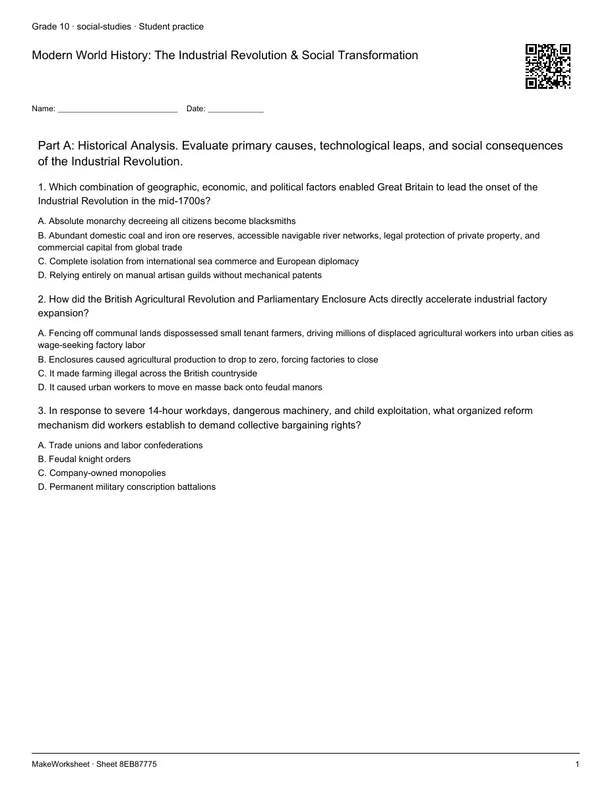 Practice preview
Modern World History: The Industrial Revolution & Social Transformation
Practice · Independent · 15 min
Analyze steam mechanization, agrarian enclosure acts, rapid urbanization, factory working conditions, and the emergence of modern economic ideologies.
Teaching and response guide
- Model the target skill: analyze why Great Britain became the birthplace of the Industrial Revolution in the late 18th century. Use the first task as a guided example before asking for an independent response.
- Check readiness first: Distinguish production, labor and trade and place industrialization in its historical setting.
- Discuss an incorrect response using this distinction: A change may benefit one group while imposing costs on another; avoid treating all industrial effects as identical.
Watch for: A change may benefit one group while imposing costs on another; avoid treating all industrial effects as identical.
Check the answer criteria for each task. A supported explanation may have more than one acceptable response. These activities offer evidence to discuss; completing a sheet alone does not establish mastery.