social studies · Grade 11
US History: The Great Depression & FDR's New Deal
Analyze economic causes of the 1929 collapse, banking panics, Dust Bowl migration, and President Roosevelt's Relief, Recovery, and Reform programs.
Find this activity in the Social Studies map
Explore the knowledge outline and its source scope. This unit supports selected ideas.
Learning goals
- Identify underlying structural vulnerabilities that triggered the 1929 stock market crash and banking collapse
- Evaluate Franklin D. Roosevelt's New Deal programs categorized by the Three R's: Relief, Recovery, and Reform
- Analyze the lasting constitutional and economic expansion of federal executive authority and the social safety net
Before you begin
Read a historical timeline and distinguish economic conditions from policy responses.
Age and grade do not measure readiness. Adjust reading or adult support to preserve the intended learning goal.
Follow the sequence
1. Practice
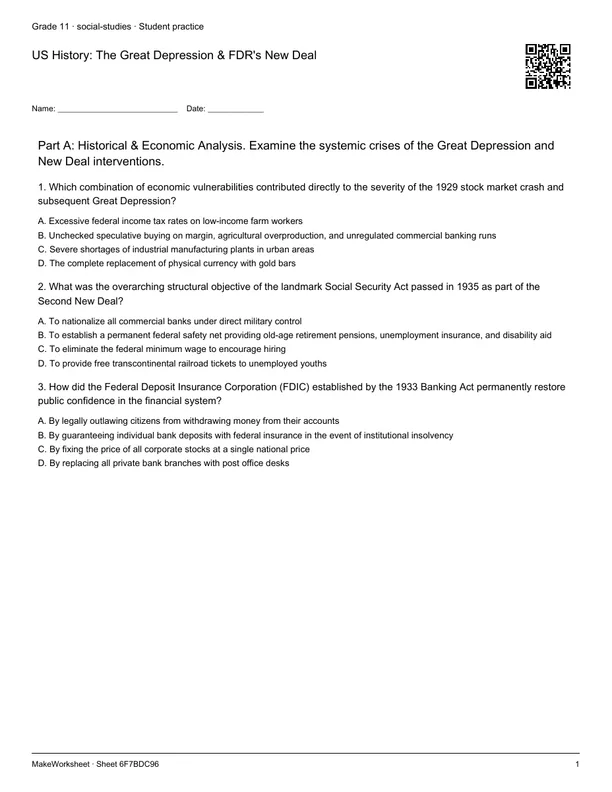 Practice preview
US History: The Great Depression & FDR's New Deal
Practice · Independent · 15 min
Analyze economic causes of the 1929 collapse, banking panics, Dust Bowl migration, and President Roosevelt's Relief, Recovery, and Reform programs.
Teaching and response guide
- Model the target skill: identify underlying structural vulnerabilities that triggered the 1929 stock market crash and banking collapse. Use the first task as a guided example before asking for an independent response.
- Check readiness first: Read a historical timeline and distinguish economic conditions from policy responses.
- Discuss an incorrect response using this distinction: A policy's intention and its measured outcome are different; the New Deal included multiple programs with different roles.
Watch for: A policy's intention and its measured outcome are different; the New Deal included multiple programs with different roles.
Check the answer criteria for each task. A supported explanation may have more than one acceptable response. These activities offer evidence to discuss; completing a sheet alone does not establish mastery.