social studies · Grade 9
Human Geography: Population Pyramids & Demographic Transition
Analyze age-sex population pyramids, birth and death rates, dependency ratios, and the five stages of the Demographic Transition Model (DTM).
Find this activity in the Social Studies map
Explore the knowledge outline and its source scope. This unit supports selected ideas.
Learning goals
- Interpret age-sex cohort structures within expansive, constrictive, and stationary population pyramids
- Trace societal shifts across the five stages of the Demographic Transition Model (DTM)
- Evaluate economic implications of changing youth and elderly dependency ratios on public infrastructure
Before you begin
Read age-group axes and distinguish a count from a percentage.
Age and grade do not measure readiness. Adjust reading or adult support to preserve the intended learning goal.
Follow the sequence
1. Practice
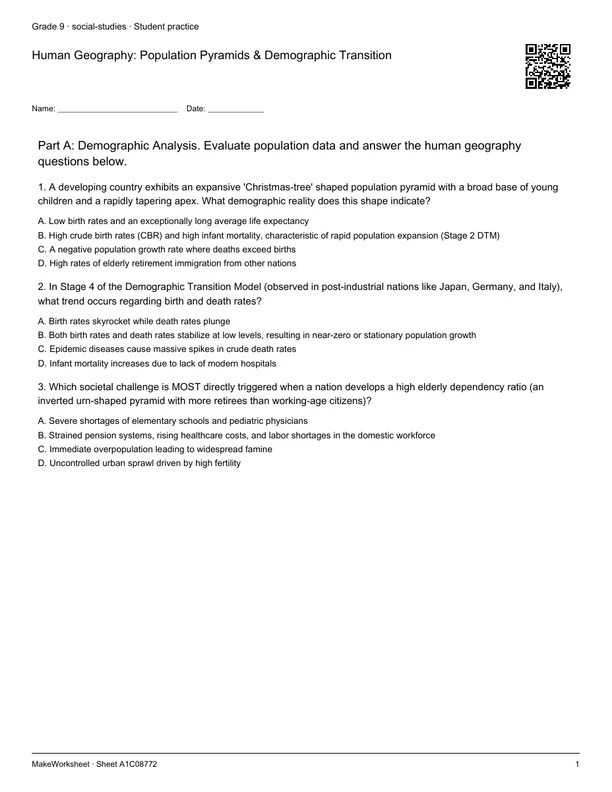 Practice preview
Human Geography: Population Pyramids & Demographic Transition
Practice · Independent · 15 min
Analyze age-sex population pyramids, birth and death rates, dependency ratios, and the five stages of the Demographic Transition Model (DTM).
Teaching and response guide
- Model the target skill: interpret age-sex cohort structures within expansive, constrictive, and stationary population pyramids. Use the first task as a guided example before asking for an independent response.
- Check readiness first: Read age-group axes and distinguish a count from a percentage.
- Discuss an incorrect response using this distinction: A wide bar describes a cohort's size; it does not by itself establish why births, deaths or migration changed.
Watch for: A wide bar describes a cohort's size; it does not by itself establish why births, deaths or migration changed.
Check the answer criteria for each task. A supported explanation may have more than one acceptable response. These activities offer evidence to discuss; completing a sheet alone does not establish mastery.