social studies · Grade 6
World History: Ancient River Valley Civilizations
Analyze geographic advantages, irrigation canals, agricultural surpluses, and legal codes in Mesopotamia, Egypt, the Indus Valley, and Early China.
Find this activity in the Social Studies map
Explore the knowledge outline and its source scope. This unit supports selected ideas.
Learning goals
- Analyze why early civilizations developed along major river systems (Tigris-Euphrates, Nile, Indus, Yellow River)
- Explain how irrigation infrastructure produced food surpluses leading to job specialization and urban settlements
- Identify key political and cultural innovations such as Hammurabi's Code and cuneiform writing
Before you begin
Recognize how water, farming and settlement are connected.
Age and grade do not measure readiness. Adjust reading or adult support to preserve the intended learning goal.
Follow the sequence
1. Practice
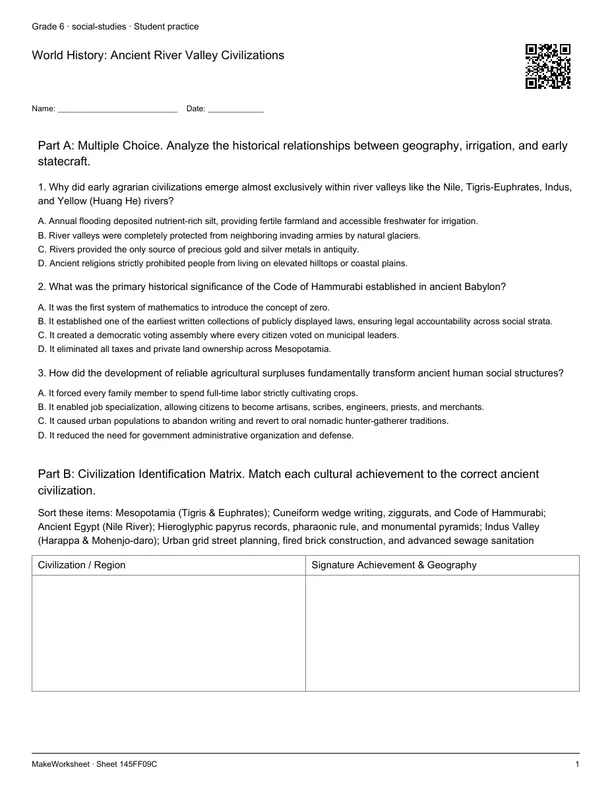 Practice preview
World History: Ancient River Valley Civilizations
Practice · Independent · 15 min
Analyze geographic advantages, irrigation canals, agricultural surpluses, and legal codes in Mesopotamia, Egypt, the Indus Valley, and Early China.
Teaching and response guide
- Model the target skill: analyze why early civilizations developed along major river systems (Tigris-Euphrates, Nile, Indus, Yellow River). Use the first task as a guided example before asking for an independent response.
- Check readiness first: Recognize how water, farming and settlement are connected.
- Discuss an incorrect response using this distinction: Rivers created benefits and risks; plentiful water did not make floods harmless or social development automatic.
Watch for: Rivers created benefits and risks; plentiful water did not make floods harmless or social development automatic.
Check the answer criteria for each task. A supported explanation may have more than one acceptable response. These activities offer evidence to discuss; completing a sheet alone does not establish mastery.