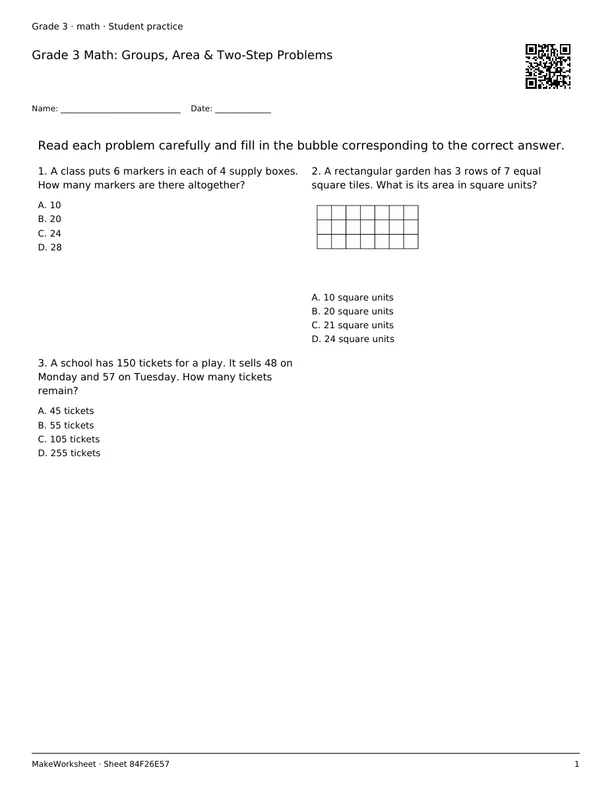
1.A class puts 6 markers in each of 4 supply boxes. How many markers are there altogether?
A10
B20
C24
D28
Working
Original practice in equal groups, rectangle area and two-step arithmetic.
The same content with a different order. No new questions are added. Choose “Save as PDF” in your browser’s print window to keep a copy.
0 practice pages · 0 answer pages. Pages are added automatically when needed. Question content and answer keys stay together.
Grade 3 · math · Matching answer key included · US Letter and A4
Downloads contain the original practice. Use the workbench above for new questions and custom printing.
Read a short word problem and identify its quantities.
A correct-looking number may answer a different question; reread what is requested.
Explain why the other choices do not answer the problem.
A class puts 6 markers in each of 4 supply boxes. How many markers are there altogether?
Answer: C. There are 4 equal groups of 6 markers: 4 × 6 = 24 markers.
Intended curriculum references: CCSS.MATH.CONTENT.3.OA.A.1 · CCSS.MATH.CONTENT.3.MD.C.7 · CCSS.MATH.CONTENT.3.OA.D.8. These references describe learning goals; they are not endorsements.
Published 2026-10-02; updated 2026-10-02. Original MakeWorksheet practice. Automated consistency checks support publication; independent subject-specialist review is not recorded. Read our editorial policy.
 Practice preview
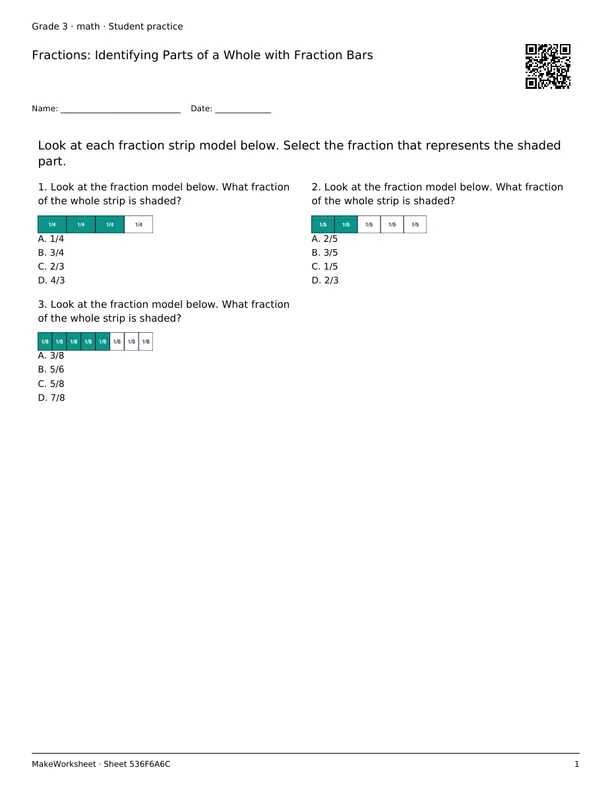
Learn to read and write fractions using visual shaded strip models. Count the shaded parts as the numerator and total equal parts as denominator.
 Practice preview
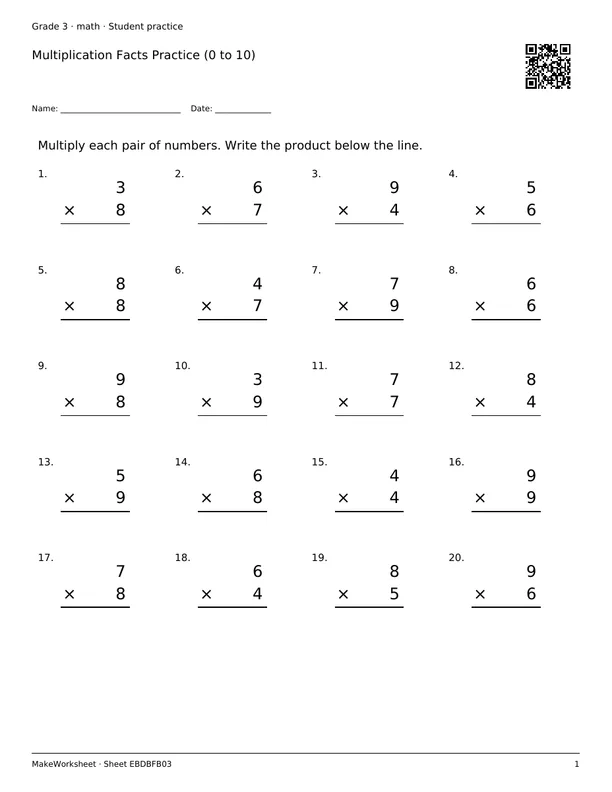
Essential multiplication facts drill for 3rd grade. 24 vertical and horizontal multiplication problems designed for computational fluency.
 Practice preview
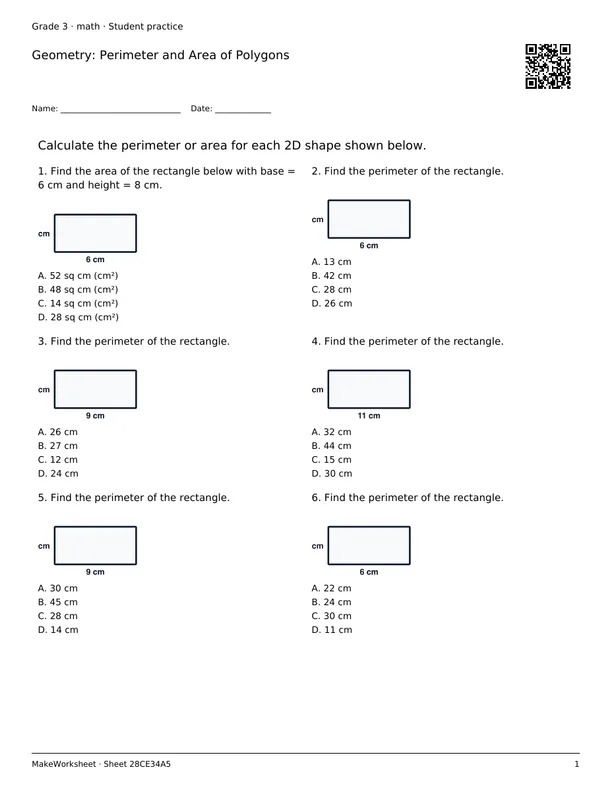
Calculate perimeter by adding outer boundaries and area using base × height from labeled geometric polygon diagrams.
 Practice preview
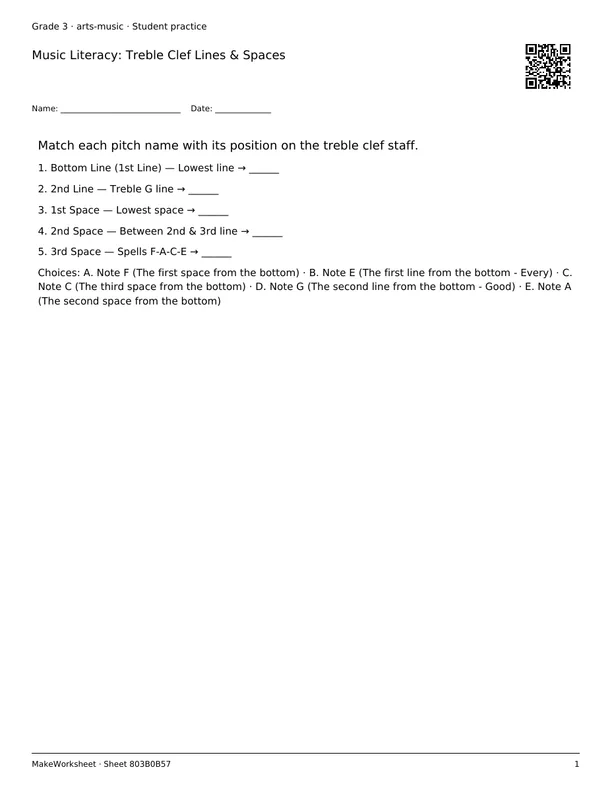
Master reading pitches on the musical staff. Learn lines (Every Good Boy Does Fine - E G B D F) and spaces (F A C E).