math · Grade 11 · Algebra 2
Exponential Functions and Growth
Interpret exponential rules and distinguish additive from multiplicative change.
Find this activity in the mathematics map
Explore the related learning targets, foundations and possible next connections.
Learning goals
- Interpret exponential rules and distinguish additive from multiplicative change.
Before you begin
Understand the words and representations introduced in the Explore activity.
Age and grade do not measure readiness. Adjust reading or adult support to preserve the intended learning goal.
Follow the sequence
Complete practice
 Practice preview
Exponential Functions and Growth
Practice · Independent · 25 min
Interpret exponential rules and distinguish additive from multiplicative change. A complete set with exploration, practice and application. Use the linked unit for the learning sequence and teaching guide.
1. Explore
 Practice preview
Exponential Functions and Growth: Explore and Explain
Explore · Independent · 10 min
Interpret exponential rules and distinguish additive from multiplicative change. A focused learn activity. Use the linked unit for the learning sequence and teaching guide.
2. Practice
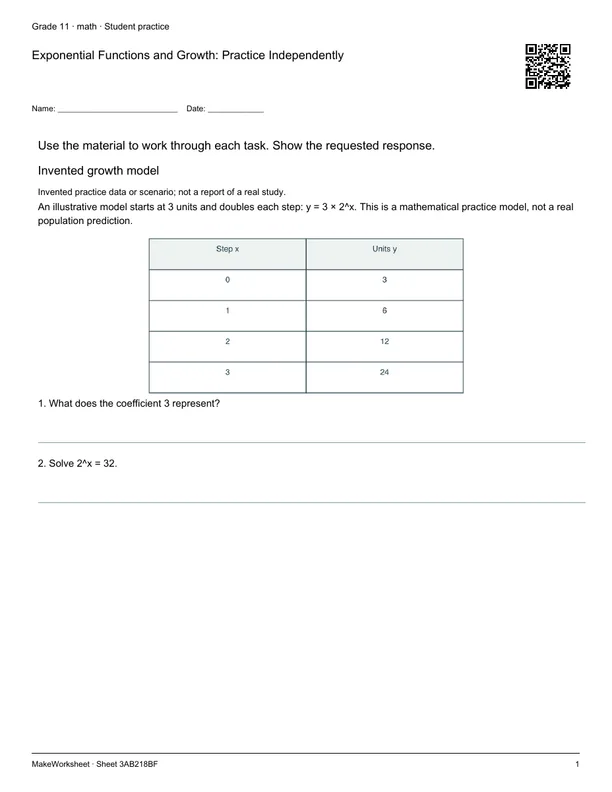 Practice preview
Exponential Functions and Growth: Practice Independently
Practice · Independent · 10 min
Interpret exponential rules and distinguish additive from multiplicative change. A focused practice activity. Use the linked unit for the learning sequence and teaching guide.
3. Apply
 Practice preview
Exponential Functions and Growth: Apply and Create
Apply · Independent · 15 min
Interpret exponential rules and distinguish additive from multiplicative change. A focused apply activity. Use the linked unit for the learning sequence and teaching guide.
Download the unit pack
Numbered activities, separate answer keys and a teaching guide in one ZIP. The pack uses the focused sequence; the complete practice sheet above is an alternative.
Teaching and response guide
- Begin with: Find y at x = 4.
- Connect the response to: What does the coefficient 3 represent?
- Ask students to apply the idea: For y = 16 × (1/2)^x, find y when x = 3.
Watch for: Accepting an answer without checking whether it uses the material and satisfies the requested relationship or criteria.
Check the answer criteria for each task. A supported explanation may have more than one acceptable response. These activities offer evidence to discuss; completing a sheet alone does not establish mastery.